
On 11 November 1975, Agostinho Neto proclaimed Angola's independence in Luanda, ending nearly five centuries of Portuguese rule. Fifty-one years on, the anniversary table is built on muamba de galinha — chicken in red palm oil — scooped up with funge, the cassava porridge that crossed the Atlantic from Brazil, plus calulu, grilled fish and a cold Cuca beer.
Independence days are usually told as dates and speeches. Angola's is better told as a table: the dishes that survived five centuries of colonisation, a war of independence and a civil war — and still arrive, steaming, on the anniversary.
# Angola Independence Day: the freedom table — muamba, funge and fifty-one years
Fifty-one years ago tonight, in a Luanda square, a poet-doctor read a proclamation and a country was born. The crowds went home and ate. What they ate is still what Angola eats when it celebrates: chicken drowned in red palm oil, a mound of cassava porridge pinched up by hand, fish and greens from the coast, and a beer so cold it hurts your teeth.
This is day two of The Holiday Table — our daily feast from November 11 to February 20, drawn from the World Cuisines guide (781 dishes) and the World Spirits guide (266 drinks). Yesterday we opened the season in Central Europe with St. Martin's goose feast. Today the table crosses the equator to Angola, where independence is not a parade you watch — it is a pot you share.
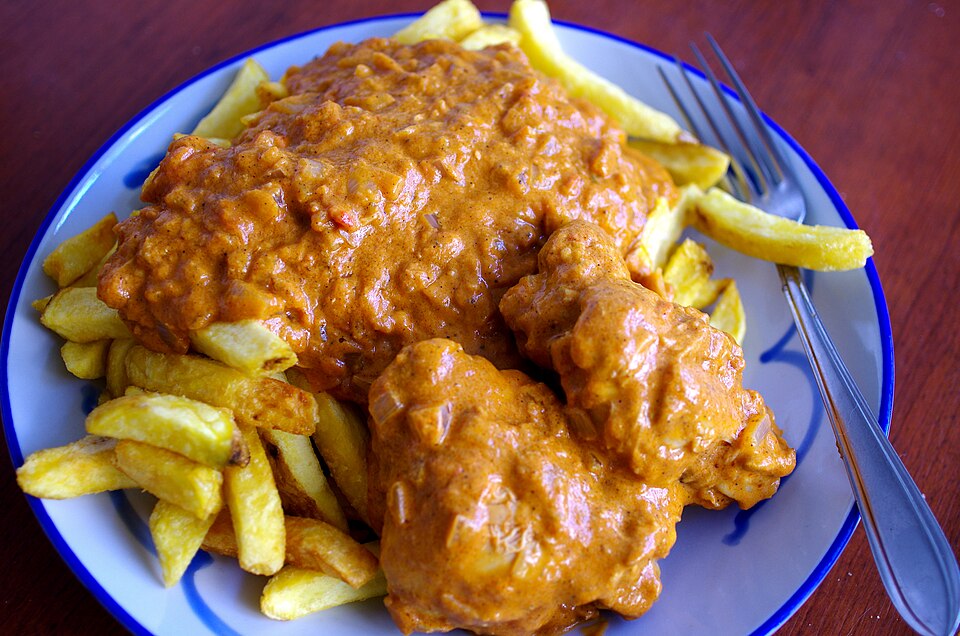
Muamba de galinha — chicken simmered in red palm oil until the sauce turns silky orange. Shown here with fries; at home it rides on funge. Photo: Wikimedia Commons.
The night Luanda became free
Angola's independence was a long time coming — and then it arrived all at once, at midnight. The armed struggle against Portuguese rule began on 4 February 1961. Fourteen years later, the Carnation Revolution in Lisbon brought down Portugal's dictatorship, and on 15 January 1975 the Alvor Agreement set the date: independence on 11 November 1975, with a transitional government to carry the country there.
It did not go as written. Portugal left without formally handing power to anyone, and three rival liberation movements each proclaimed their own state on the same day: the MPLA, led by Agostinho Neto, proclaimed the People's Republic of Angola in Luanda; the FNLA proclaimed a rival republic in Ambriz under Holden Roberto; UNITA proclaimed its own in Huambo under Jonas Savimbi. The MPLA's government in Luanda became the internationally recognised one — and the rival claims became a civil war that would not end until 2002.
But the night itself belonged to Luanda. At midnight on 11 November 1975, in what is now the Largo 1º de Maio — First of May Square — António Agostinho Neto, the MPLA leader, poet and doctor who became the country's first president, proclaimed the People's Republic of Angola before a crowd that had waited nearly five centuries: Portuguese ships first reached the Angolan coast in the 1480s, and the colony they built lasted until that night. The red-and-black flag went up — red for the blood of the struggle, black for the African continent, its emblem a machete crossed with a half gear beneath a star — and the country began again.
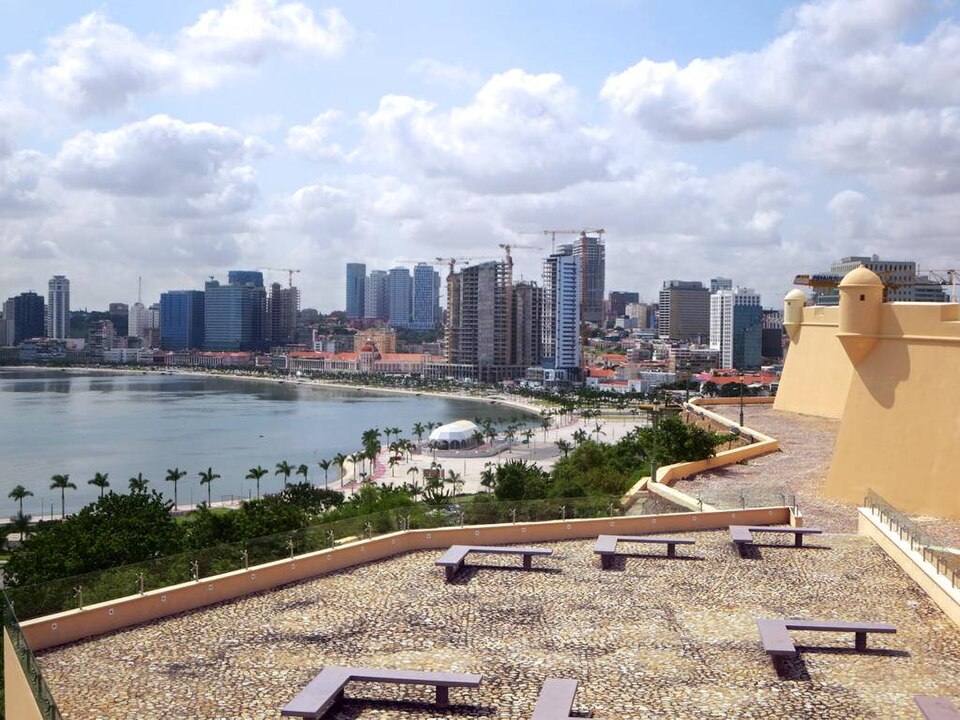
Luanda bay and the Marginal, seen from the old fortress — the city where independence was proclaimed at midnight on 11 November 1975. Photo: Wikimedia Commons.
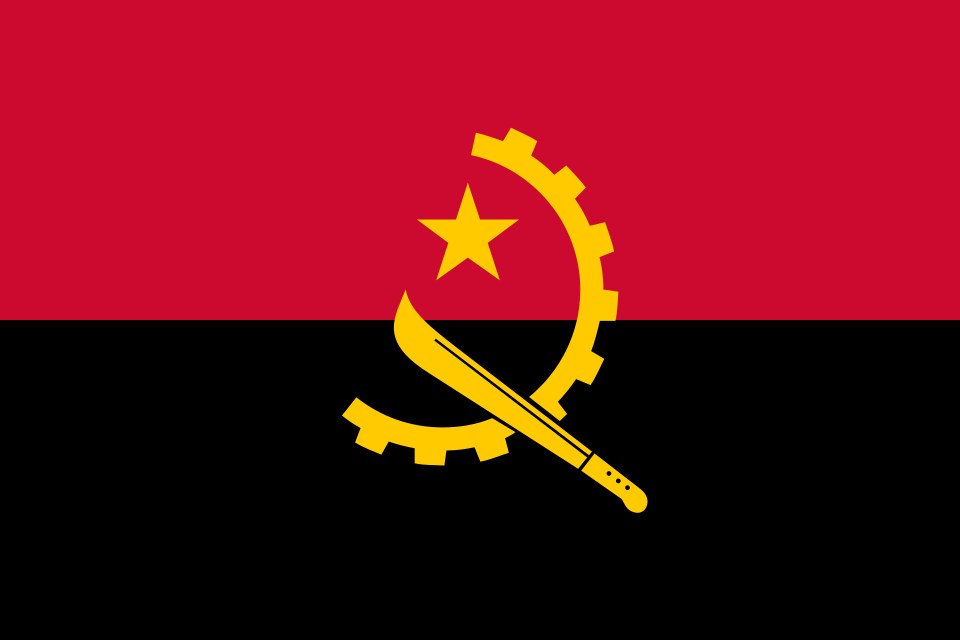
The flag raised that night: red for the blood of the struggle, black for the African continent, and the machete, half gear and star at its heart. Photo: Wikimedia Commons.
That is the history. The food is older than the history — and it is how the history is remembered. Angola's freedom table is not a menu invented for the anniversary. It is the food people were already eating in the musseques, the neighbourhoods of Luanda, and in the villages of the interior: the palm-oil pot, the cassava porridge, the coastal fish stew, the grilled fish of the Ilha, the cold beer. Independence did not create these dishes. It gave them a day.
A country is born at midnight; a table is born over centuries. Angola's independence feast is older than the republic — palm oil, cassava and the sea were feeding this coast long before any flag flew over it.
The freedom table, at a glance
Four dishes and one beer carry the anniversary. Here is the whole table on one card — every plate gets its full story in the chapters that follow, and every dish links straight into the guides.
- Muamba de Galinha — Chicken simmered in red palm oil with okra, onion, tomato and squash — the national dish — Funge, pinched up by hand — Angola collection
- Funge — Cassava flour beaten into a smooth, glossy porridge — the daily foundation — Every stew on this page; the pairing with muamba is law — Angola collection
- Calulu — Dried and fresh fish layered with greens, okra and eggplant in palm oil — Funge and palm-oil beans, at family Sundays — Angola collection
- Peixe Grelhado — Whole tilapia grilled over charcoal with lemon, garlic and chile — Funge, beans and a raw onion-tomato relish, on the Ilha — Angola collection
- Cuca Beer — Angola's lager since 1947 — the liquid flag — Served very cold, with muamba and funge at family Sundays — World Spirits Angola
🇦🇴 Muamba de Galinha: the national dish in red gold
If Angola had to be summed up in one pot, it would be muamba de galinha — chicken simmered in palm oil with okra, onions and squash, the Luanda table's heart and the dish most often named as Angola's national one. The colour gives it away before the smell does: red palm oil, óleo de dendê, turns the sauce a deep, silky orange that no other fat can imitate. Angolans will tell you plainly that a muamba made with anything else is a chicken stew, not a muamba.
The dish is built on a word. Muamba names a whole family of palm-based dishes across Angola and the wider Congo basin — the chicken version is muamba de galinha, the groundnut version is muamba de ginguba — and the word itself comes from Kimbundu, the language of the Mbundu people of the Luanda hinterland. The oil palm, Elaeis guineensis, is indigenous to West and Central Africa; its fruit has been pressed there for several thousand years. The chicken, the onion, the tomato and the garlic arrived later, with the Portuguese — centuries of colonisation folded into the pot, the way colonisation folds into everything, and the dish that came out the other side is unmistakably Angolan.
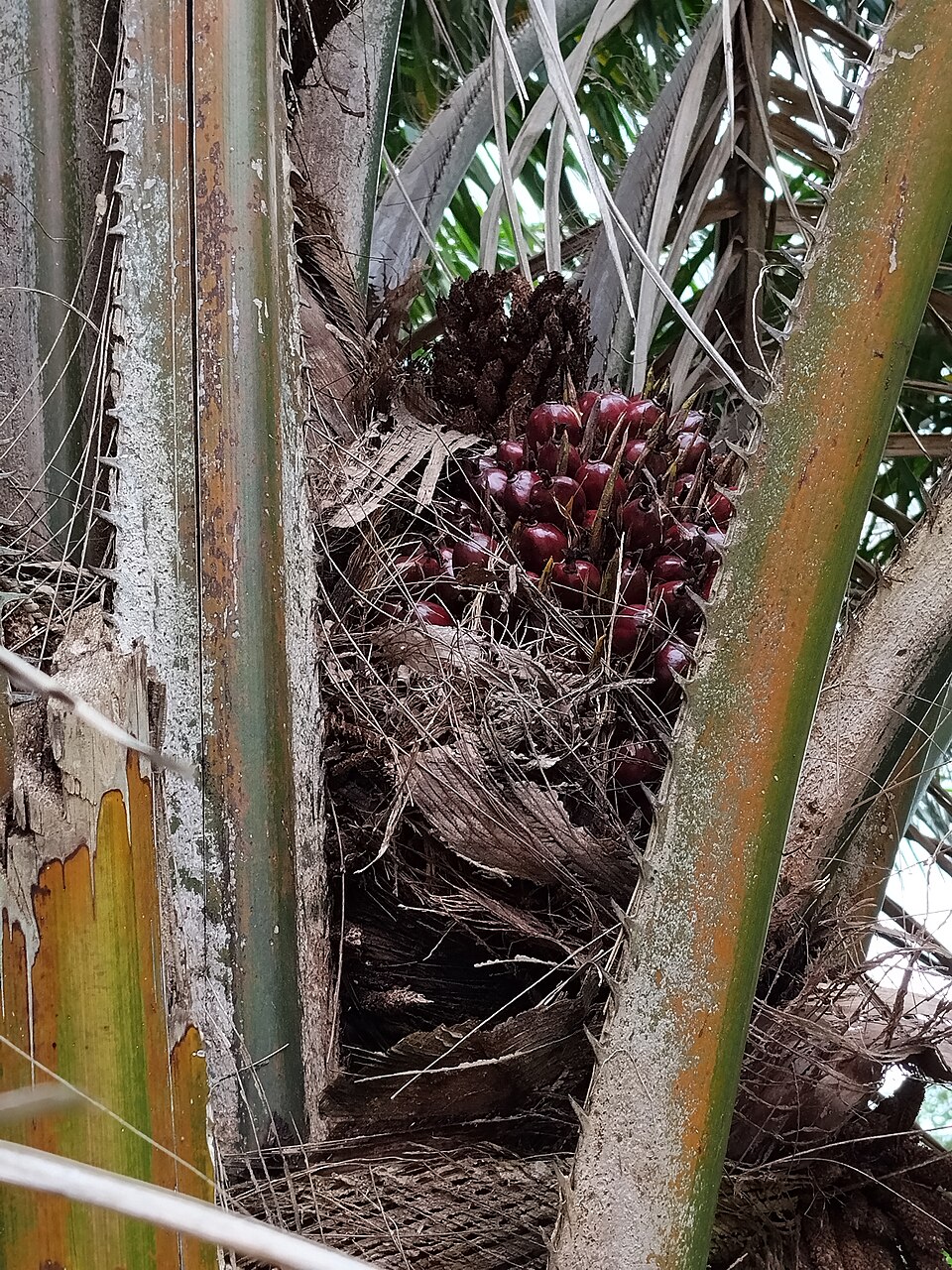
The African oil palm, Elaeis guineensis — its fruit gives Angola's cooking its red-gold colour and its deepest flavour. Photo: Wikimedia Commons.
The method is simple and unforgiving. Chicken is marinated in lemon, browned in the red oil, then simmered with onions, garlic, tomatoes and chilli until the meat gives; okra goes in near the end to thicken, squash to sweeten. Thirty to forty minutes and the pot is done — but the dish is not served alone, and it is never served with a fork doing the work. It arrives over a mound of funge, and the funge is the other half of the dish: you pinch it, swirl it through the sauce, and eat with your hands. In the Angola collection, the guide says it plainly — the pairing is law.
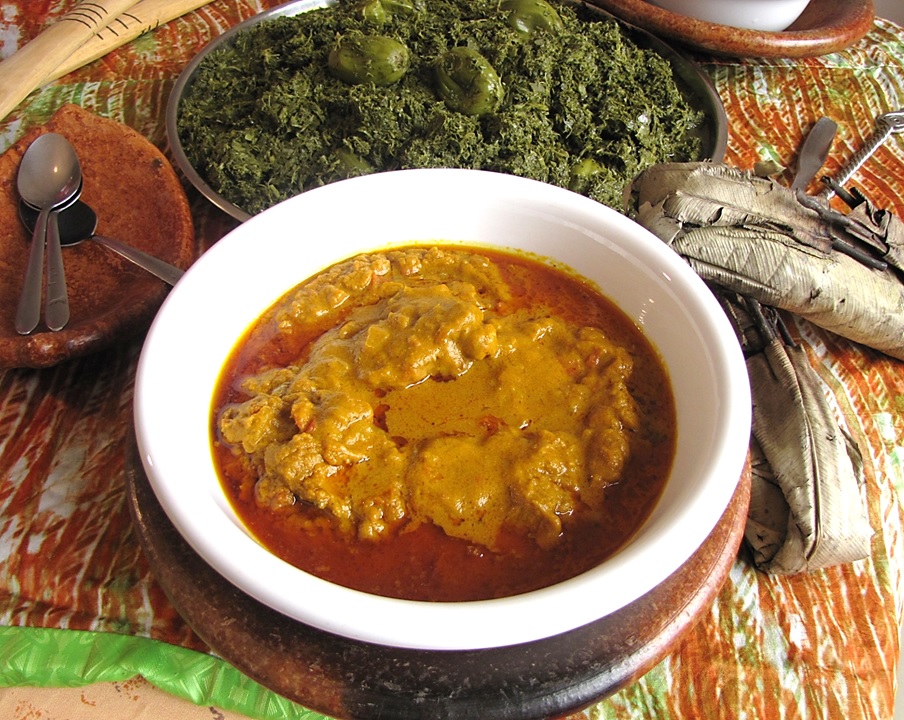
Moambe — the palm-nut sauce itself, red-gold and silky, with cassava-leaf greens alongside. Photo: Wikimedia Commons.
Muamba travelled, the way food travels when people are moved against their will. The same palm-oil chicken appears in Congo and Gabon — Gabon's national dish, poulet nyembwe, is chicken simmered in nyembwe, the sauce of palm nuts, with okra and dried fish — and the Angolan version was carried across the Atlantic in the slave-trade centuries to Brazil's Bahia, where the same dendê oil still colours the cooking today. A dish that began as a rural comfort food became, across four centuries and two continents, a national symbol of hospitality: sharing a pot of muamba is how Angola says welcome, and on the anniversary of independence, how it says we are still here.
Eat it like an Angolan: no cutlery for the funge — pinch, swirl, scoop. The okra is not a garnish; it is the thickener that makes the sauce cling. And leave room: muamba is a family-gathering dish, and family gatherings do not end with one helping.
🇦🇴 Funge: the root that crossed an ocean
Every stew on this page needs its foundation, and the foundation is funge — also spelled funje — the elastic cassava porridge that is Angola's daily bread. It is made from almost nothing: cassava flour rained into boiling water and stirred with a long paddle, beaten and kneaded against the pot until it turns smooth and glossy, then shaped in a wet bowl. Mild, dense, satisfying — and deliberately so. Funge is not meant to be interesting on its own. It is meant to carry sauce.
The root behind it is a traveller. Cassava — Manihot esculenta, manioc, yuca — is native to South America, domesticated in west-central Brazil perhaps 10,000 years ago. Portuguese traders introduced it to Africa from Brazil in the 16th century, and it remade Central African eating: a root that grows in poor soil, survives drought, and stores in the ground until you need it. Angola took it and made it the centre of the table. The connoisseur's version is funge de bombó, made from fresh cassava rather than flour — softer, more fragrant, and worth asking for by name.
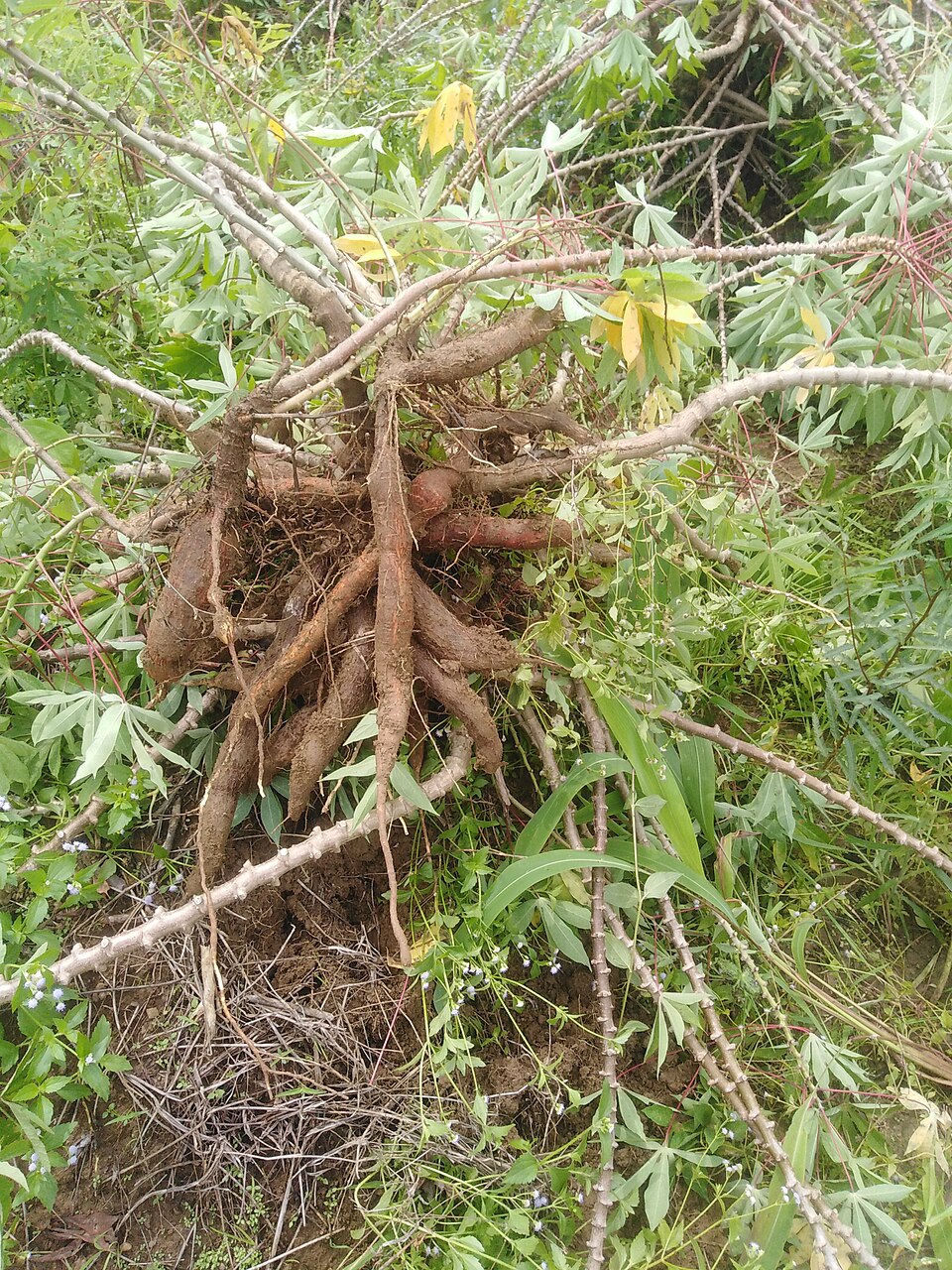
Freshly harvested cassava — the root that crossed the Atlantic from Brazil in the 1500s and remade Central African eating. Photo: Wikimedia Commons.
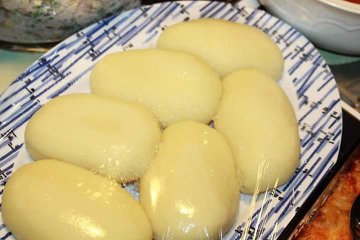
Funge — cassava flour beaten into a smooth, glossy mass, shaped in a wet bowl and pinched up by hand. From the World Cuisines Angola collection.
Funge is also the thread that ties Angola to its whole region. South of the border, Zambia eats nshima and Zimbabwe eats sadza — stiff porridges of maize meal, kneaded smooth with a paddle, shaped into mounds and pinched up by hand, dipped into relish. Different grain, same grammar: the porridge is the plate, the relish is the meal. Angola's version is cassava; the gesture is African.
Eat it like an Angolan: tear off a small ball with the fingers of your right hand, press a hollow into it with your thumb, and use it to scoop the sauce. Funge eaten with a spoon is funge misunderstood.
🇦🇴 Calulu: the Kimbundu coast in a pot
If muamba is the celebration, calulu is the Sunday depth — the fish-and-greens stew of Luanda, layered rather than stirred. Dried fish is soaked and simmered; fresh fish, okra, eggplant, sweet-potato leaves and tomatoes are layered over it in the pot; red palm oil is poured across the top; and the whole thing cooks slowly until everything melds and the flavours marry. Then it rests — because calulu, like all good stews, is better after the pot has had a moment to think.
The dish is said to come from the Kimbundu people of the coast, whose cooking is built on palm oil, and its name is said to come from Kimbundu too — the portion of food set aside for the family. Both claims are the kind food history trades in: plausible, repeated, and impossible to prove to the year. What is certain is the shape of it: a coastal logic, dried fish for the days when the boats stay in, fresh fish for the days they go out, leaves from the garden, oil from the palm. São Tomé, the island across the water, shares a famous version of its own — the same sea, the same pot, a different shore.
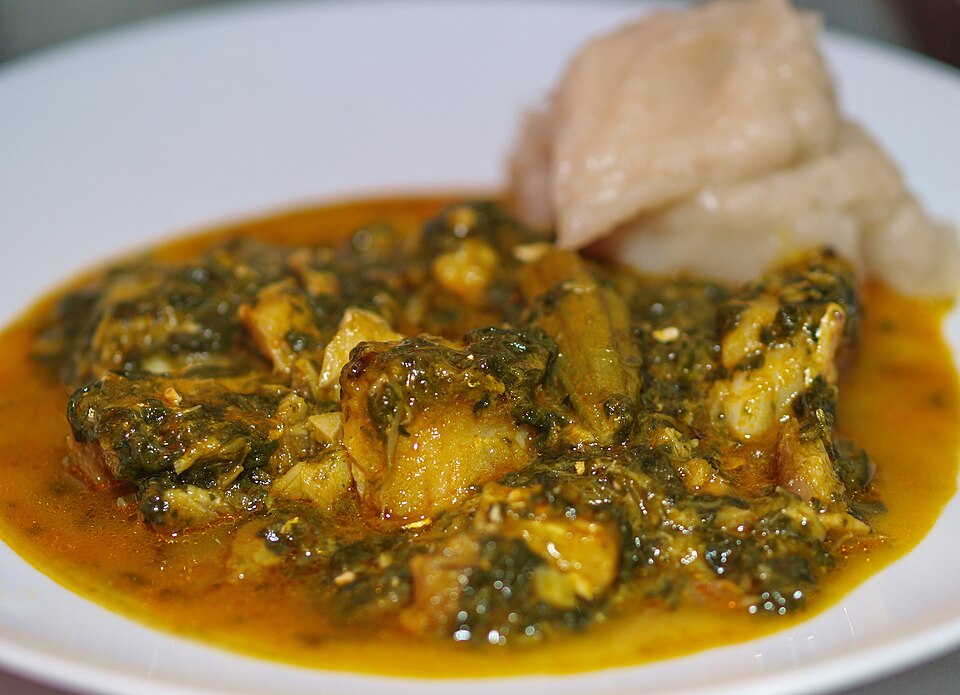
Calulu — dried and fresh fish layered with greens and okra in red palm oil, with funge alongside. From the World Cuisines Angola collection.
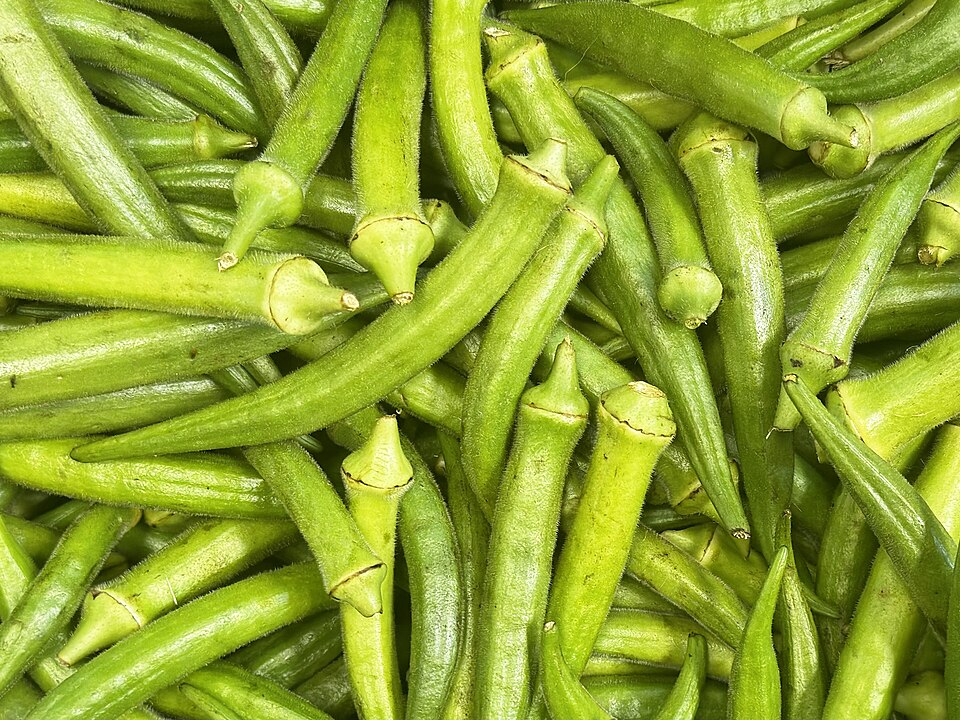
Okra — the pod that thickens muamba and calulu and gives them their silky body. Photo: Wikimedia Commons.
Calulu is traditionally served with funge and with feijão de óleo de palma — beans in palm oil — at family Sundays, and it carries a meaning beyond its ingredients: in Angola, calulu served at a festive meal symbolises abundance. The pot is deep, the leaves are dark, the oil runs red-gold across the top, and there is always, by design, more than the table can finish. Abundance is the point. On an independence anniversary, it is also the argument: a country that can feed a crowd from its own coast and its own gardens is a country that has already won the argument that matters.
Eat it like an Angolan: with funge, always — and let the pot rest before serving. The layering is the technique; the waiting is the seasoning.
The pot is the argument. Muamba says celebration, calulu says abundance, funge says home — and together they say what fifty-one years of independence taste like.
🇦🇴 Peixe Grelhado: Sunday on the Ilha
Angola has one of the longest coastlines in Africa, and its people's feast is grilled fish. Peixe grelhado — grilled fish, Luanda-style — is a whole tilapia or mackerel, scored and marinated in lemon, garlic and chile, grilled over charcoal and basted with its own marinade, served whole and family-style with funge, beans and a raw onion-tomato relish. Smoky, lemony, fresh: the opposite of the long-simmered stews, and the perfect answer to them.
Its temple is the Ilha de Luanda — the narrow sand spit that curls away from the city into the bay, lined with beach restaurants where the fish comes off the boat and onto the grill. Sundays there are an institution: families claim tables, the grills smoke, the beer is cold, and the fish arrives whole, head and tail, because a fish served in pieces is a fish that has lost its argument. The guide calls the Ilha's stalls the temple of Angola's grilled fish, and on a Sunday afternoon it is hard to disagree.
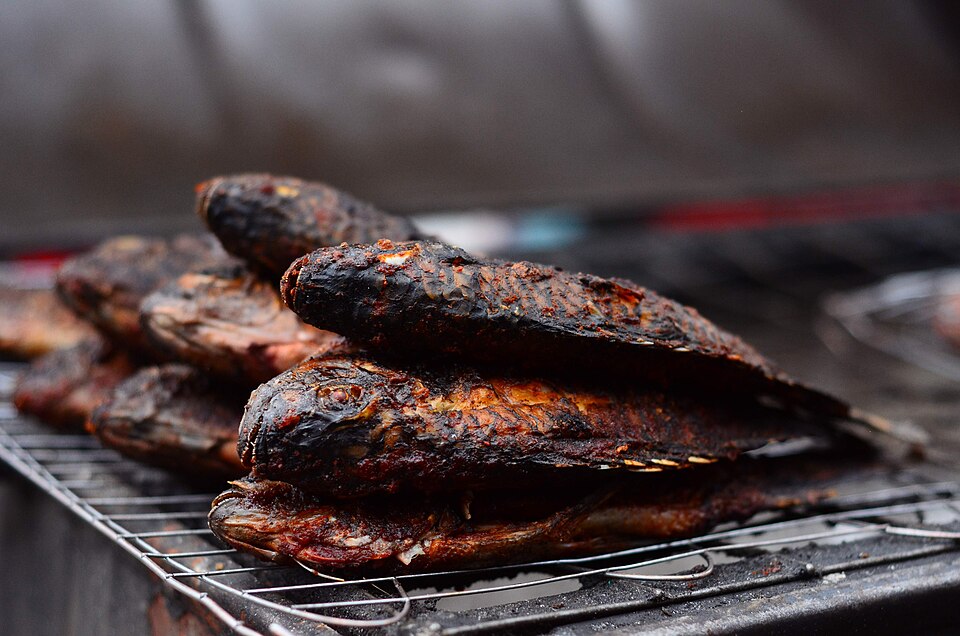
Grilled tilapia on the coals — the Ilha de Luanda way: whole fish, lemon, garlic and chile, eaten with the fingers. Photo: Wikimedia Commons.
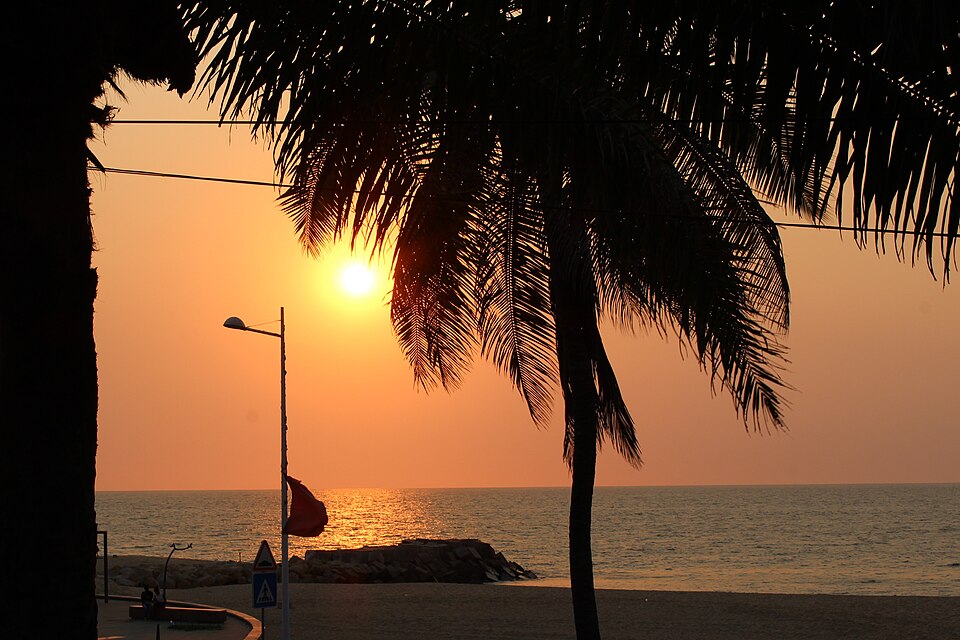
Sunset on the Ilha de Luanda — the narrow sand spit where the city's Sunday fish restaurants line the shore. Photo: Wikimedia Commons.
The fish is also the most democratic plate on the freedom table. Muamba needs a chicken and an afternoon; calulu needs a pantry of dried fish and leaves; grilled fish needs a fire, a lemon and a fisherman. It is the plate that belongs to everyone, which is exactly what an independence day should taste like.
Eat it like an Angolan: whole, with your hands, the relish spooned over the top — and go on a Sunday, when the Ilha is doing what it was built to do.
🇦🇴 Cuca: the beer that survived everything
Every freedom table needs something to drink, and Angola's answer has been the same since before independence: Cuca. The lager was established in 1947, while Angola was still a Portuguese overseas territory, as CUCA — Companhia União de Cervejas de Angola — a daughter company of Portugal's Central de Cervejas. It survived the independence it predates: on 26 May 1976 the government confiscated and nationalised the brewery, and the beer went on being brewed in Luanda — and in Catumbela, near Lobito in Benguela province — through the civil war, through shortages, through everything. Today it is owned by the French Castel Group, and it is still, by a distance, Angola's beer. EKA and Nocal are its sibling lagers; Cuca is the one everyone means when they say "uma Cuca" — a sentence everyone in Angola finishes.
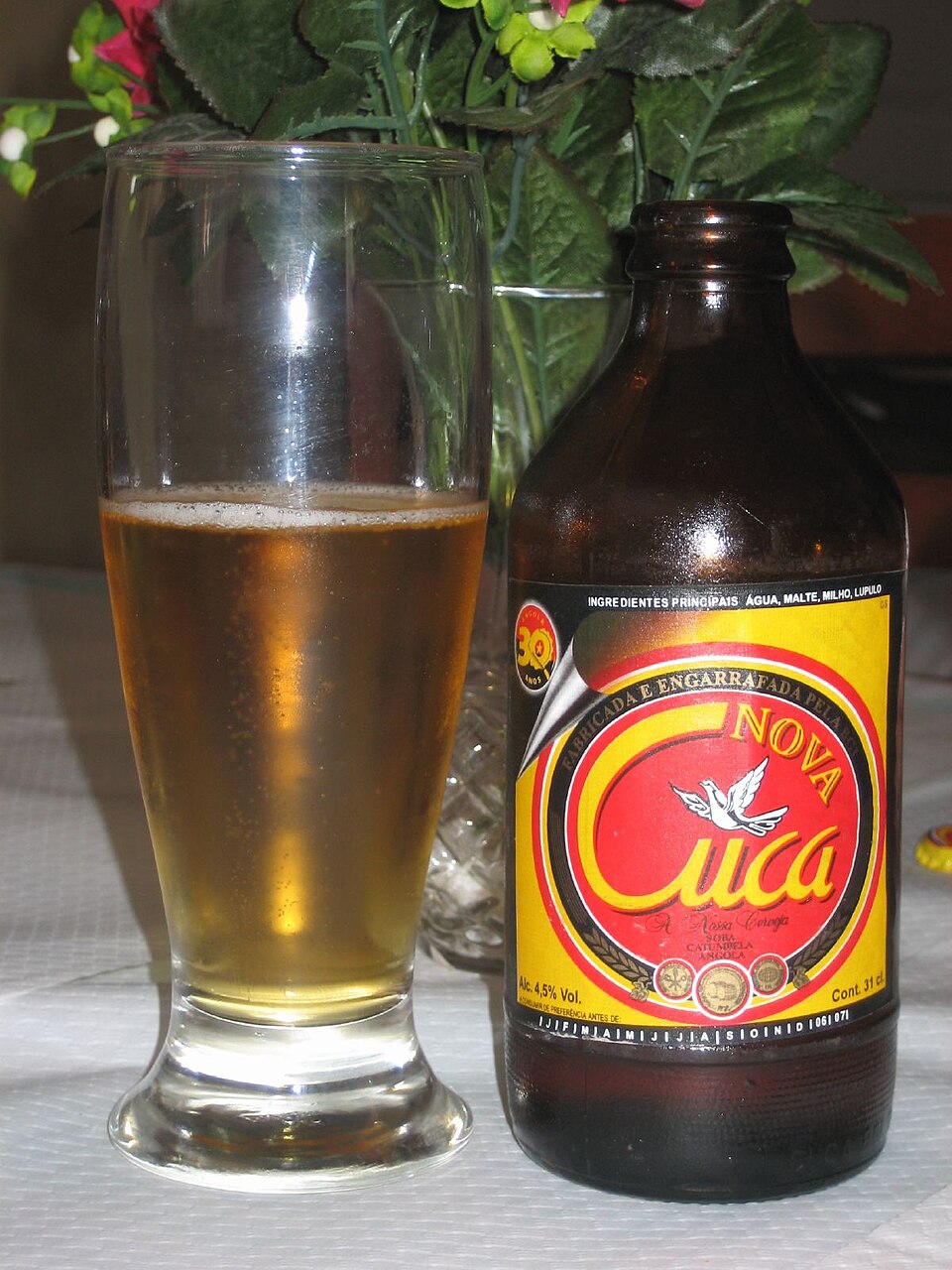
Cuca — Angola's lager since 1947, served very cold. The yellow label is the country's liquid flag. From the World Spirits Angola collection.
The rules are simple and non-negotiable: serve it cold — very cold — in bars and at festas, with muamba and funge at family Sundays. A warm Cuca, Cuca quente, is a joke told about the unlucky. At around 5% alcohol it is a standard crisp lager, elevated entirely by context: the same beer in another country would be unremarkable, and in Angola it is a flag you can drink. The World Spirits Angola collection keeps it as the country's single entry — because for Angola, one beer has always been enough.
Drink it like an Angolan: ice-cold, with the food on this page, and never warm. The joke writes itself, and every Angolan has already heard it.
The wider table: where Angola's food travelled
Angola's kitchen does not stop at Angola's borders — it is one room in a much larger house, and the World Cuisines guide lets you walk through the whole of it. The palm-oil pot, the cassava leaf, the stiff porridge and the grilled fish each have cousins across the region and across the Atlantic, and tasting the family is the fastest way to understand the dish in front of you.
Across the Atlantic, to Brazil. The road cassava travelled from Brazil to Angola ran both ways, and the food that came back is unmistakable. Feijoada, Brazil's black-bean feast — beans and smoked pork simmered for hours, served with rice, collard greens, farofa and orange — is the long Saturday lunch of the country that sent cassava to Angola. And moqueca, the coconut-milk fish stew of Bahia, is bright with dendê — the very same palm oil that colours muamba — cooked in a clay pot with peppers, cilantro and lime. The Brazil collection holds both: two dishes that prove the Atlantic is a bridge, not a wall.
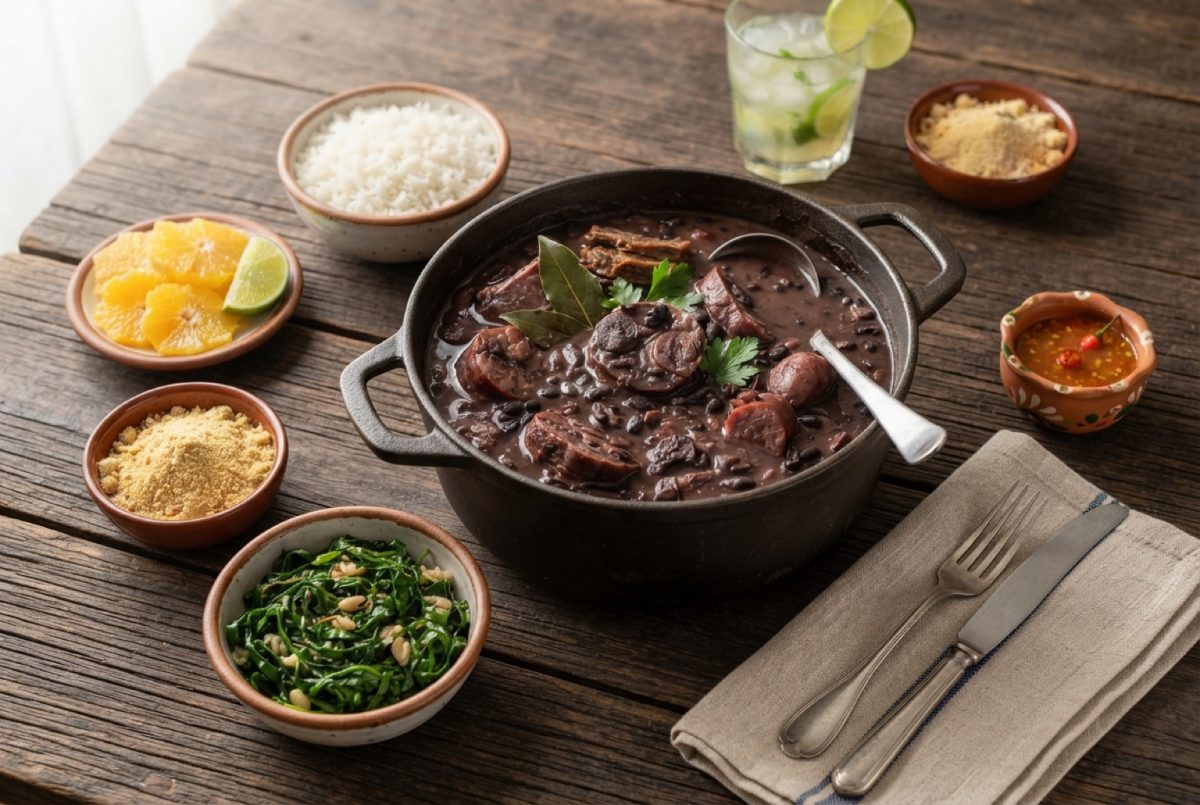
Feijoada — Brazil's black-bean feast, the dish that sailed the same Atlantic road as cassava, in the other direction. From the World Cuisines Brazil collection.
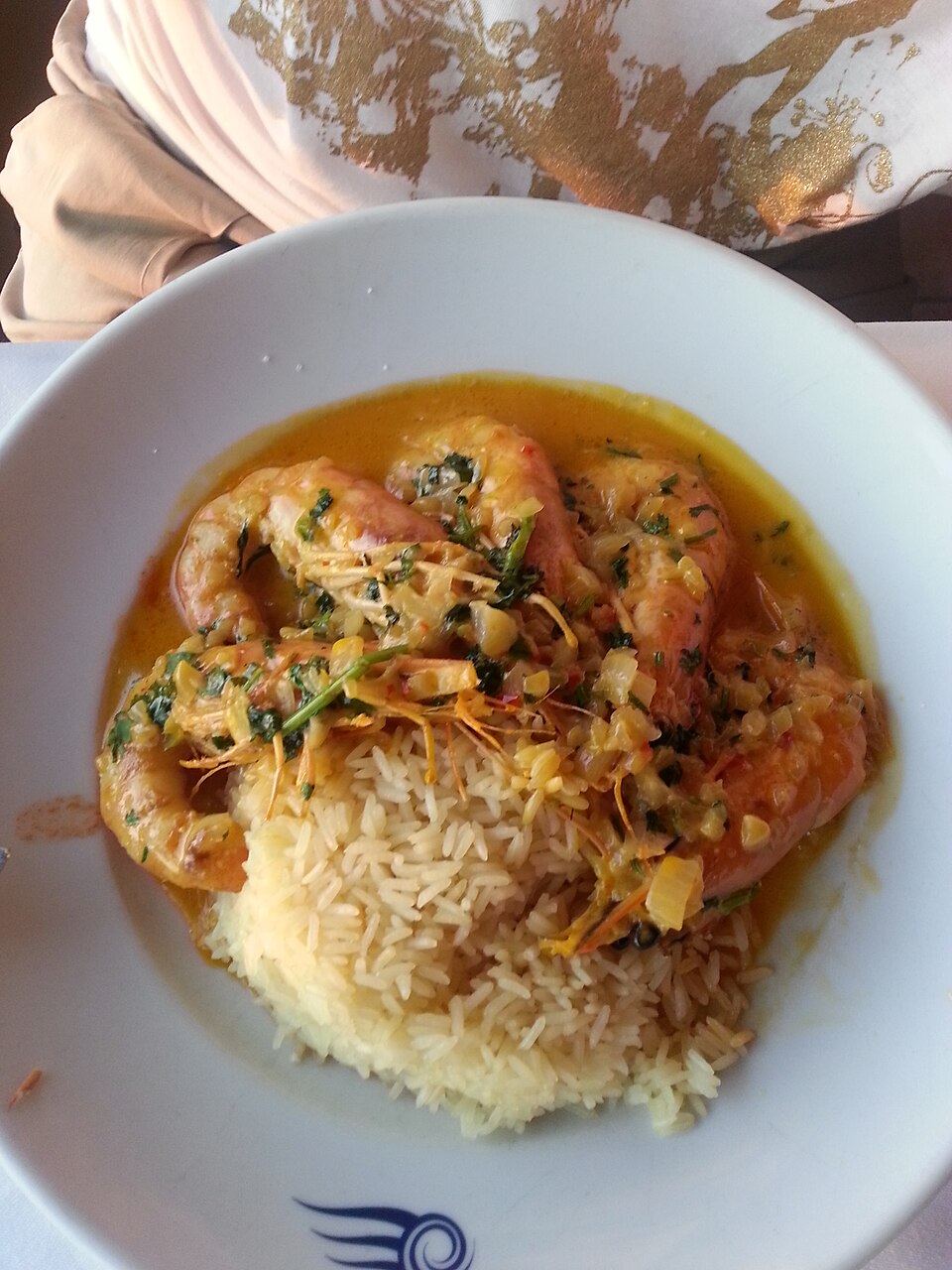
Moqueca de camarão — Bahia's shrimp stew, bright with the very same dendê palm oil that colours muamba. Photo: Wikimedia Commons.
Up the coast, to the Congos and Gabon. Across the Congo River, Brazzaville eats saka-saka — cassava leaves ground fine and simmered with groundnuts and palm oil, the Republic of Congo's national plate, served with fufu or rice beside makayabu, the salt fish stewed with onions, tomatoes and chiles, or fried crisp with sorrel sauce. The two Congos share the leaf and argue the details; the Congo collection keeps both sides of the argument, plus liboke, fish steamed in leaves. North again, Gabon's poulet nyembwe is muamba's closest relative — the same palm-nut sauce, the same okra, the same red pot. The Gabon collection is the family album.
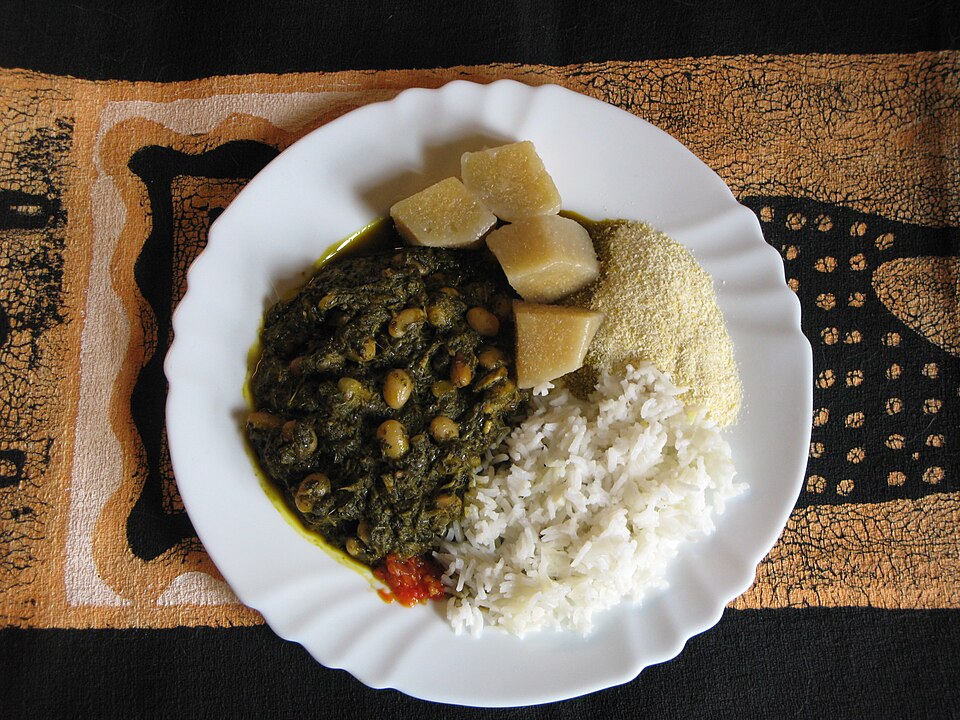
Saka-saka — Brazzaville's cassava-leaf icon, ground fine with groundnuts and palm oil. From the World Cuisines Congo collection.
Down the coast, to Mozambique. Where Angola cooks cassava leaves in palm oil, Mozambique cooks them in coconut milk and ground peanuts: matapa, pounded cassava leaves simmered until dark green and creamy, sometimes with prawns or crab for a feast, served with rice or xima. The same leaf, a different sea. The Mozambique collection also keeps frango piri piri — the fire sauce of bird's-eye chiles, garlic, lemon and oil that travelled from Mozambique via Portugal to the whole world — camarões, giant tiger prawns grilled with garlic and piri piri butter, and caril, the peanut curry of the coast.
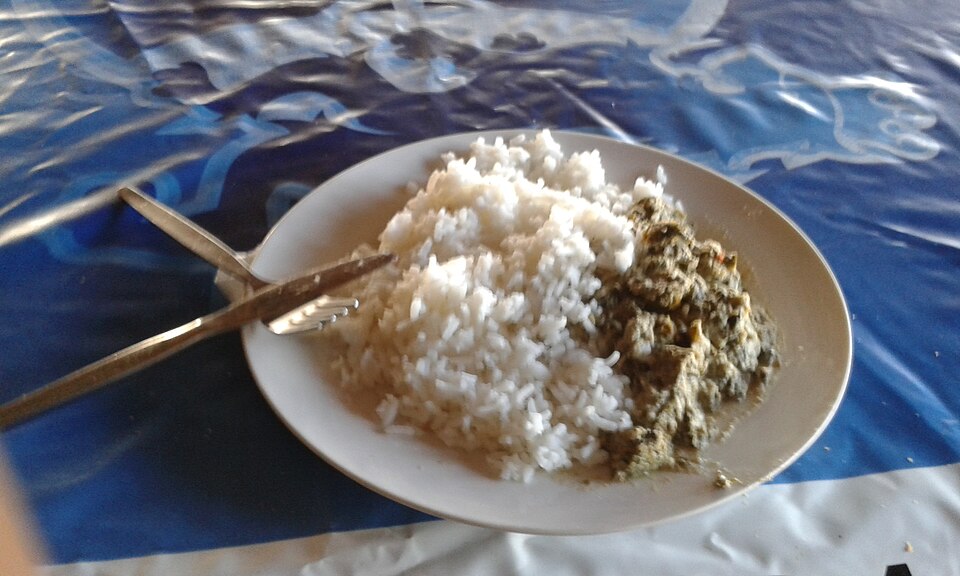
Matapa — Mozambique's creamed cassava leaves in coconut milk and ground peanuts. From the World Cuisines Mozambique collection.
Inland, to the porridge belt. Zambia's nshima and Zimbabwe's sadza are funge's maize cousins — stiff porridges kneaded smooth, shaped into mounds, pinched up by hand and dipped into relish. The Zambia collection pairs nshima with ifisashi, pumpkin leaves simmered in groundnut sauce, and kapenta, the tiny lake fish; the Zimbabwe collection pairs sadza with nyama meat and muriwo — greens in peanut sauce. Same hand, same gesture, different grain.
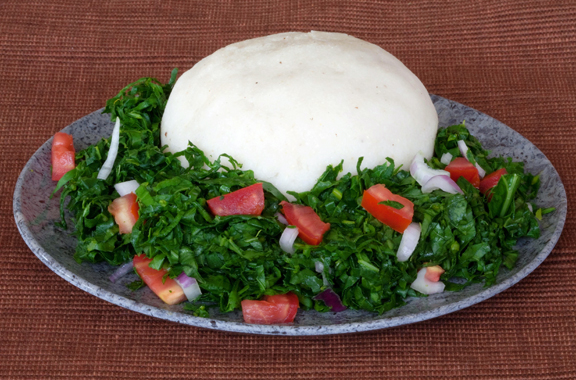
Nshima — Zambia's stiff maize porridge, the southern cousin of funge, served with greens and relish. From the World Cuisines Zambia collection.
West, to Senegal and the jollof family. Thieboudienne — Senegal's national masterpiece, broken rice cooked in a rich tomato-fish broth with vegetables and served on a great platter around the fish — is jollof's ancestor, and the Senegal collection keeps it beside yassa poulet, chicken drowned in caramelised onion and lemon, and mafé, the peanut stew. Nigeria answers with jollof rice and egusi soup from the Nigeria collection; Ghana with waakye and groundnut stew from the Ghana collection. The rivalry between the jollofs fills a thousand arguments; the palm oil and the peanut are the common ground underneath them all.
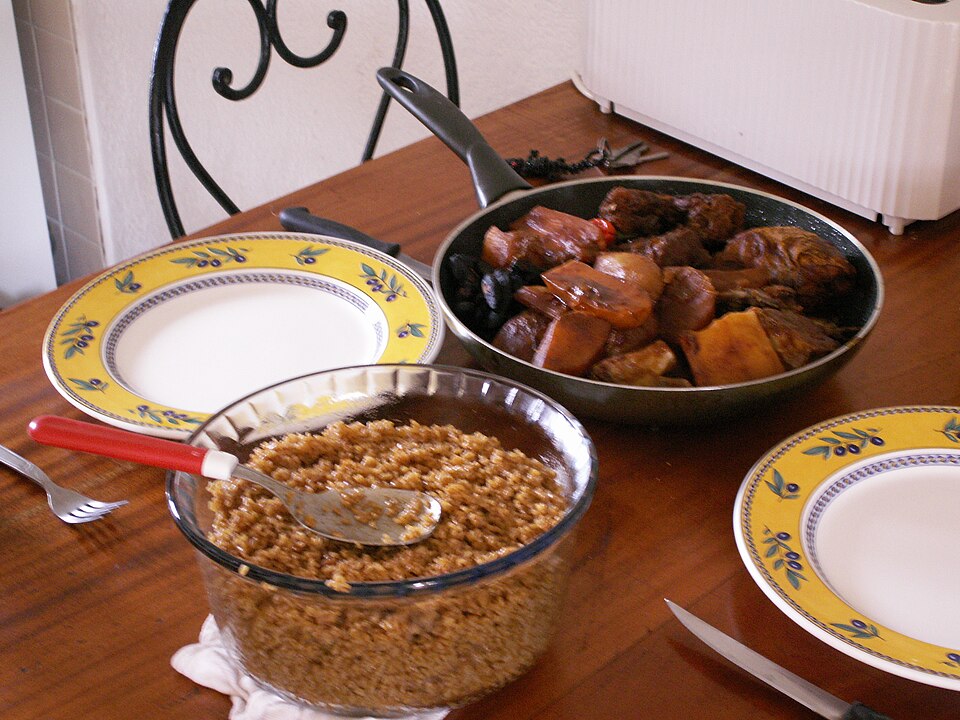
Thieboudienne — Senegal's national rice-and-fish masterpiece, the ancestor of West Africa's jollof. From the World Cuisines Senegal collection.
And back to Lisbon. None of this exists without Portugal — the coloniser whose ships carried cassava one way and carried muamba's name the other. The Portugal collection keeps the other end of the exchange: bacalhau à brás, salt cod scrambled with matchstick potatoes and egg; pastéis de nata, the custard tarts; caldo verde, the green kale soup. Angola took the salt cod too — calulu's dried fish is its cousin — and made it African. That is the whole story of this table in one sentence: nothing arrived unchanged, and everything that arrived became Angola's.
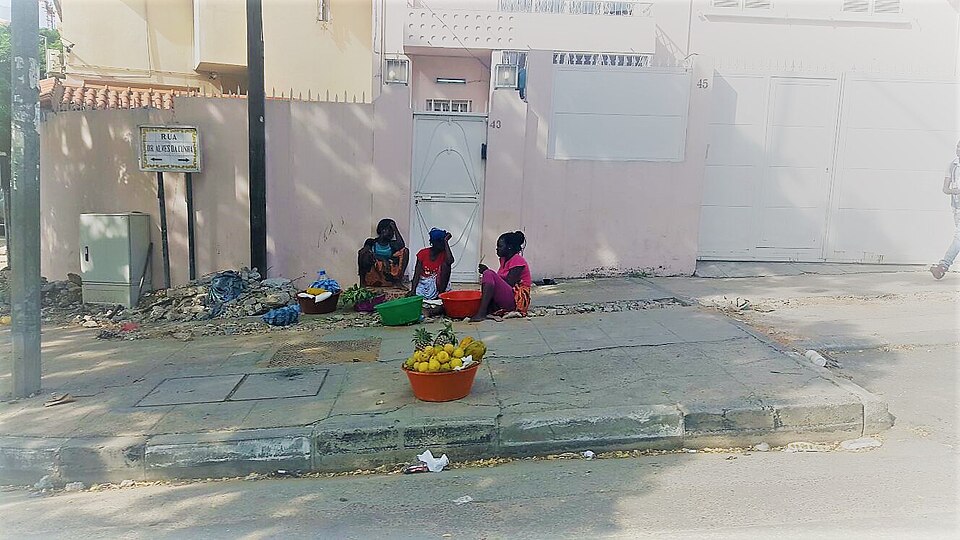
The market comes to the pavement: fruit sellers on a Luanda street. Photo: Wikimedia Commons.
One pot, four centuries, two continents. Cassava sailed from Brazil, palm oil never left Africa, the chicken came with Portugal — and the table they built together is Angola's.
From a freedom table to your city's table
The Holiday Table travels all season — and when a feast makes you hungry for a restaurant table instead of a history lesson, the CallPages restaurant guides carry the same dish-by-dish honesty to the cities we track, every menu with its real prices: Paris, Rome, Madrid, San Francisco and New York. Angola's food is still rare on those streets — which is exactly why the guides matter: the table is out there, waiting to be found.
The season ahead
That is day two — the freedom table, served the way every day of this season will now be served: deep, visual and linked dish by dish. Ahead of us: Friday fish day tomorrow, then the Diwali season close, the British Sunday roast, Thanksgiving on November 26, the December feasts — St. Nicholas, St. Lucia, Las Posadas, Nochebuena, Christmas tables from four continents — then New Year as a dozen cultures eat it, Three Kings on January 6, Orthodox Christmas, Lunar New Year and Carnival, all the way to February 20. Every day, one feast and the dishes that carry it, each one already waiting in the guides:
- World Cuisines — 781 dishes, 199 country collections, each dish with its origin, ingredients and history.
- World Spirits — 266 drinks, from the lagers of Luanda to the bottles opened at New Year.
- ¿Lees en español? Esta misma mesa está servida en español: El Día de la Independencia de Angola.
And keeping the night watch over the whole season — while Angola feasts under its red-and-black flag, our own host works the dark hours:

Your host for the season: the Múcaro, Puerto Rico's night owl, in CallPages acid colours. He keeps the night watch while Angola feasts.
Tomorrow, the table goes fishing. Bring an appetite.
How it works
- Every featured dish and drink comes from the CallPages World Cuisines and World Spirits guides — 781 dishes and 266 drinks with their origins, ingredients and histories — linked dish by dish below.
- Holiday dates and customs are verified against published sources for the 2026–27 season; legends are labelled as legends.
- The Holiday Table runs daily from November 11, 2026 to February 20, 2027: one feast, one culture (or several), one story per day, through Thanksgiving, the December feasts, New Year, Three Kings, Lunar New Year and Carnival.
Related reading
Innovation by Vasily Starostenko, founder of CallPages.