Friday fish day: the Mediterranean-to-Pacific fish table — fihunu mas, kokoda and pastizzi
Every Friday, Catholics have abstained from meat since the early Church — and the world’s fishing cultures answered with their finest cooking. Today the table runs from the Maldives, where pole-and-line tuna is grilled as fihunu mas, to Fiji, where raw fish is cured in citrus and coconut cream as kokoda, to Malta, where Friday ends at the pastizzeria with hot pastizzi.
Friday is the most cooked-for day in the Christian calendar — the day meat leaves the table — yet the fish that replaces it is usually treated as an afterthought. Three island nations prove the opposite: their Friday fish is the best thing they cook.
Friday fish day: the Mediterranean-to-Pacific fish table — fihunu mas, kokoda and pastizzi
It is Friday, and across half the world the meat has left the table. In Lisbon the cod is already soaking. In Malé the tuna is on the grill. In Suva the fish is curing in lime and coconut cream. In Valletta the pastizzeria queue is out the door. One rule, written nearly two thousand years ago — no flesh meat on the day of the Crucifixion — built the richest fish cooking on earth, and today the table runs from the Mediterranean to the Pacific: the Maldives, Fiji and Malta, three island nations that turned Friday into a feast.
This is day three of The Holiday Table — our daily feast from November 11 to February 20, drawn from the World Cuisines guide (781 dishes) and the World Spirits guide (266 drinks). We opened the season with St. Martin’s goose feast and yesterday we ate at Angola’s freedom table. Today there is no meat at all — and the table has never been better.
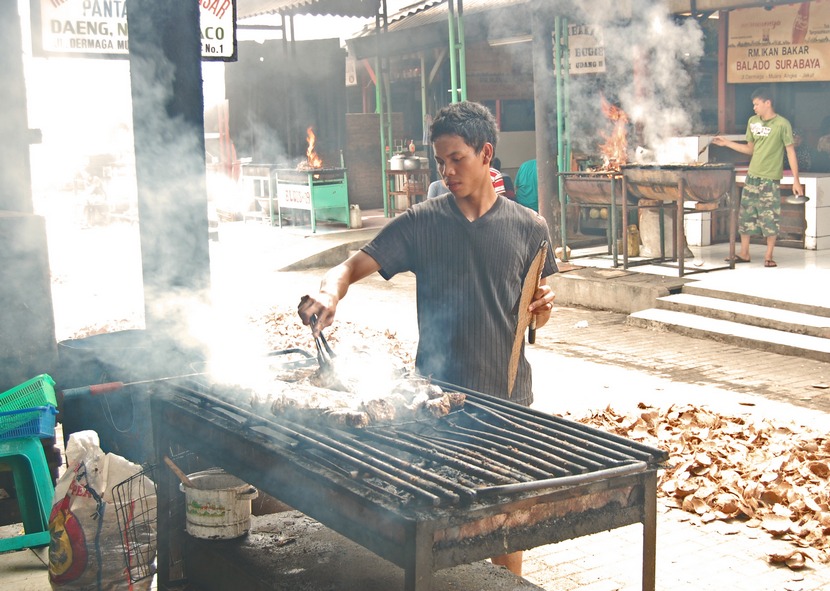
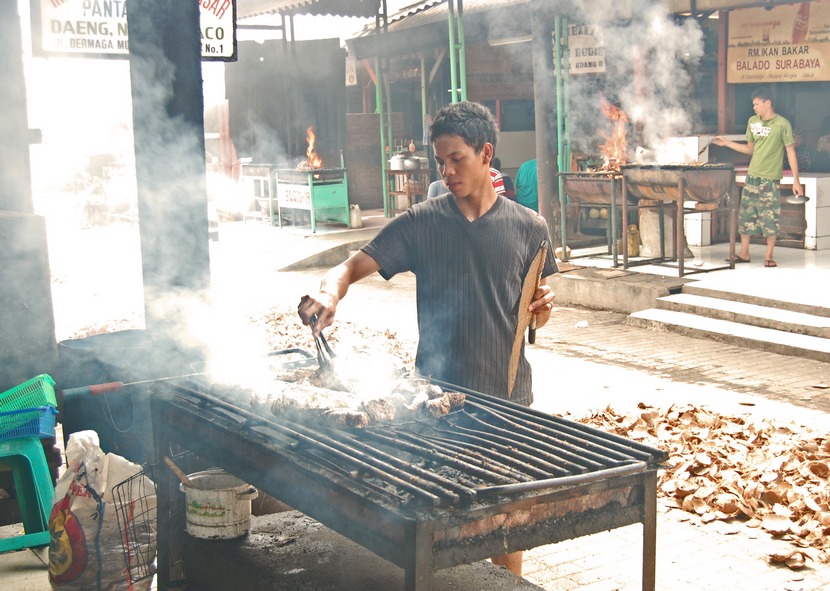
Fish over charcoal, smoke in the air — the grammar of fihunu mas, and of every Friday grill from Malé to Marsaxlokk. Photo: Wikimedia Commons.
Friday, the fish day: two thousand years of abstinence
Friday is fish day because Friday is the day of the Crucifixion, and the early Church marked it by fasting. The Didache, a Christian handbook written around AD 100, already names Wednesday and Friday as the week’s fast days. The fast was strict at first — in the earliest centuries it meant little or no food at all from sunrise to sunset — and it softened over time into abstinence: no flesh meat, while fish, being cold-blooded and of the water rather than the land, was permitted. By the sixth century fish was allowed on abstinence days, though Pope St. Gregory the Great still forbade the richer seafood, the lobsters and delicacies, as too luxurious for a day of penance.
The rule held, with local variation, for more than a millennium. Canon law still says it plainly: canons 1250–1251 of the Code of Canon Law name every Friday of the year a penitential day and require abstinence from meat on all Fridays, unless a solemnity falls on that day, for everyone aged fourteen and over. The great change came in 1966, when Pope Paul VI issued the apostolic constitution Paenitemini and gave bishops’ conferences authority to adapt the discipline — in the United States the bishops allowed another act of penance to substitute for abstinence outside Lent, which is why so many Americans now think the rule was abolished. It was not: during Lent the Friday abstinence is still the hard rule, and in much of the Catholic world — Portugal, Malta, the Philippines, Latin America — Friday fish never went away at all.
A fast that became a feast. The Church asked for sacrifice; the fishing villages answered with their finest cooking — and two thousand years later, Friday is still the best fish day of the week.
The rule reshaped whole economies. Lisbon’s cod trade, the Friday fish fries of the American Midwest, the Filet-O-Fish — invented in 1962 by Lou Groen, a McDonald’s franchisee in heavily Catholic Cincinnati who was losing money every Friday because his customers would not buy burgers — all of them are Friday’s children. But the deepest answer to the rule came from the islands, where the sea was already the pantry and Friday simply made the everyday sacred. That is where today’s table begins: three archipelagos, three fish, one Friday.
The Friday table, at a glance
Three featured dishes, three island nations, one rule. Here is the whole table on one card — every plate gets its full story in the chapters that follow, and every dish links straight into the guides.
| The plate | What it is | What joins it at the table | In the guides |
|---|---|---|---|
| Fihunu Mas | Whole reef fish or tuna, scored and rubbed with a fiery chile-garlic paste, grilled over coconut husks | Garudhiya broth and rice, lime over the top | Maldives collection |
| Kokoda | Raw mahimahi or Spanish mackerel cured in citrus, folded through coconut cream with onion, chile and tomato | Served chilled in a coconut shell, as the starter of every Fijian feast | Fiji collection |
| Pastizzi | Blistered diamond pastries of thousand-layer dough, filled with ricotta or curried peas | Hot from the pastizzeria, with tea in a glass — Malta’s democratic snack | Malta collection |
🇲🇻 Maldives: fihunu mas — the grilled fish of the atolls
The Maldives is a country that is almost all sea: some 1,200 islands grouped into 26 atolls, scattered across the Indian Ocean, with dry land so low and so scarce that the pantry was never going to be a field. It is the sea. And the sea, in the Maldives, is tuna — skipjack above all, caught one fish at a time on pole and line from the low wooden dhoni, a method the islands have used for centuries and the world now holds up as the model of selective, low-impact fishing. Close to 88% of the tuna landed in the Maldives in 2022 was caught by pole-and-line, virtually the entire skipjack catch; the skipjack fishery won Marine Stewardship Council certification in 2012, and tuna directly sustains around 30% of the Maldivian population. When a Maldivian eats fish on Friday, he is eating the fish his grandfather caught the way his grandfather caught it.
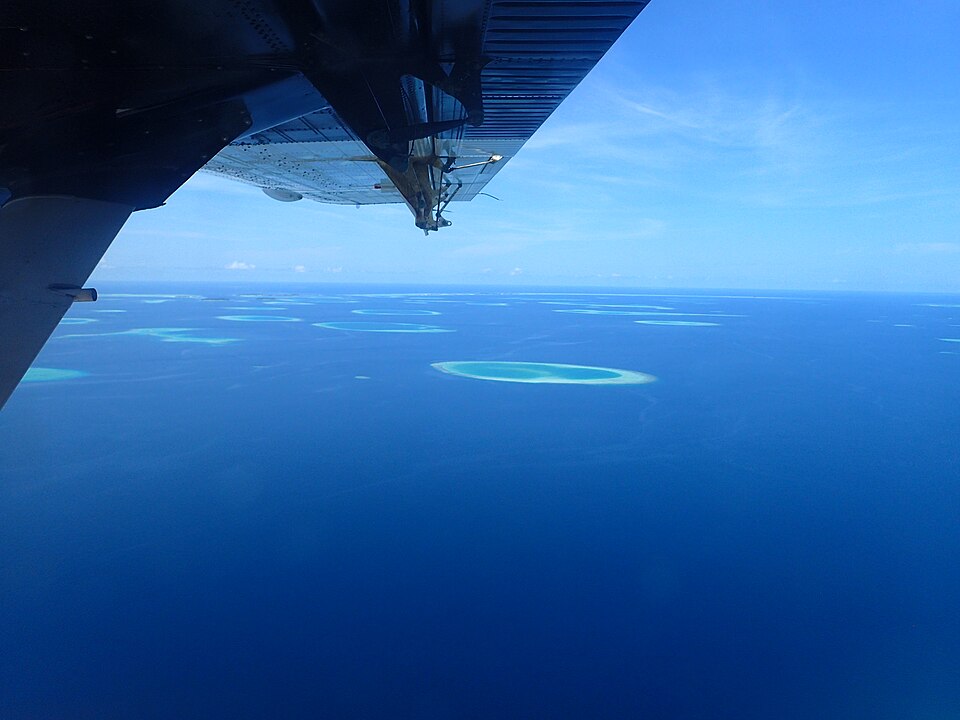
The Maldives from the air — a nation of atolls where the pantry is the sea itself. Photo: Wikimedia Commons.
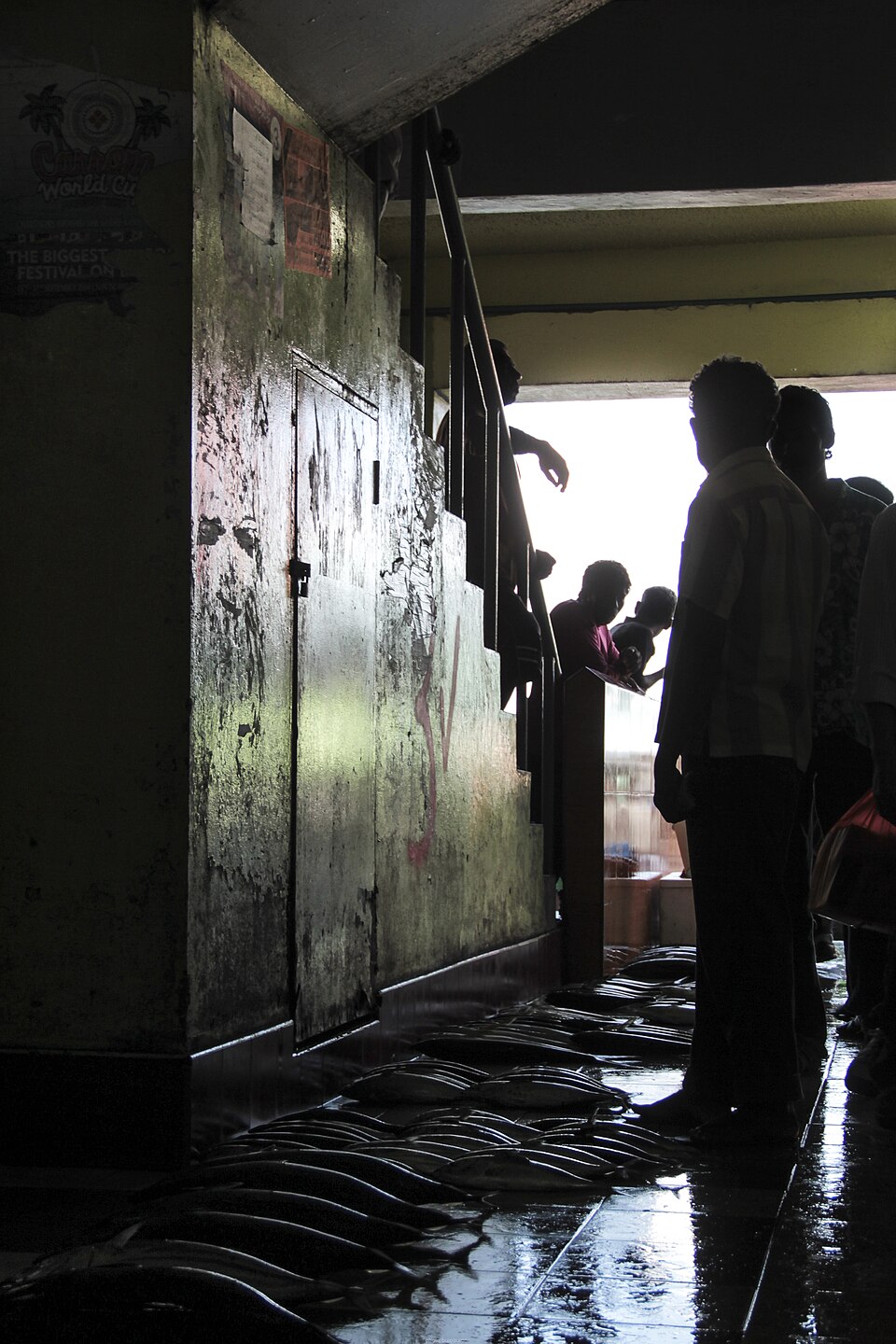
Morning at the Malé fish market: the day’s tuna laid out in rows before the cafés open. Photo: Wikimedia Commons.
The festive face of that pantry is fihunu mas — grilled fish, the islands’ barbecue. A whole reef fish or a tuna is scored, packed with havaadhu, a fiery paste of dried chiles, garlic, cumin and curry leaves, rested so the paste works into the cuts, and grilled whole over coconut husks until the skin chars and the flesh stays sweet inside. Lime over the top at the end. It is the dish of island barbecues and cafés, and it is also the shape of the Maldivian table itself: fire, chile, lime, fish — nothing else needed, nothing else wanted.
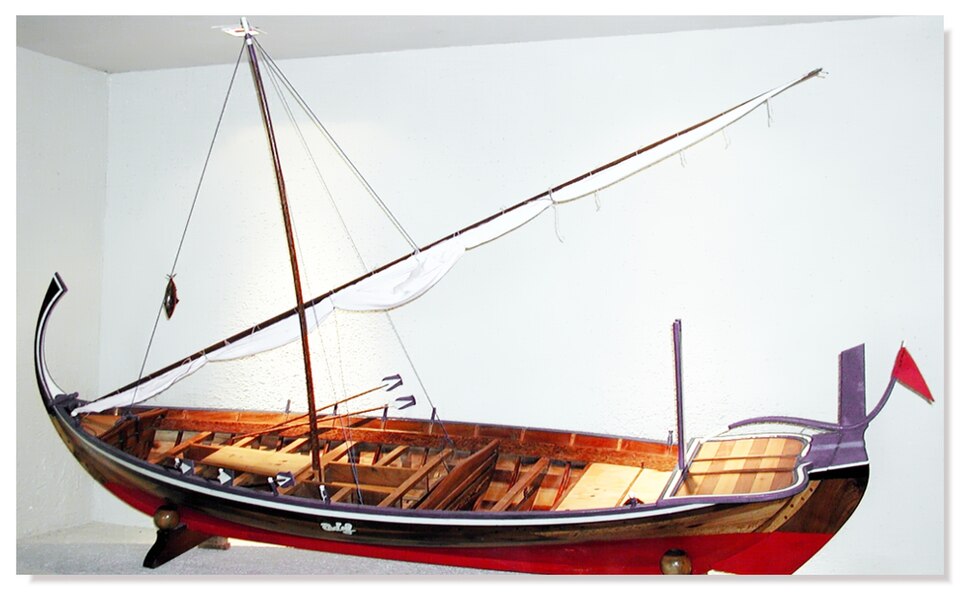
The dhoni — the Maldives’ traditional fishing boat, built for pole-and-line tuna. This one is a museum model of the working fleet. Photo: Wikimedia Commons.
Around the grill sits the rest of the Maldivian day. Mas huni is the breakfast: shredded smoked tuna mixed with grated coconut, red onion, chile and lime, scooped up with roshi, the flatbread — the atolls’ morning anthem, and the most minimal dish in this whole season: tuna and coconut, the archipelago’s whole pantry, in one bowl. Garudhiya is the soul soup: tuna poached gently in water with curry leaves, onions and chiles into a fragrant, crystal-clear broth, served over rice with lime and fried onions — a soup centuries old, the taste of home, made from the finest catch without hiding it. And mas riha is the tuna curry, the same fish in coconut milk and spice, the version that turns a catch into a celebration.
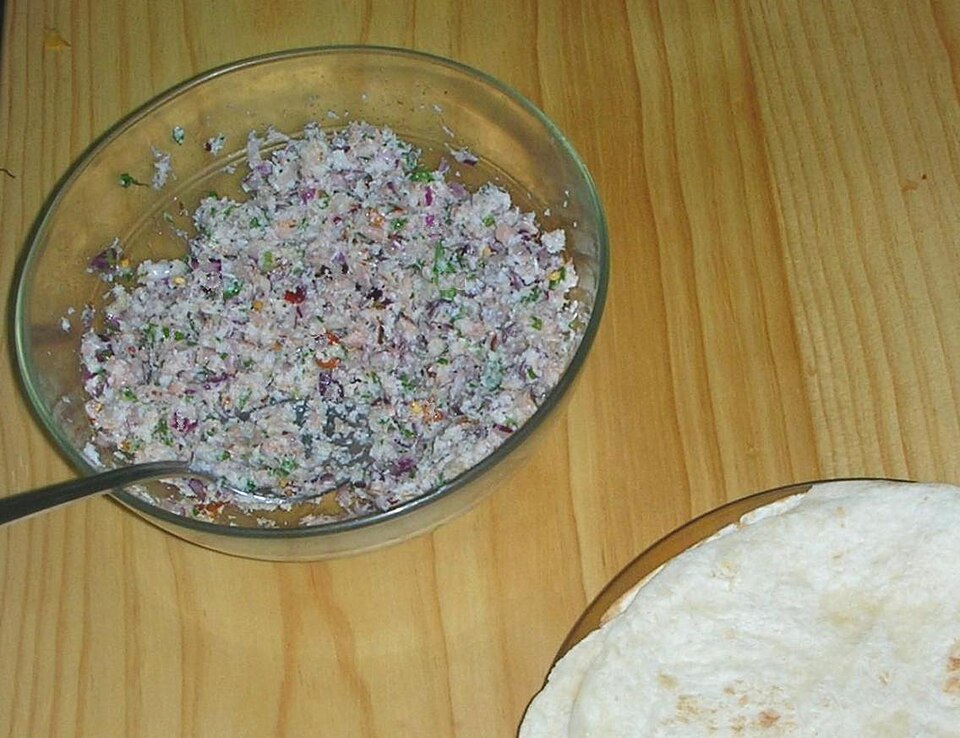
Mas huni — shredded smoked tuna, coconut, onion, chile and lime, with roshi to scoop it. From the World Cuisines Maldives collection.
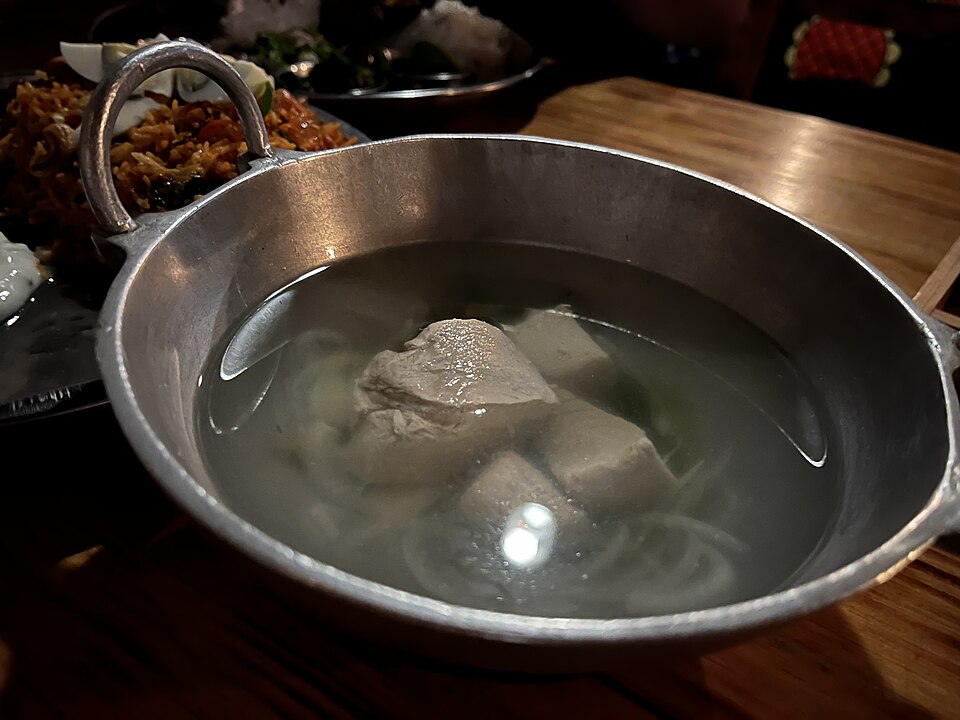
Garudhiya — the clear tuna broth that is the Maldives’ soul soup. From the World Cuisines Maldives collection.
Friday has a second meaning here. The Maldives is a Muslim nation, and Friday is Jumu’ah, the congregational prayer day — the week’s holy day, when the working week pauses at noon and the islands gather at the mosque. The fish that follows is the same fish as every day, and that is the point: in the Maldives, Friday does not need a special dish, because the everyday dish is already the best thing the sea gives. Fihunu mas on a Friday is not an exception to the rule. It is the rule, kept perfectly.
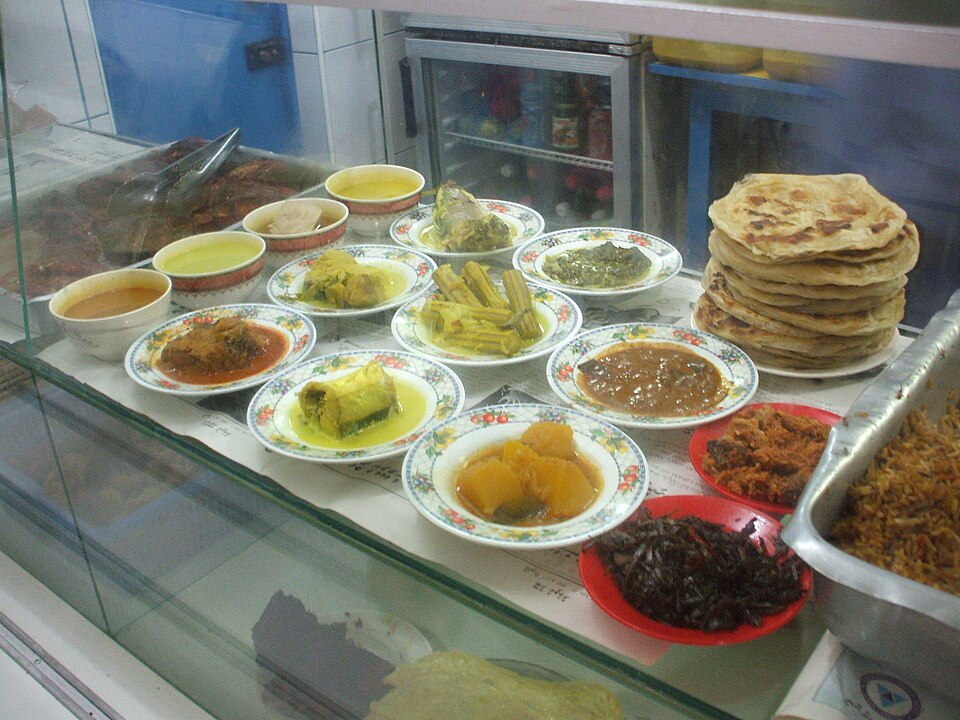
A Malé café case: curries, roshi and condiments — the working lunch of a fishing nation. From the World Cuisines Maldives collection.
Eat it like a Maldivian: with your hands, off a shared plate, lime squeezed over the fish at the table — and ask for the theluli mas, the fried tuna condiments, on the side. The smoke is the seasoning; the paste is the heat; the lime is the finish.
🇫🇯 Fiji: kokoda — the Pacific’s freshest bowl
If the Maldives grills its Friday fish, Fiji does not cook it at all — and the result is the freshest bowl in the Pacific. Kokoda is raw fish, mahimahi or Spanish mackerel, cubed and marinated in lemon or lime until the citrus turns it opaque, then drained and dressed in coconut cream with onions, chiles, tomatoes and coriander, chilled and served — classically — in a halved coconut shell. Bright, creamy, oceanic: it is the starter of every Fijian feast, and it is also the logic of the whole South Pacific raw-fish family, kin to Tahiti’s poisson cru and Samoa’s oka, with Fiji’s coconut-cream hand as its badge.
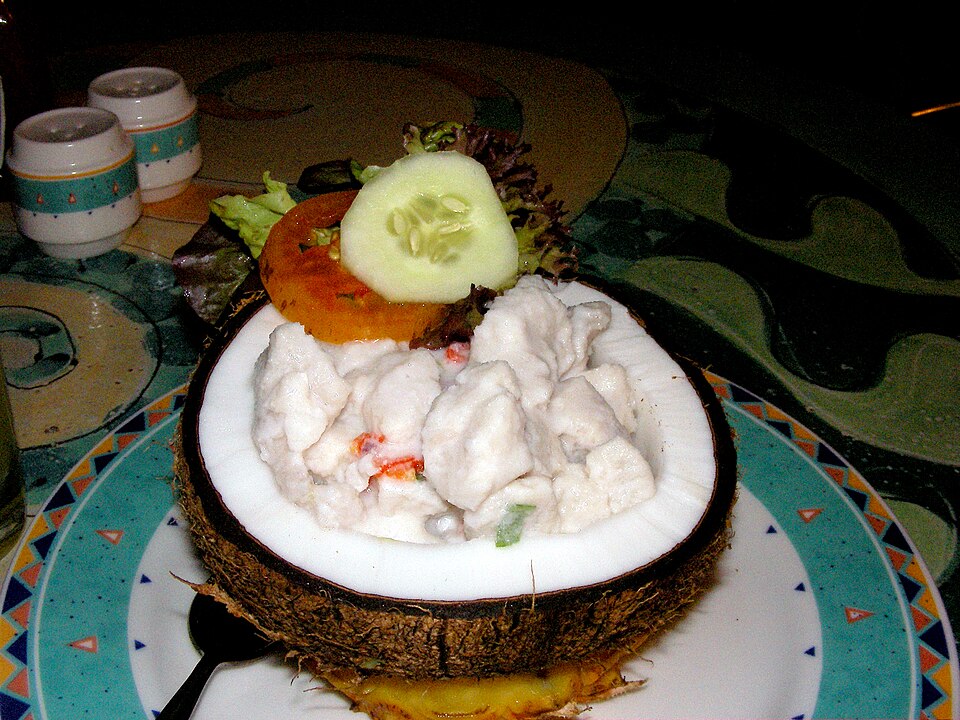
Kokoda in its coconut shell — raw fish cured in citrus, folded through coconut cream. From the World Cuisines Fiji collection.
Kokoda is a dish that depends entirely on the sea being clean and close, and Fiji’s sea is both. The reef flat at low tide is the pantry: fish, shellfish and seaweed gathered at the edge of the village, and the coconut palm above it supplies the cream, the shell and the spoon. The fish must be faultlessly fresh — kokoda has nowhere to hide a tired catch — which is why it is a feast dish and a test of the cook at once: the citrus must cure, not cook; the cream must coat, not drown; the chile must wake the palate, not burn it.
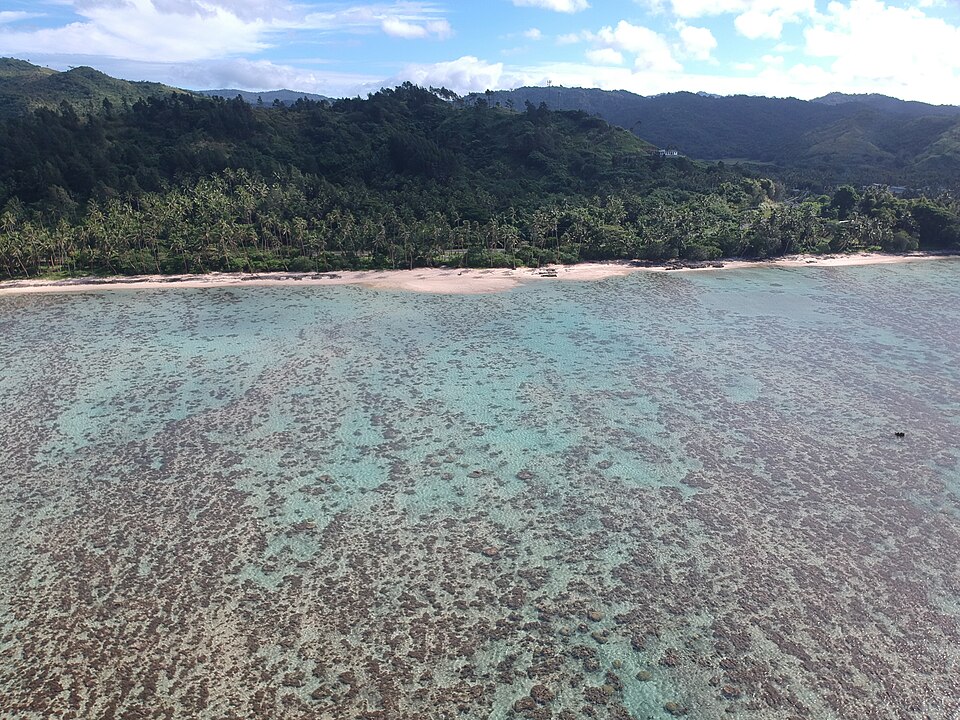
The reef flat at low tide off Votua Lalai — the shallow water where Fiji’s fish are caught. Photo: Wikimedia Commons.
The feast that kokoda opens is the lovo — the earth oven, Fiji’s feast engine for weddings and Sundays. Stones are heated in a pit; pork, chicken, palusami (taro leaves in coconut cream) and root crops — taro, cassava, sweet potato — are wrapped in leaves and laid over the stones; the pit is covered with leaves and earth and left for two or three hours; then it is uncovered and the food is served on woven mats. It is the Fijian umu, Polynesian earth-oven technology in Melanesian hands, and it is how a village feeds a hundred people from one hole in the ground.
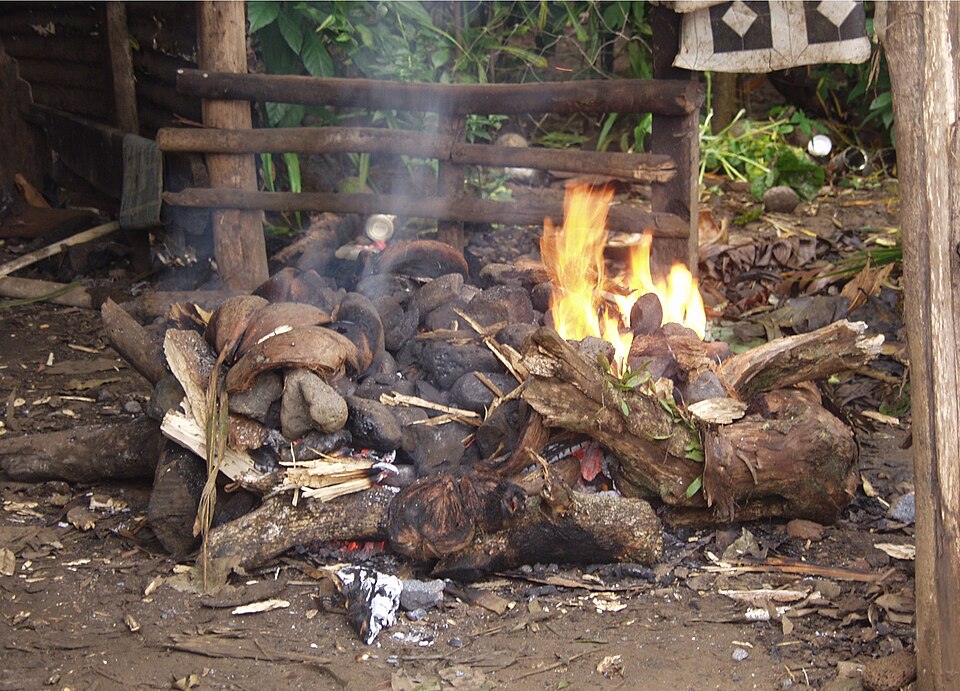
Stones heating for the lovo — the earth oven that is Fiji’s feast engine. From the World Cuisines Fiji collection.
Two more plates complete the Fijian table. Duruka is the wild asparagus — the unopened flower spikes of a wild cane, harvested in season, roughly April to June, and simmered in coconut milk or curried, sometimes with crab for the connoisseurs — a seasonal treasure of the wet zone whose short season makes it a celebration in itself. And the Fijian Indian curry is the other half of Fiji’s story: the heritage of the indentured labourers who arrived from India from 1879, five generations of hand-pounded masala — turmeric, cumin, coriander, mustard seed, fenugreek, curry leaves — simmered into chicken, goat or crab curries served with roti, distinct from any Indian original. Fiji is two kitchens that became one, and the Friday table holds both.
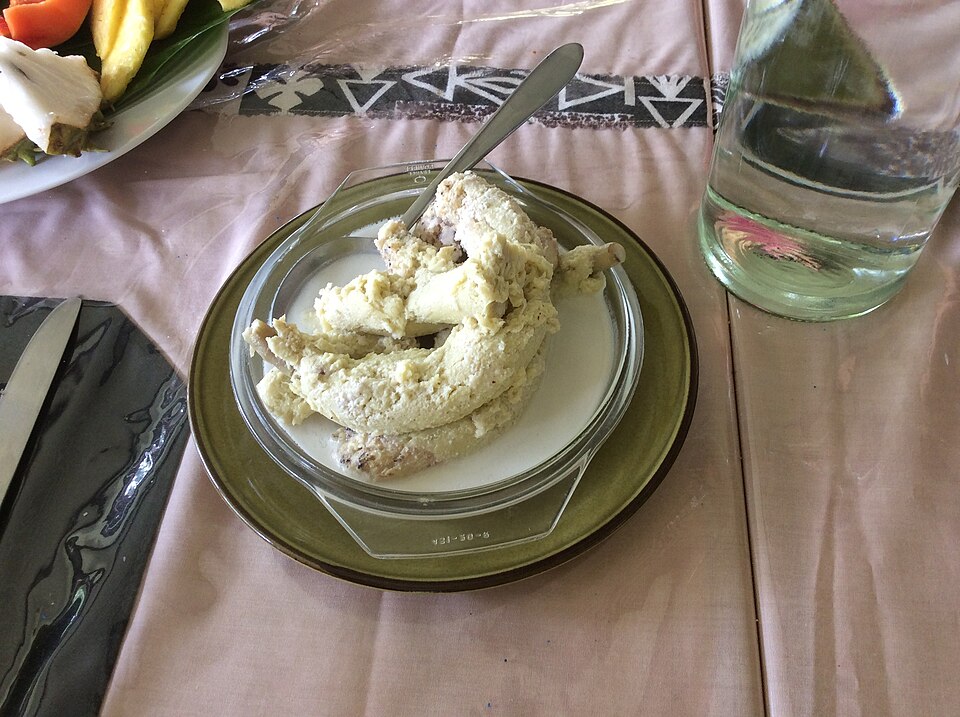
Duruka in coconut milk — the seasonal delicacy that only appears for a few weeks a year. From the World Cuisines Fiji collection.
Eat it like a Fijian: kokoda first, chilled, from the shell — then the lovo, eaten cross-legged on a mat, with your hands. Sunday is the lovo day in the villages; Friday is the kokoda day everywhere, because the fish is freshest at the end of the working week.
Raw, grilled, or baked in the earth — the Pacific never met a fish it wanted to hide. Fiji cures it in citrus, the Maldives chars it over husks, and both of them trust the sea to do the talking.
🇲🇹 Malta: pastizzi — the Friday that ends at the pastizzeria
Malta is the smallest country on today’s table and the one where Friday fish day is most visibly a Catholic institution. The islands — Malta and Gozo, a limestone rock in the middle of the Mediterranean — have been Catholic since St. Paul was shipwrecked there, so the story goes, in AD 60, and Friday abstinence shaped the Maltese week for centuries: the fish market at Marsaxlokk, the Friday lampuki season in autumn, the pastizzeria as the place where the day ends. Malta’s Friday is not a rule you remember. It is a queue you join.
The queue is for pastizzi — brittle, blistered pastry diamonds filled with ricotta or with curried mushy peas, eaten hot from every pastizzeria for a few cents. The dough is rolled and folded with fat, again and again, until it holds a thousand layers; the circles are cut, filled, pinched into the diamond with the seam on top, and baked at high heat until the pastry shatters. The ricotta version, with parsley and egg, is the classic; the pea version, curried and mashy, is the people’s favourite. They descend, the guide says, from Ottoman-Mediterranean börek currents — the same pastry family that runs from Istanbul to the Balkans — and the pastizzeria is Malta’s democratic clubhouse: everyone eats standing up, everyone pays cents, everyone is equal for the length of a pastizz.
Pastizzi, hot from the pastizzeria — blistered pastry diamonds filled with ricotta or curried peas. From the World Cuisines Malta collection.
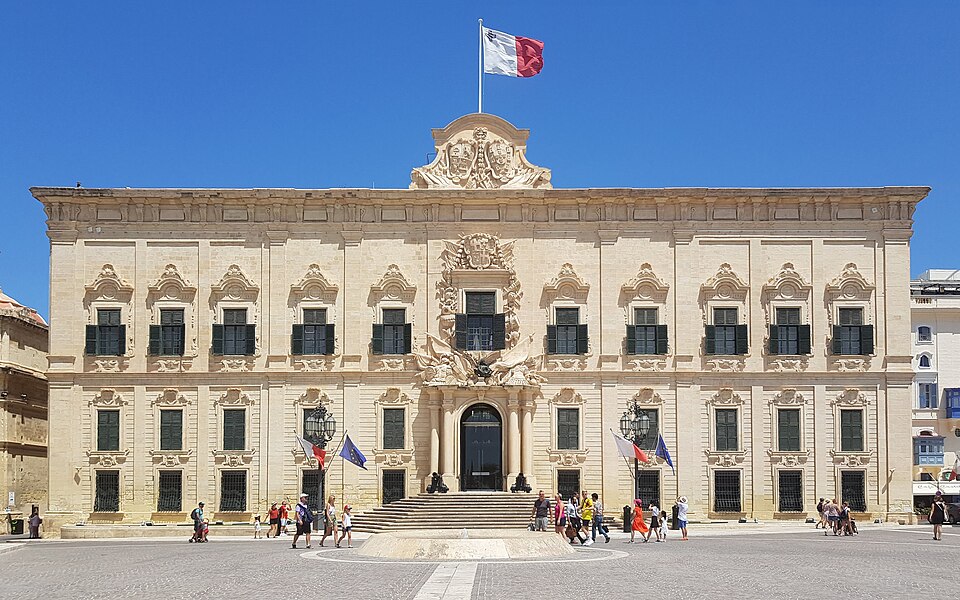
The Auberge de Castille, Valletta — the fortress-city the Knights of St John built after the Great Siege of 1565. Photo: Wikimedia Commons.
Malta’s table is a history lesson in layers, and every layer is still on the plate. The Knights of St John ruled the islands from 1530 to 1798, and Valletta — the fortress-city they built on the peninsula after the Great Siege of 1565, when 40,000 Ottoman troops failed to take it — is still the capital they laid out, a grid of limestone streets above the Grand Harbour. The Arabs ruled before them, from 870 to 1091, and left their mark in the language and in the sweets. The British ruled after, until independence on 21 September 1964, and left the tea that pastizzi are eaten with, in a glass, the Maltese way.
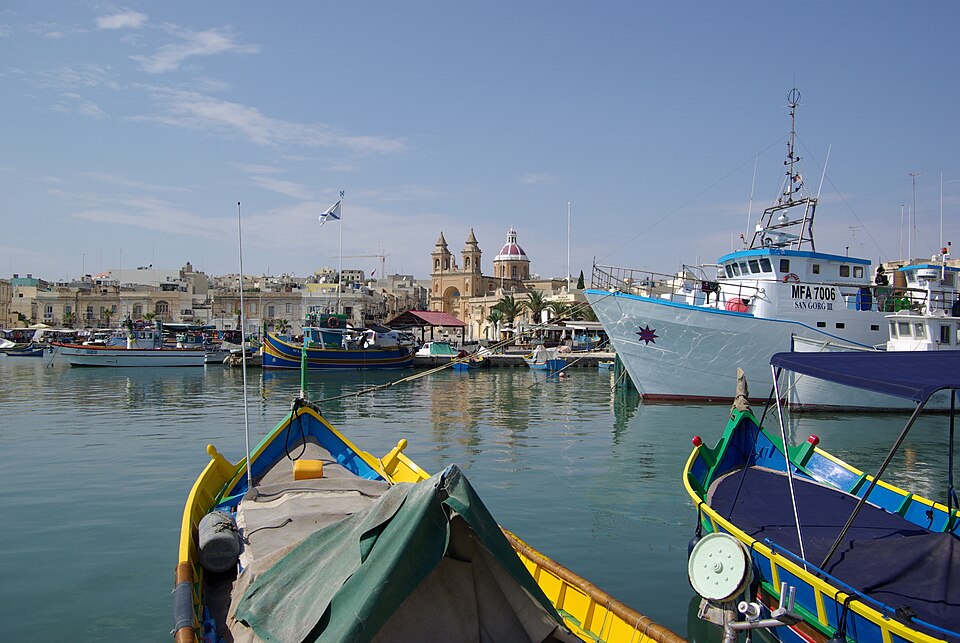
Luzzu boats at Marsaxlokk — painted in the colours of the catch, eyes on the prow watching for the fish. Photo: Wikimedia Commons.
The fishing village that feeds the Friday table is Marsaxlokk, on the south-east coast, where the painted luzzu boats still work — their prows carrying the painted eye, the Eye of Osiris, that has watched over Mediterranean fishermen since the Phoenicians. The Sunday fish market there is the island’s great food theatre, but the Friday catch is the working one: lampuki (dolphinfish) in autumn, tuna and swordfish through the summer, and the small fish that go into the soups and the ftira.
Around the pastizzi sits the rest of the Maltese feast. Fenkata, the rabbit stew, is the national dish: rabbit jointed and marinated in wine and garlic overnight, seared and braised with tomatoes, herbs and wine, peas and potatoes near the end — the sauce served first over spaghetti, the rabbit as the main, at long gatherings in farmhouse restaurants around Mġarr and Baħrija. Rabbit hunting was restricted under the Knights, which made the fenek a symbol of defiance; today it is Malta’s festive signature, and the fenkata night is the island’s great social institution.
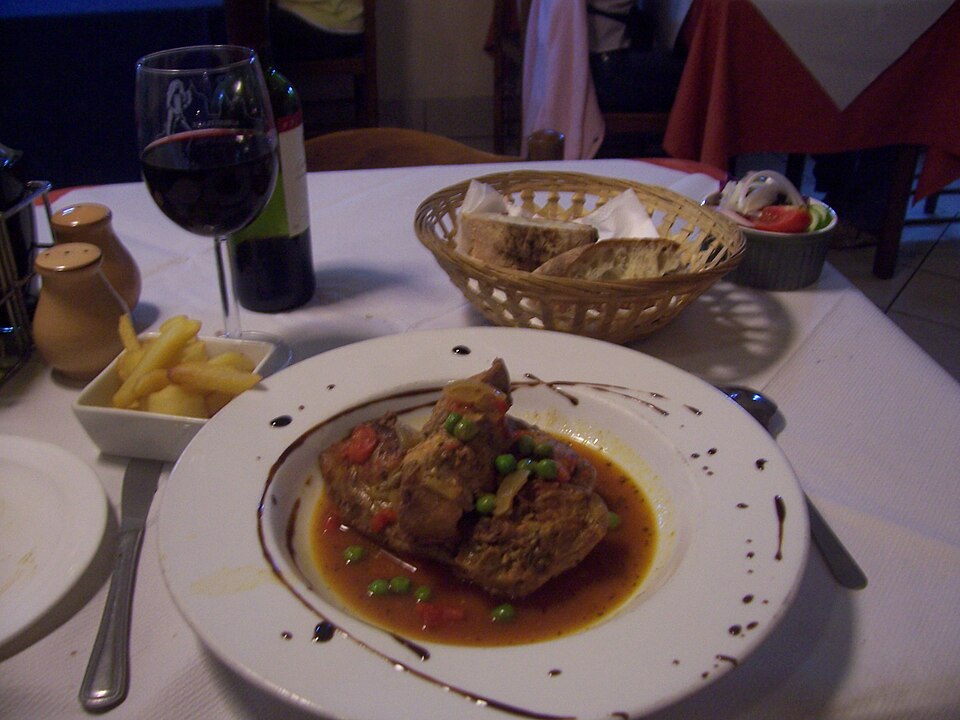
Fenkata — rabbit braised in wine and tomato, the centrepiece of a Maltese feast night. From the World Cuisines Malta collection.
Ħobż biż-żejt is the farmworker’s lunch perfected: crusty ħobż bread rubbed with ripe tomato until the crumb turns pink, drenched in olive oil, piled with capers, olives, tuna, white beans, onion and mint — the taste of a Maltese summer day, eaten at the beach, on boats, at village festas. The flat ftira version of the same bread was inscribed by UNESCO in 2020 as Il-Ftira, Malta’s culinary art and culture. And imqaret are the date diamonds: short pastry wrapped around spiced date paste, fried and eaten warm at Christmas and village festas — maqrut, diamond-shaped, carrying Malta’s Arab centuries in their very name.
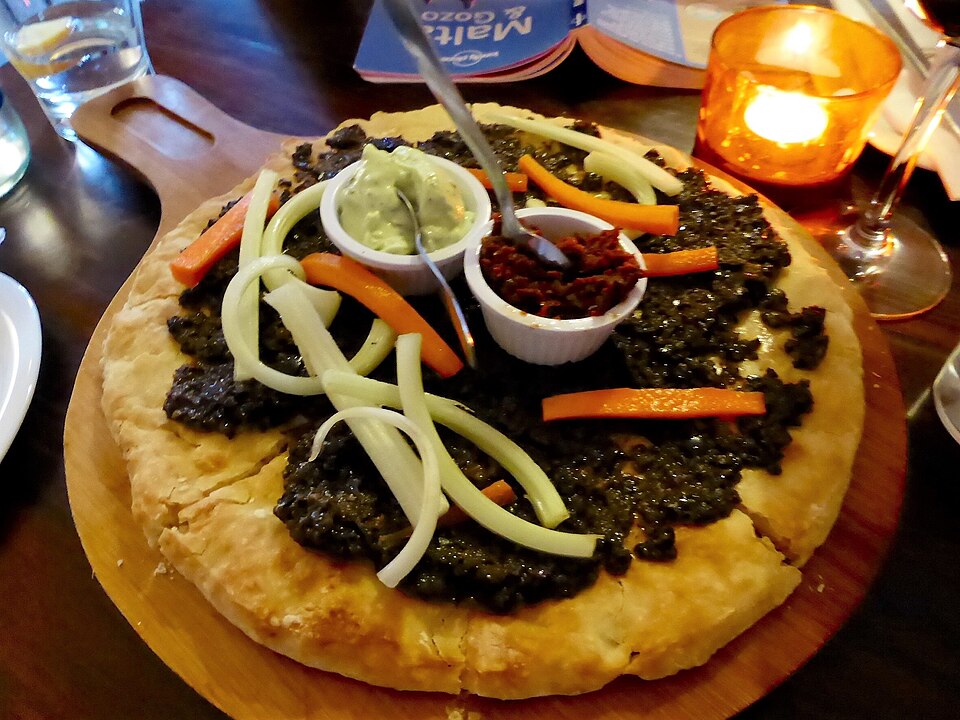
A ftira dressed the Maltese way — tomato, oil and the toppings of the day. From the World Cuisines Malta collection.
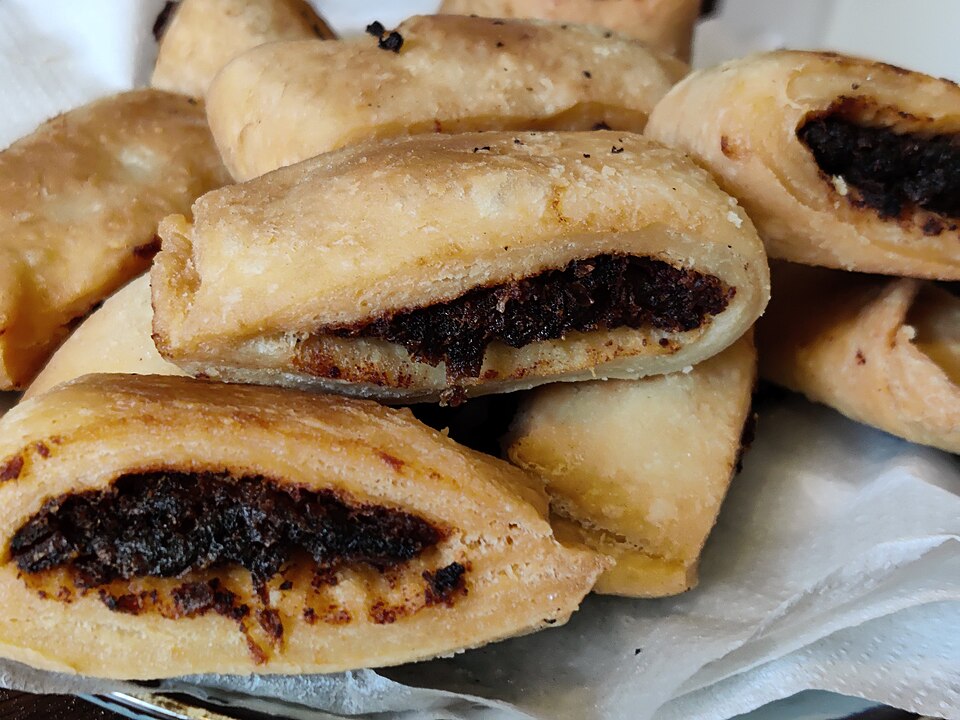
Imqaret, cut open — dark date paste inside crisp pastry, fried to order at festa stalls. From the World Cuisines Malta collection.
Eat it like a Maltese: pastizzi standing up at the counter, two of each filling, tea in a glass — and never one pastizz, because nobody in Malta has ever eaten one pastizz. On Friday, order the pea one first: it is the taste of the island’s working week.
The wider table: the raw-fish family and the cod that fed a continent
Three islands cannot hold the whole Friday story, and the guides do not ask them to. The raw-fish idea that Fiji calls kokoda runs right around the Pacific, and the World Cuisines guide keeps the whole family. In Samoa it is oka — fresh fish or octopus diced and dressed in coconut cream with onion, chile and cucumber — served at the umu, the Sunday feast. In Tonga it is ota ika, the same logic with Tonga’s hand. In Peru it is ceviche, the most famous raw fish in the world — fish cured in lime juice with red onion and chile, served with sweet potato and corn — a practice with pre-Inca roots that UNESCO inscribed on its Representative List of Intangible Cultural Heritage in December 2023. And in Japan it is sushi, the Edo-period art of raw fish over vinegared rice that began as street food in nineteenth-century Tokyo and became the world’s shorthand for eating the sea raw.
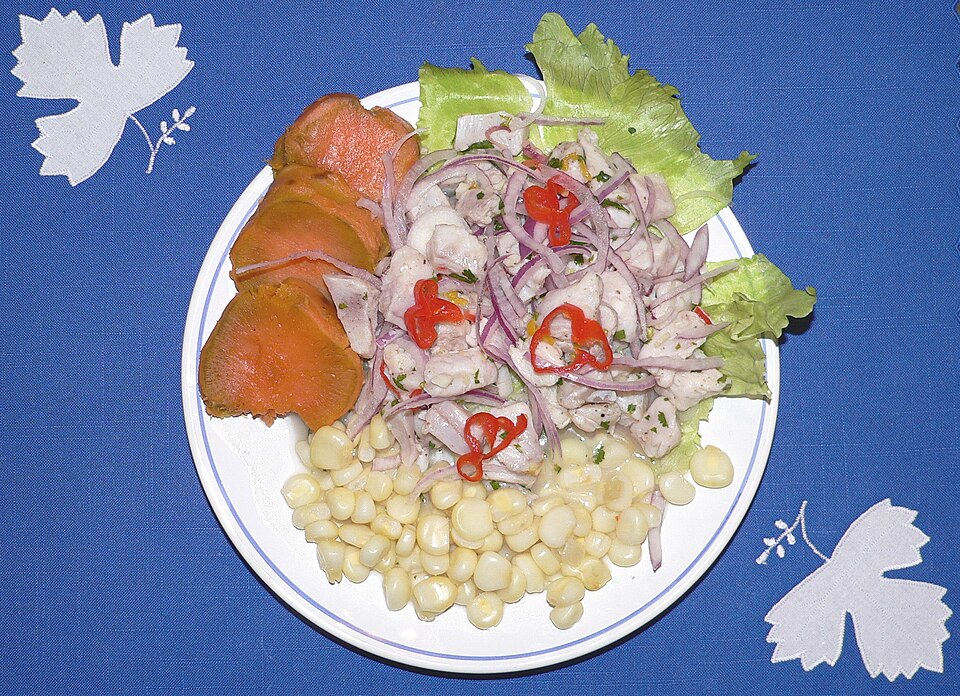
Peruvian ceviche — raw fish cured in lime, the Pacific’s other answer to kokoda, with sweet potato and corn. Photo: Wikimedia Commons.
The other Friday tradition is the one that fed the continent: salt cod. Portugal’s bacalhau à brás — salt cod shredded and scrambled with matchstick potatoes, egg and onion — is the Lisbon answer to the Friday rule, and the Portugal collection keeps it beside caldo verde, the green kale soup, and pastéis de nata, the custard tarts that end every Portuguese meal worth remembering. The Portuguese say there are 365 ways to cook bacalhau, one for every day of the year — a saying, not a census, but the cod trade that fed it is real enough: dried and salted in the North Atlantic since the fifteenth century, it kept for months without ice, crossed oceans in barrels, and became the protein of Catholic Fridays from Lisbon to Luanda to San Juan.
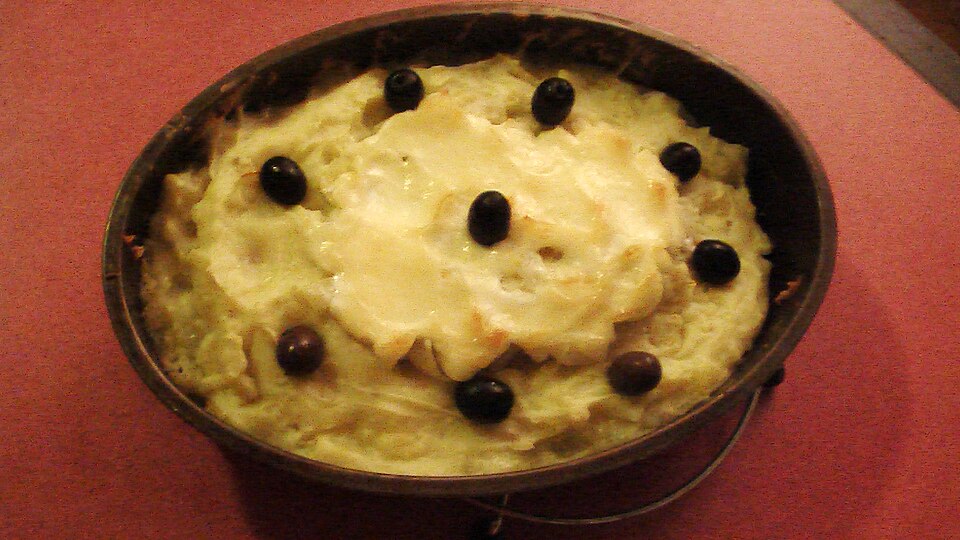
Bacalhau Zé do Pipo — baked salt cod under mashed potato, the Lisbon tavern classic. Photo: Wikimedia Commons.
The sour soups belong here too. The Philippines collection keeps sinigang, the tamarind-soured soup that is the Filipino Friday table’s answer to a rich week — fish or prawns in a broth that wakes the whole mouth. Thailand answers with tom yum goong, the hot-sour prawn soup, from the Thailand collection. Senegal’s thieboudienne — broken rice cooked in a rich tomato-fish broth, served on a great platter around the fish — was inscribed by UNESCO in 2021, and the Senegal collection keeps it as the national masterpiece it is. Brazil’s moqueca, the coconut-milk fish stew of Bahia, closes the circle: the Atlantic’s answer to the Pacific’s raw fish, cooked in a clay pot with peppers, cilantro and lime. Spain’s paella valenciana — from the Spain collection — is the Friday pan when the week has gone well: saffron rice, seafood, and a table full of people who stayed for the socarrat.
One rule, a hundred answers. The fast said no meat; the islands said yes to everything the sea offers — raw in lime, charred over husks, folded into pastry, dried in salt and brought back to life in a pan.
From a Friday table to your city’s table
The Holiday Table travels all season — and when a feast makes you hungry for a restaurant table instead of a history lesson, the CallPages restaurant guides carry the same dish-by-dish honesty to the cities we track, every menu with its real prices: Paris, Rome, Madrid, San Francisco and New York. Ask for the Friday fish wherever you land — the grilled whole fish, the raw fish in citrus, the salt cod in a pan — and judge the kitchen by how seriously it takes the day the meat leaves the table.
The season ahead
That is day three — the Friday fish table, served from the Mediterranean to the Pacific. Ahead of us: the Diwali season close tomorrow, the British Sunday roast, Thanksgiving on November 26, the December feasts — St. Nicholas, St. Lucia, Las Posadas, Nochebuena, Christmas tables from four continents — then New Year as a dozen cultures eat it, Three Kings on January 6, Orthodox Christmas, Lunar New Year and Carnival, all the way to February 20. Every day, one feast and the dishes that carry it, each one already waiting in the guides:
- World Cuisines — 781 dishes, 199 country collections, each dish with its origin, ingredients and history.
- World Spirits — 266 drinks, from the lagers of Luanda to the bottles opened at New Year.
- ¿Lees en español? Esta misma mesa está servida en español: Viernes de pescado: la mesa del Mediterráneo al Pacífico.
And keeping the night watch over the whole season — while the fish grills from Malé to Marsaxlokk, our own host works the dark hours:

Your host for the season: the Múcaro, Puerto Rico’s night owl, in CallPages acid colours. He keeps the night watch while the fish grills.
Tomorrow, the table closes the Diwali season. Bring an appetite.
How it works
- Every featured dish comes from the CallPages World Cuisines guide — 781 dishes with their origins, ingredients and histories — linked dish by dish below.
- Holiday dates and customs are verified against published sources for the 2026–27 season; legends are labelled as legends.
- The Holiday Table runs daily from November 11, 2026 to February 20, 2027: one feast, one culture (or several), one story per day, through Thanksgiving, the December feasts, New Year, Three Kings, Lunar New Year and Carnival.
Related reading
Innovation by Vasily Starostenko, founder of CallPages.
Create your call page
Turn your website visitors into phone conversations — set up in under two minutes.
Create your call page →