
Diwali fell on Sunday, 8 November 2026, and the festival week runs to Bhai Dooj on Wednesday 11 November — so this Saturday is the season's last great table. The Indian festival table is built on three dishes: samosa, the crisp triangle that travelled a thousand years to Delhi; masala dosa, South India's fermented crepe; and biryani, the sealed dum pot of the Mughal courts.
Diwali is the world's most famous festival of light — and the most reduced to a single image of lamps. Behind the lamps is a week of cooking that most of the world never tastes: the snacks fried for guests, the breakfasts cooked for family, and the great sealed pot opened at the table. This is that cooking, dish by dish.
# Diwali season close: the Indian festival table — samosa, masala dosa and biryani
The lamps went out on Sunday night. On Sunday, 8 November 2026, the main day of Diwali — Lakshmi Puja, the new-moon night of Kartik — tens of millions of homes across India and the diaspora lit their diyas, and the festival of lights reached its brightest hour. But Diwali is not a single night, and it does not end when the last lamp gutters. The festival week runs on to Bhai Dooj on Wednesday, 11 November, the day brothers and sisters mark their bond — and in between, the cooking goes on. The sweets are still being boxed, the guests are still arriving, and the table is still full.
This is day four of The Holiday Table — our daily feast from November 11 to February 20, drawn from the World Cuisines guide (781 dishes) and the World Spirits guide (266 drinks). We opened the season with St. Martin's goose feast, ate at Angola's freedom table, and yesterday we kept Friday fish day from the Mediterranean to the Pacific. Today the table turns east, to the festival that lights up the darkest night of the year — and to the three dishes that carry it: the samosa, the masala dosa, and the biryani.
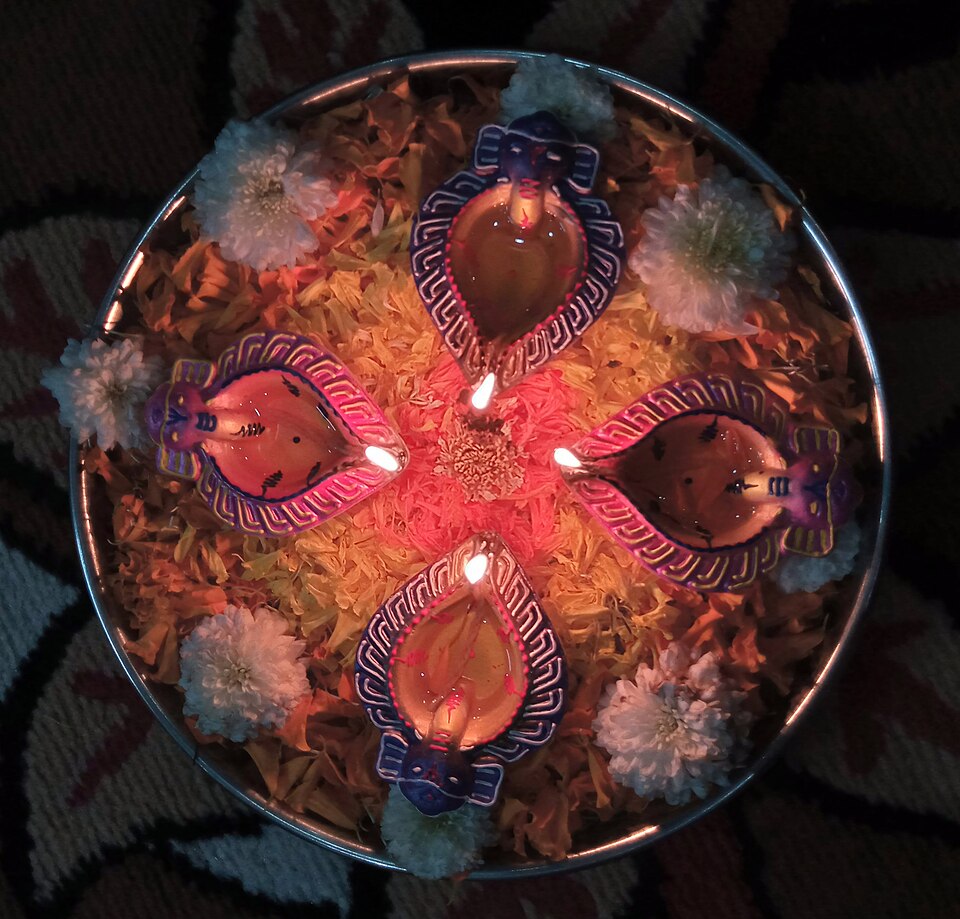
The diya — the small clay lamp that gives Diwali its name: Deepavali, the row of lamps. Photo: Wikimedia Commons.
Diwali: five days of light, and the week that follows
Diwali — Deepavali, from the Sanskrit for "row of lamps" — is the biggest festival of the Hindu calendar, and one of the most widely celebrated festivals on earth, kept by Hindu, Jain, Sikh and some Buddhist communities from Delhi to Durban, Leicester to Singapore. The date follows the moon, so it moves every year: the main day always falls on the new moon — amavasya — of the month of Kartik, the darkest night of the year. In 2026 the main day fell on Sunday, 8 November, with the Lakshmi Puja muhurat in New Delhi running from 5:54 PM to 7:50 PM (Drik Panchang, via The Economic Times). The whole festival runs five days, and this year the lunar calendar stretched it to six observances, from Dhanteras on Friday, 6 November — the day for buying gold and new utensils — through Naraka Chaturdashi and the main Lakshmi Puja on Sunday, 8 November, to Govardhan Puja on Tuesday, 10 November and Bhai Dooj on Wednesday, 11 November. (A note for the careful: some regional panchangs keep Govardhan Puja on Monday, 9 November — the lunar tithi straddles the two days, and families follow their own almanac.)
Why the lights? The stories differ by faith and region, and they are legends, told and retold for centuries — which is exactly why they matter. In the north, the lamps welcome Rama, Sita and Lakshmana home to Ayodhya after fourteen years of exile and the defeat of Ravana, as the Ramayana tells it; the people lit rows of lamps to guide them through the dark, and the festival took its name from those rows. In the south, the same night celebrates Krishna's defeat of the demon Narakasura. The evening's puja honours Lakshmi, goddess of prosperity, and Ganesha, remover of obstacles — the home is cleaned, the doorway is drawn with rangoli, and the lamps are set out to show the goddess the way in. Jains mark the night as the nirvana of Mahavira; Sikhs keep it as Bandi Chhor Divas, the day Guru Hargobind was released from imprisonment. One night, four faiths, one idea: light wins, and it wins in public, on every doorstep at once.
A festival that is also a census of light. In 2026, Ayodhya — the city of the Rama legend — lit more than 3 million earthen lamps along the ghats of the Saryu river for its Deepotsav on 7 November, the night before Diwali. The 2025 display set a Guinness World Record at 2.62 million lamps; the 2024 count, confirmed by a Guinness adjudicator, was 2,512,585.
The scale is the point. Diwali is not a private holiday. The whole street lights at once — the diyas in the windows, the rangoli on the thresholds, the fireworks over the rooftops — and the whole street eats at once. That is where this article lives: not in the theology, but in the kitchen that feeds the week. And the newest chapter of the story was written only weeks before this Diwali: on 10 December 2025, Deepavali was inscribed on UNESCO's Representative List of the Intangible Cultural Heritage of Humanity, at the 20th session of the Intergovernmental Committee held at the Red Fort in Delhi — India's sixteenth element on the list, joining the Kumbh Mela, Durga Puja of Kolkata, Garba of Gujarat, yoga and Ramlila. The lamps, the sweets, the rangoli and the cooking are now, officially, heritage of humanity.
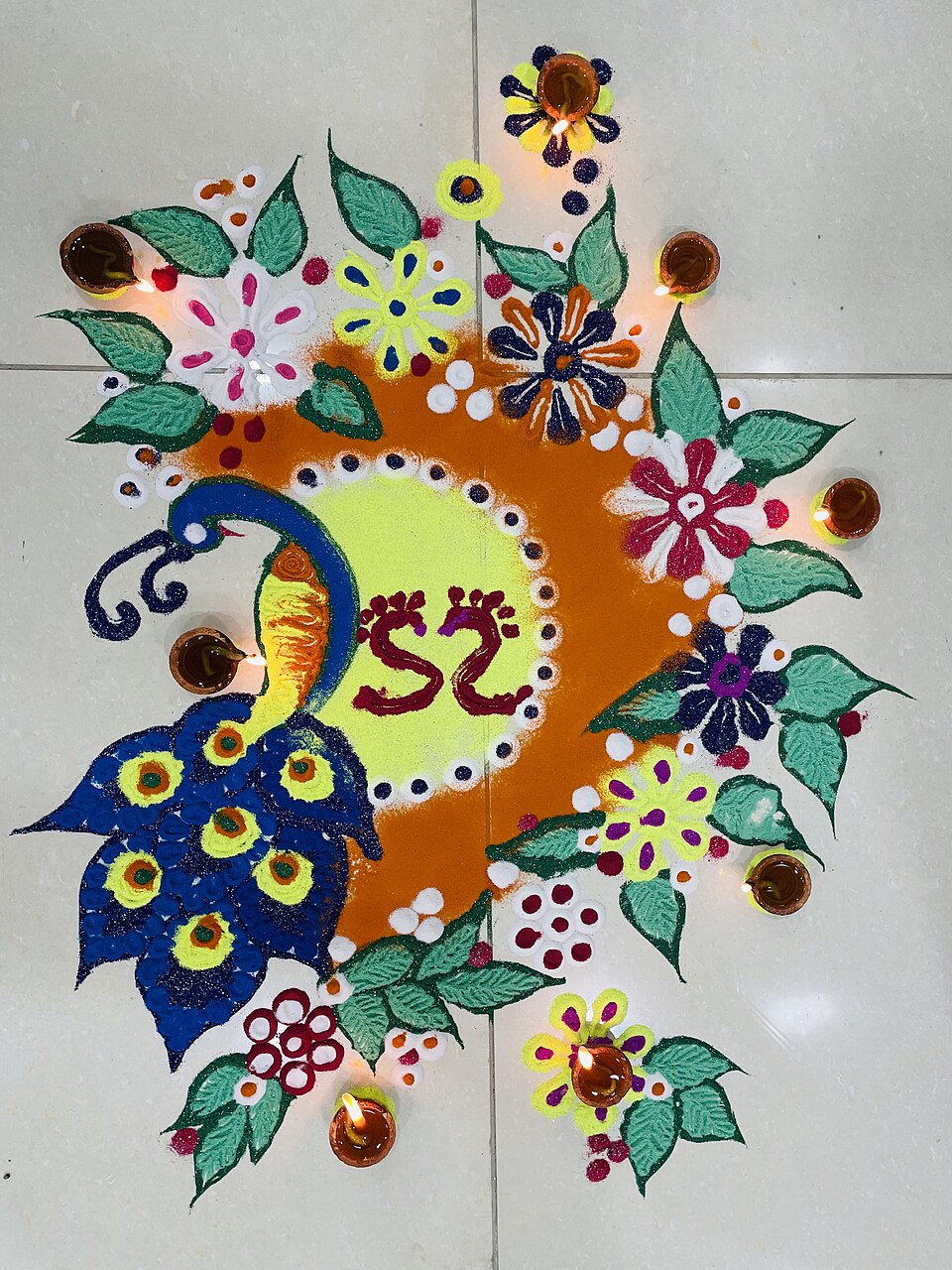
A peacock rangoli in coloured powders, ringed with diyas — the threshold art that welcomes Lakshmi into the home. Photo: Wikimedia Commons.
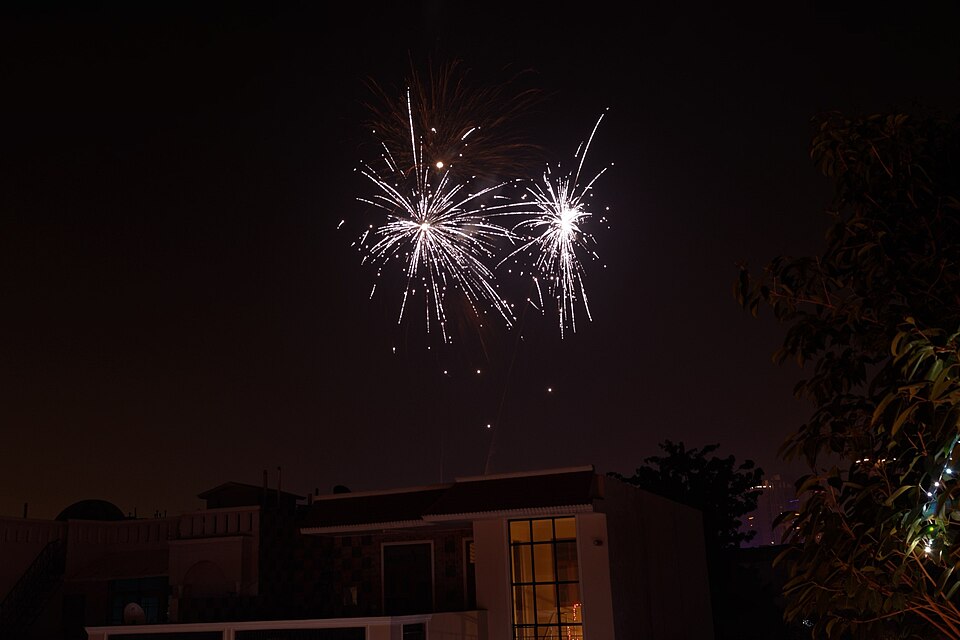
Fireworks over Gurgaon on Diwali night — the loud half of the festival, after the lamps are lit. Photo: Wikimedia Commons.
The Indian festival table, at a glance
Three featured dishes, one country, one festival week. Here is the whole table on one card — every plate gets its full story in the chapters that follow, and every dish links straight into the guides.
- Samosa — A crisp golden triangle of flaky pastry around spiced potato and peas, fried and eaten with chutneys — Tamarind and mint chutneys, and a cup of masala chai — India collection
- Masala Dosa — A lacy fermented rice-and-lentil crepe, crisped on a tawa and folded over spiced potato masala — Coconut chutney and hot sambar, for dipping — India collection
- Biryani — Fragrant layered rice and marinated meat, sealed and slow-steamed so saffron, mint and fried onion perfume every grain — Raita and salad, the layers revealed at the table — India collection
🇮🇳 Samosa — the triangle that travelled a thousand years
If one snack could stand for the whole of India, it would be the samosa — the crisp golden triangle, flaky pastry folded around spiced potatoes and peas (or minced meat), fried and eaten with chutneys across half the world. It is the first thing offered to a guest at Diwali, and the last thing anyone refuses. The samosa is not a festival dish by design. It is a festival dish by destiny: it is cheap, it is fried in batches of dozens, it travels well, it is eaten standing up with your hands, and it makes a room full of people happy within minutes of the oil heating. Every Diwali gathering in India has a plate of them somewhere, going cold only because nobody lets them sit.
The samosa is also the oldest dish on today's table, and the most travelled. It comes from the sambusak of Central Asia and Persia, carried to India by traders a thousand years ago and praised in Mughal court chronicles — a pastry that began as a portable meal for merchants and soldiers on the trade routes and became, in India, the subcontinent's great snack. The guide's recipe is the classic: rub fat into flour for a stiff, flaky dough and rest it; temper the spices, add boiled potato and peas, and cool the filling; roll ovals, halve them, form cones, fill and seal with water; fry low and slow first for the blisters, then hotter to finish golden. Serve hot with both chutneys — tamarind, dark and sour-sweet, and mint, bright and green — and a cup of chai. The flavour is warm spice, tangy chutney, shattering crust.
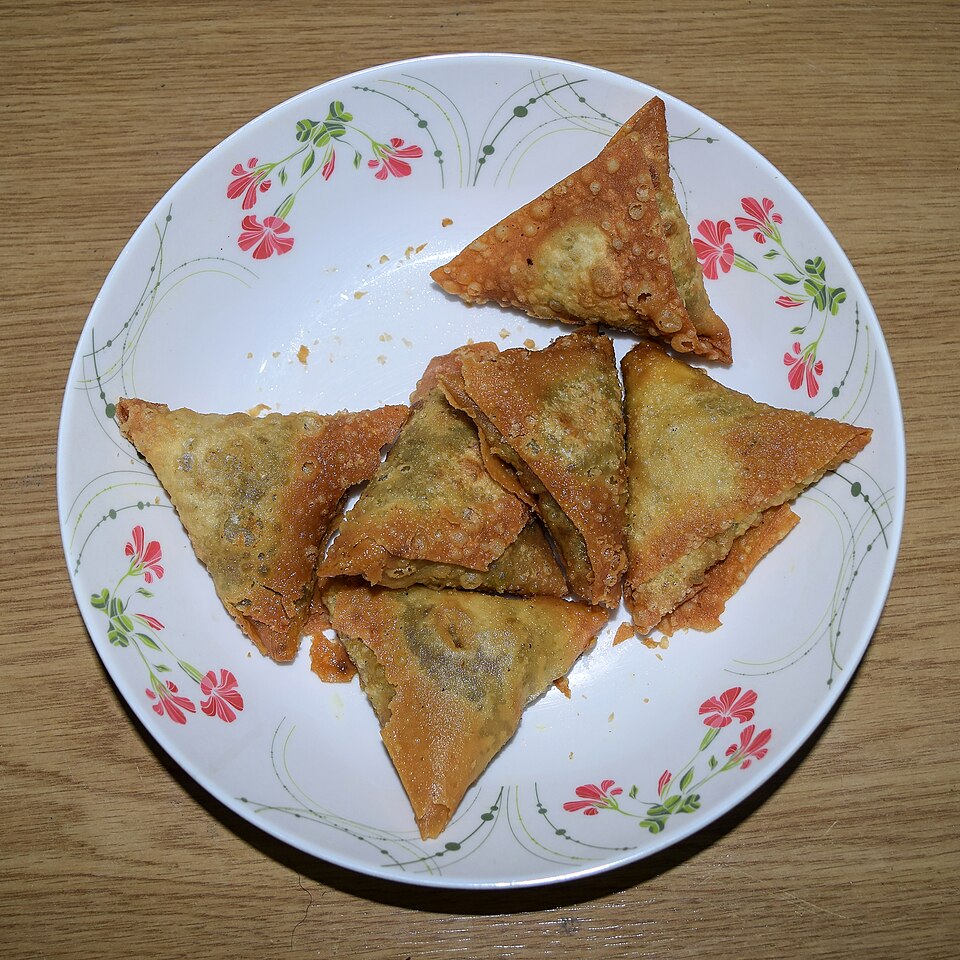
Samosas, golden and blistered — the crisp triangle that travelled a thousand years to reach the Diwali table. From the World Cuisines India collection.
What makes the samosa a Diwali dish is not its origin but its manners. Diwali is a festival of visiting: neighbours drop in, cousins arrive unannounced, the door stays open and the sweets go out. A host needs food that can be made ahead, fried in minutes, and eaten without a plate or a chair. The samosa is exactly that — and it is also the dish that crosses every line in India: Hindu, Muslim, Jain and Sikh tables all serve it, in vegetarian and meat versions, from Delhi's street carts to the sweet shops of Chennai. In the week of Diwali it is fried by the thousand in the halwai shops and home kitchens alike, and the only argument it ever starts is which chutney it belongs with. The answer, everywhere, is both.
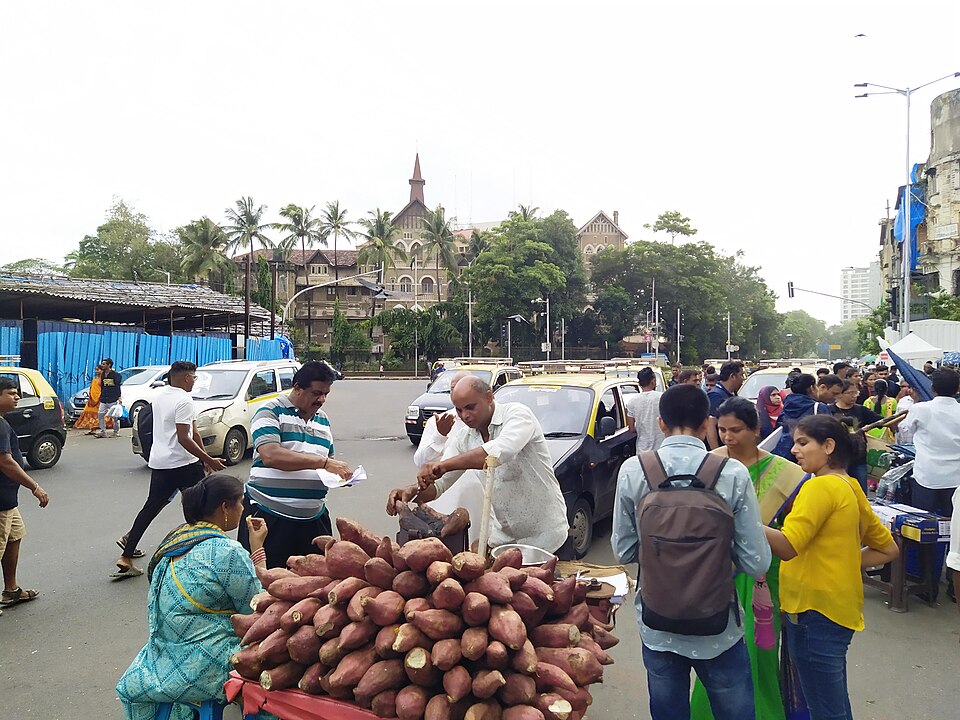
A street vendor's cart in Kalbadevi, Mumbai — the city's festival crowds eat standing up, straight off the cart. Photo: Wikimedia Commons.
Eat it like a Delhite: hot, in your hand, torn open so the steam escapes, both chutneys on the same bite — and never one samosa, because nobody in India has ever eaten one samosa. At Diwali, the plate is refilled before it is empty.
🇮🇳 Masala Dosa — the temple crepe that conquered the world
If the samosa is the guest's snack, the masala dosa is the family's breakfast — and the most technically demanding dish on the Diwali table. South India's great crepe: a lacy, fermented rice-and-lentil dosa crisped on a tawa, wrapped around spiced potato masala, with coconut chutney and sambar for dipping. It is eaten at Diwali not because the festival demands it, but because the festival week is a week of family mornings — cousins sleeping over, grandparents in the kitchen, a house full of people who need feeding before the day's visiting begins. The dosa feeds them all, one crisp crepe at a time, straight off the hot iron.
The dosa's history is temple history. It comes from the temple kitchens of Karnataka and Tamil Nadu, where fermented rice-and-lentil batter was a sacred food long before it was a restaurant one, and it was popularised across India in the twentieth century by the Udupi restaurants — the vegetarian canteens founded by cooks from the temple town of Udupi, who carried the dosa to every Indian city and then to the world. The method is the whole dish: soak rice and urad dal, grind to a batter and ferment overnight until it bubbles; temper mustard seeds and curry leaves and make the yellow potato masala; ladle the batter in a spiral onto a screaming-hot tawa, drizzle ghee, and cook until crisp — never flip; fold it over the potato filling. The flavour is tangy, crisp, buttery, the potato warm with turmeric and chile. Served with coconut chutney and hot sambar for dipping, on a banana leaf when the occasion is right.
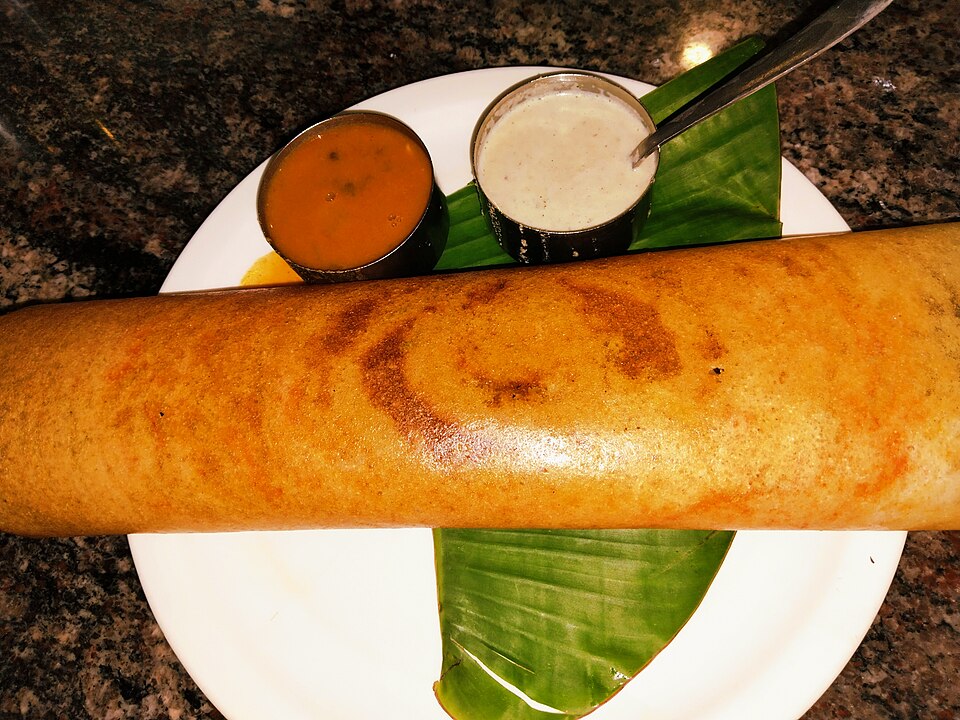
Masala dosa, rolled and crisp, with sambar and coconut chutney — South India's great crepe. From the World Cuisines India collection.
The dosa is the quiet proof of how deep Indian cooking runs. Fermentation is one of the oldest food technologies on earth, and the dosa's batter — rice and lentil, ground, left overnight to sour and rise — is a piece of biotechnology older than the festival it is served at. The tawa is the other half: a flat iron griddle so hot that the batter sets in seconds, lacy at the edges, golden in the middle, crisp enough to shatter and tender enough to fold. No oven, no yeast, no wheat — just time, heat and a cook's wrist. At Diwali, when the house is full and the mornings are long, the dosa is the dish that turns a crowd into a family: everyone waits for their turn at the tawa, and everyone eats standing by the stove.
The dosa is a temple dish that became a street dish that became a world dish. From the temple kitchens of Karnataka and Tamil Nadu, carried by Udupi restaurants across India in the twentieth century, it is now cooked in more countries than the samosa — and it still takes an overnight ferment to make it right.
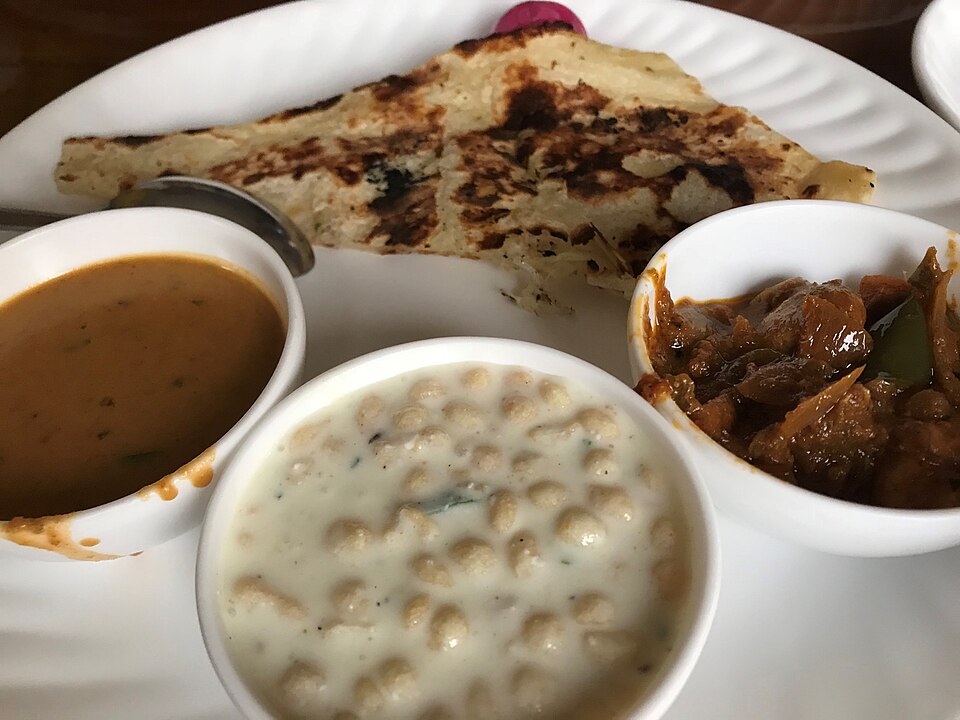
A North Indian vegetarian thali — the whole meal on one plate, the way a festival lunch is served. Photo: Wikimedia Commons.
Eat it like a Bangalorean: with your hands, torn from the crisp end first, dipped in sambar — never with a knife, because the dosa is a hand food and the tawa is its table. And order it "family style" at Diwali: one after another, hot off the iron, until nobody can eat another.
🇮🇳 Biryani — the sealed pot that opens at the table
Every festival needs a centrepiece, and the biryani is Diwali's. Fragrant layered rice and marinated meat, sealed and slow-steamed so saffron, mint and fried onion perfume every grain. It is the big gathering dish — the one cooked for twenty people when the samosa fed them at the door and the dosa fed them at breakfast. The biryani is cooked in a handi, a deep pot, and the whole performance is in the sealing: the meat is marinated in yogurt and spices; the rice is parboiled with whole spices; the two are layered with saffron milk, mint, cilantro and fried onions; the pot is sealed — traditionally with a ring of dough — and dum-cooked on low heat for forty minutes. Then the seal is broken at the table, and the steam comes out carrying the whole meal at once. Serve with raita and salad, the layers revealed at the table.
Biryani's history is court history. It comes from Persian pilaf traditions via the Mughal courts, and Hyderabad and Lucknow guard rival, beloved versions — the Hyderabadi kacchi style, raw marinated meat layered with rice and sealed to cook in its own juices, against the Lucknowi pukki style, meat and rice cooked separately and layered. The argument between the two cities is one of India's great friendly feuds, and it has never been settled, because it cannot be: the dish belongs to both, and to every city that adopted it. The biryani is also the dish that proves Indian cooking is a geography, not a recipe — the same name, a different pot in every city, and every city certain that its own is the real one.
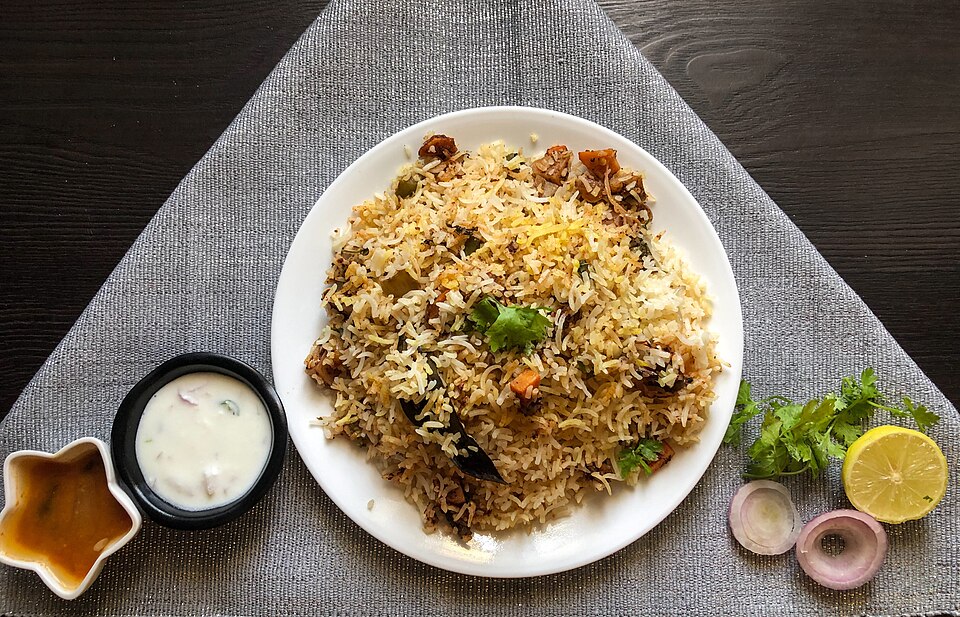
Hyderabadi dum biryani with raita — layered rice sealed and slow-steamed, opened at the table. From the World Cuisines India collection.
The biryani family runs far beyond India, and the World Cuisines guide keeps the whole clan. In Dhaka it is Kacchi Biryani — the wedding biryani of the Bangladesh collection, raw marinated mutton layered with fragrant kalijira rice and sealed to steam in its own juices; kacchi means "raw", and the courage is the point. In Karachi it is Sindhi Biryani — from the Pakistan collection, layered rice and masala with potatoes, dried plums and a chile heat that Sindh is proud of, the spiciest of the great biryanis. And in Mauritius it is Biryani (Mauritian) — from the Mauritius collection, fragrant layered rice with beef, chicken or fish, potatoes and fried onions, cooked in great deg pots for weddings and Eid. One pot, three countries, one rule: seal it, steam it, open it at the table, and let the room go quiet for the smell.
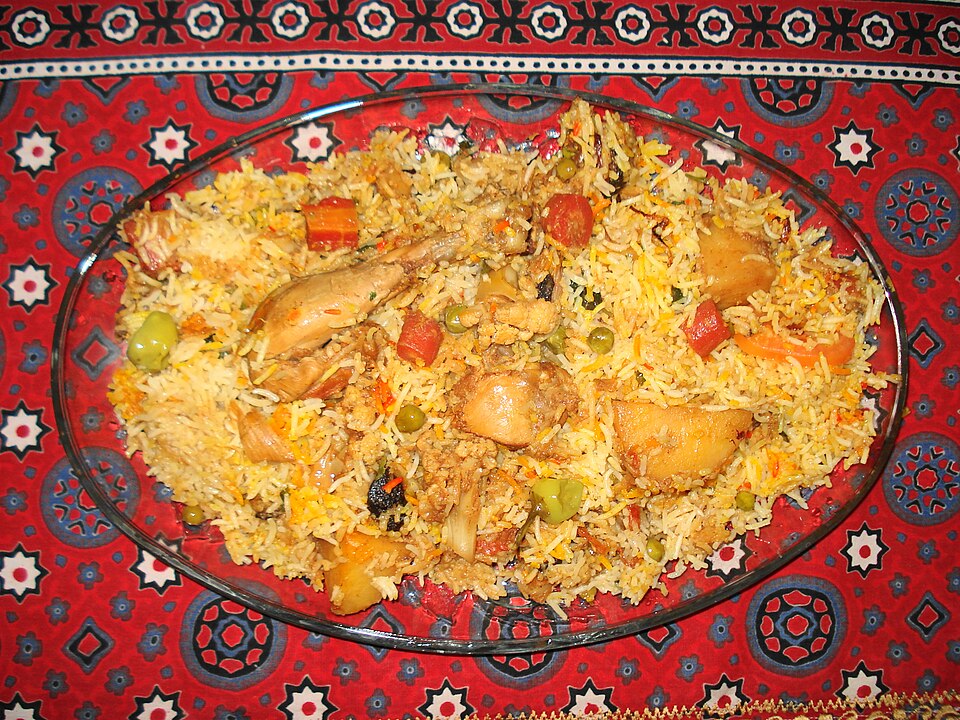
Sindhi biryani — Karachi's fiery answer, with potatoes and dried plums, served on Sindhi cloth. From the World Cuisines Pakistan collection.
Eat it like a Hyderabadi: from the pot, not the plate — the layers are the point, and the cook who breaks the seal is the host of the evening. Raita on the side, not on top; lemon squeezed at the table; and a second helping before the pot is empty, because a biryani pot empties fast at Diwali.
The rest of the table: butter chicken, palak paneer, and the bread that carries them
Three dishes do not make a festival, and the India collection keeps two more that belong on any Diwali table. Butter Chicken is Delhi's world-famous curry: tandoor-cooked chicken folded into a silky tomato-butter sauce, mellowed with cream — invented in the 1950s at Moti Mahal in Delhi, when leftover tandoori chicken was simmered in a tomato-butter gravy, and now the most internationally recognised emblem of Indian cooking. The guide's method is the original: marinate the chicken in yogurt, spices and ginger-garlic; grill or roast until charred; simmer tomatoes with butter and spices and blend smooth; strain, return to the pan, add cream and crushed kasuri methi — dried fenugreek; add the chicken and simmer briefly. Serve with naan or basmati rice. It is the dish that turns a festival dinner into a restaurant night, and the one every guest asks for by name.
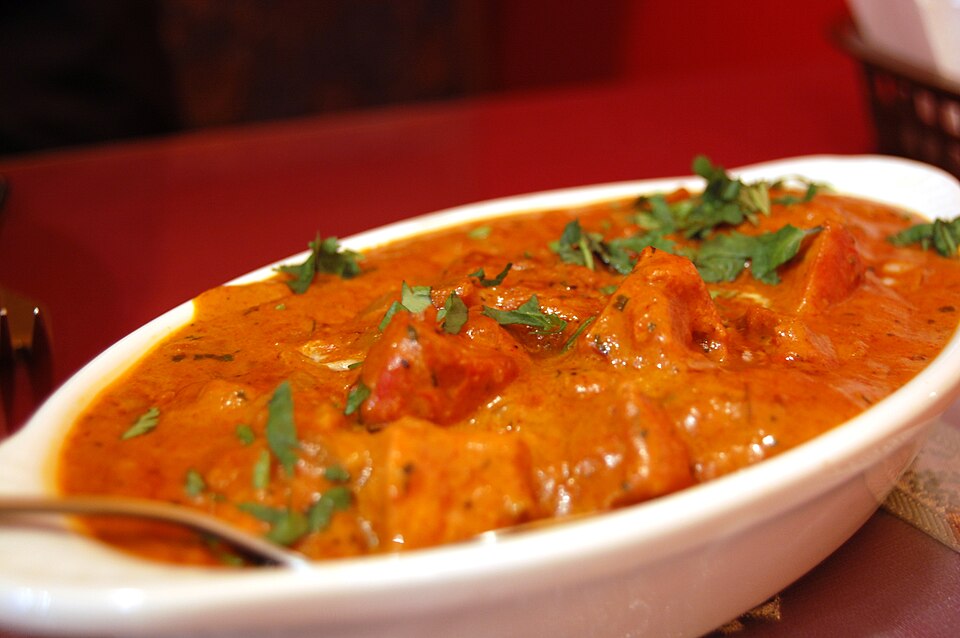
Butter chicken — Delhi's world-famous curry, invented in the 1950s from leftover tandoori chicken. Photo: Wikimedia Commons.
Palak Paneer is the quiet counterpart: a vivid green spinach curry studded with soft paneer cubes, gently spiced and finished with cream — a Punjabi vegetarian classic, the comfort counterpart to the region's meat curries. Blanch the spinach, blend it smooth with green chile; fry onion, ginger and garlic, add tomato and spices; stir in the spinach purée and simmer ten minutes; add the paneer cubes and a swirl of cream. Serve with naan, roti or rice. At a festival table that runs heavy on fried snacks and rich rice, palak paneer is the green balance — and for the many families that keep Diwali vegetarian, it is the main event, not the side.
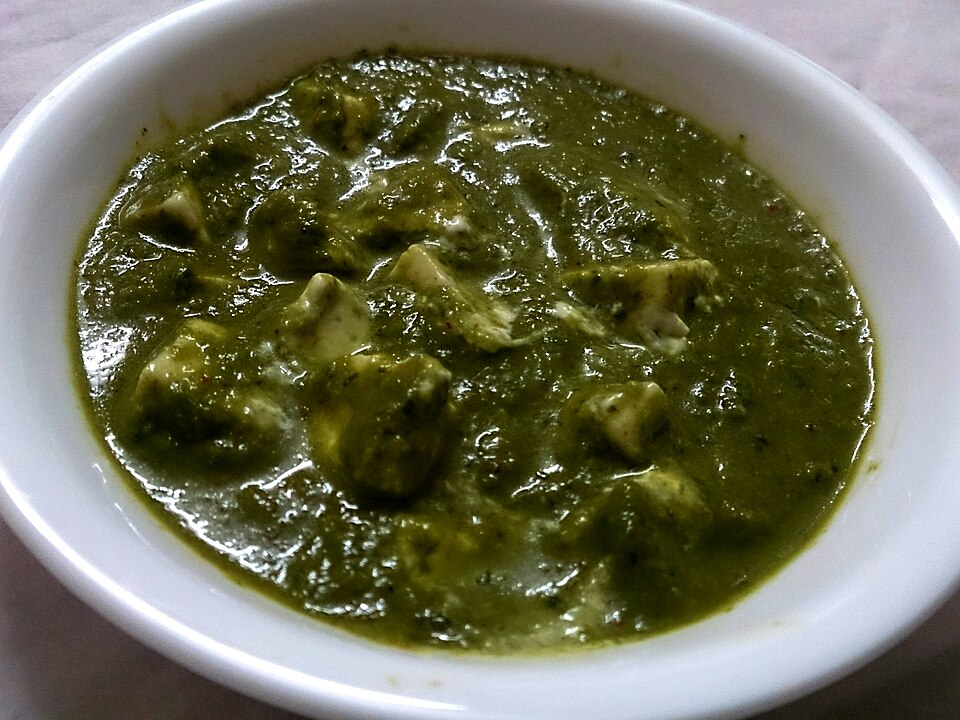
Palak paneer — spinach and soft paneer, the Punjabi vegetarian classic. Photo: Wikimedia Commons.
And the bread that carries them both comes out of the same fire. Naan is slapped onto the wall of a clay tandoor — a cylindrical oven fired to ferocious heat — where it blisters in seconds and is pulled out with iron hooks, brushed with ghee. The tandoor is the other half of the Indian kitchen: the same oven that chars the chicken for butter chicken bakes the bread that scoops it up. At Diwali, the tandoor works all evening, and the bread never stops coming.
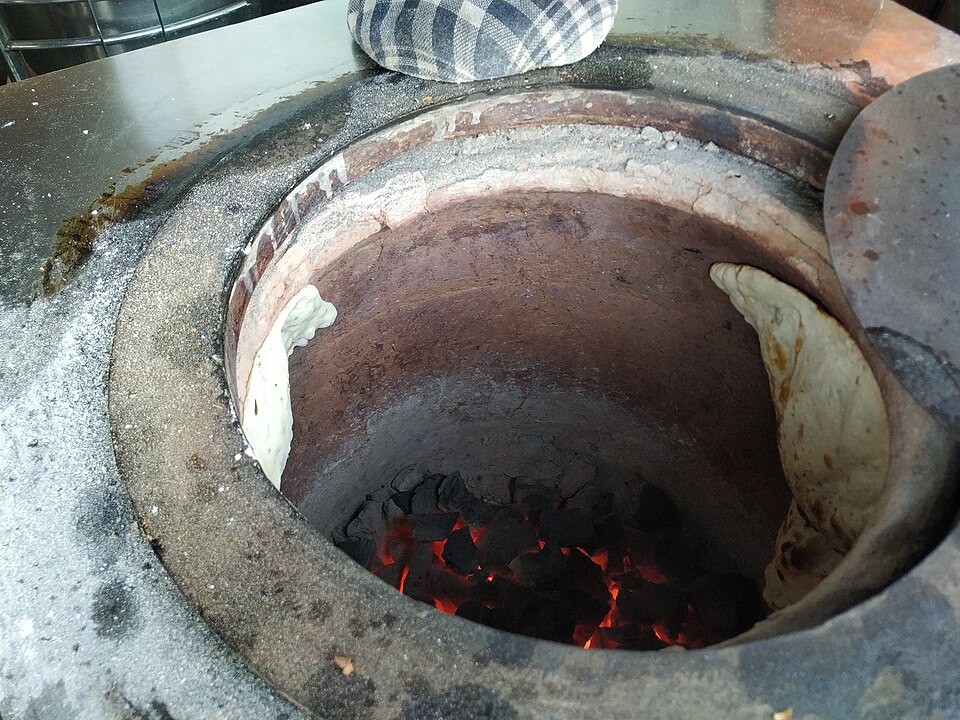
Naan slapped onto the wall of a tandoor — the oven that makes the festival bread. Photo: Wikimedia Commons.
The sweet half of the festival: mithai, jalebi, gulab jamun — and chai
Diwali is, above all, a sweet festival. The savoury dishes feed the guests; the sweets are the festival itself. Mithai — the whole world of Indian sweets — is boxed, gifted and carried from house to house all week: neighbours exchange boxes, colleagues receive them at work, and the sweet shop is the busiest place in the city. The boxes hold a dozen kinds at once — milk cakes, nut barfis, coconut laddus — and the rule is that a box is never returned empty.
Two sweets lead the tray. Gulab jamun — soft milk-solid dumplings fried golden and soaked in rose-scented syrup — is the sweet that ends every Diwali meal, eaten warm, one at a time, with a spoon. Jalebi — fermented batter piped in spirals into hot oil and drowned in saffron syrup — is the street sweet, fried to order at the market stall while the fireworks go off overhead. Both are older than the festival's modern form, and both are made the same way in every city: fried, soaked, eaten hot, before the syrup sets.
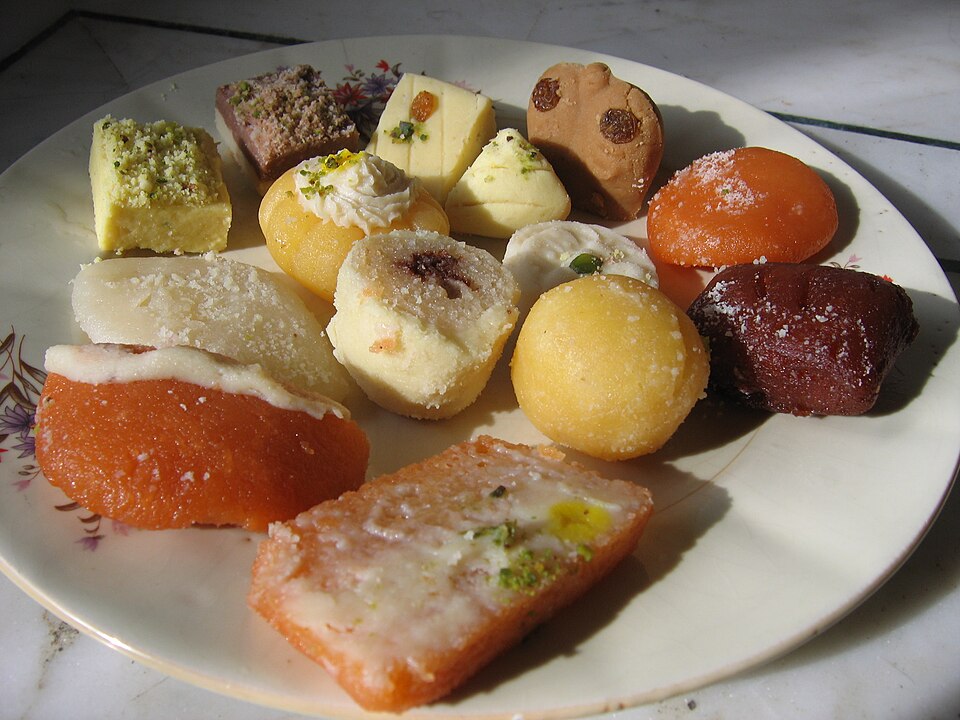
Mithai — the sweet boxes of Diwali, carried from house to house as gifts. Photo: Wikimedia Commons.
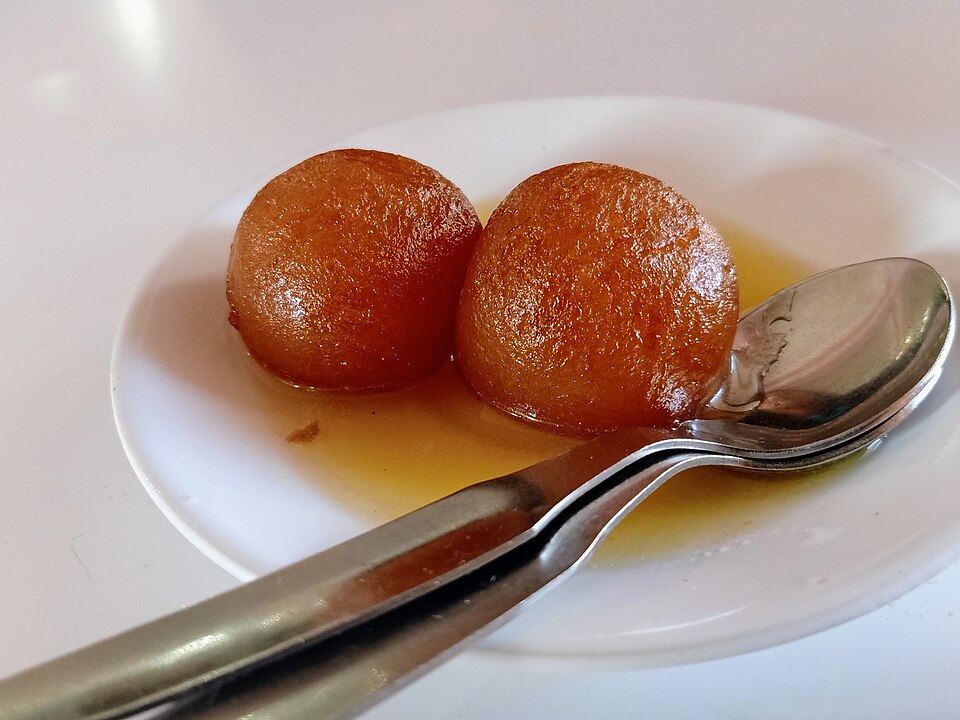
Gulab jamun in syrup — the festival sweet that ends every Diwali meal. Photo: Wikimedia Commons.
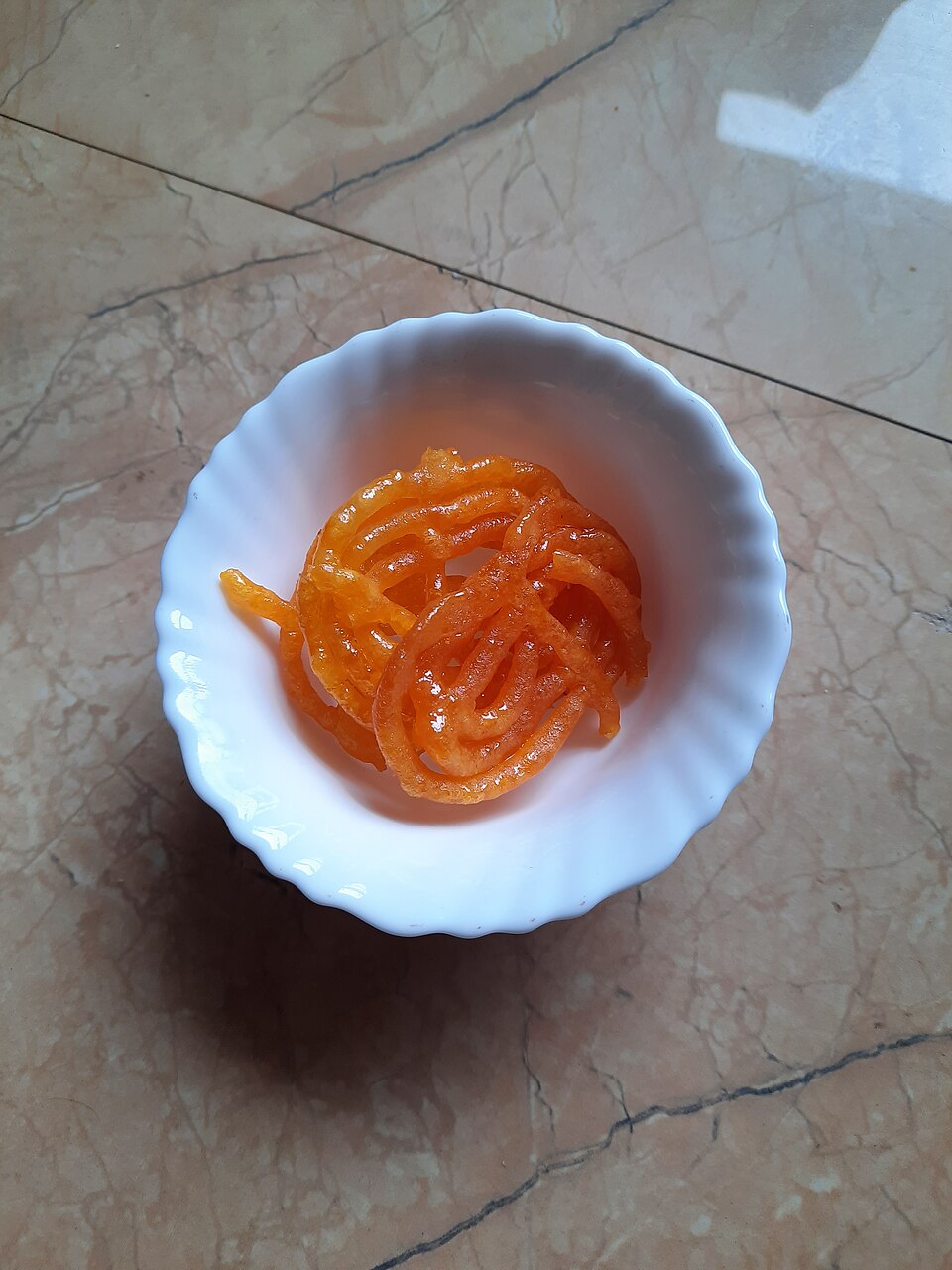
Jalebi — crisp syrup spirals, fried to order at every festival market. Photo: Wikimedia Commons.
And behind every sweet is the drink that never leaves the table: masala chai. Black tea boiled with milk, ginger, cardamom, cinnamon, cloves and sugar, poured steaming into small glasses — the drink that follows the samosa, settles the biryani, and keeps the visiting going long after the lamps are lit. The spices come from markets like Khari Baoli in Old Delhi, where the festival's masalas are weighed out by the kilo — cardamom by the scoop, dried chiles by the handful, and the whole street smelling of it at once.
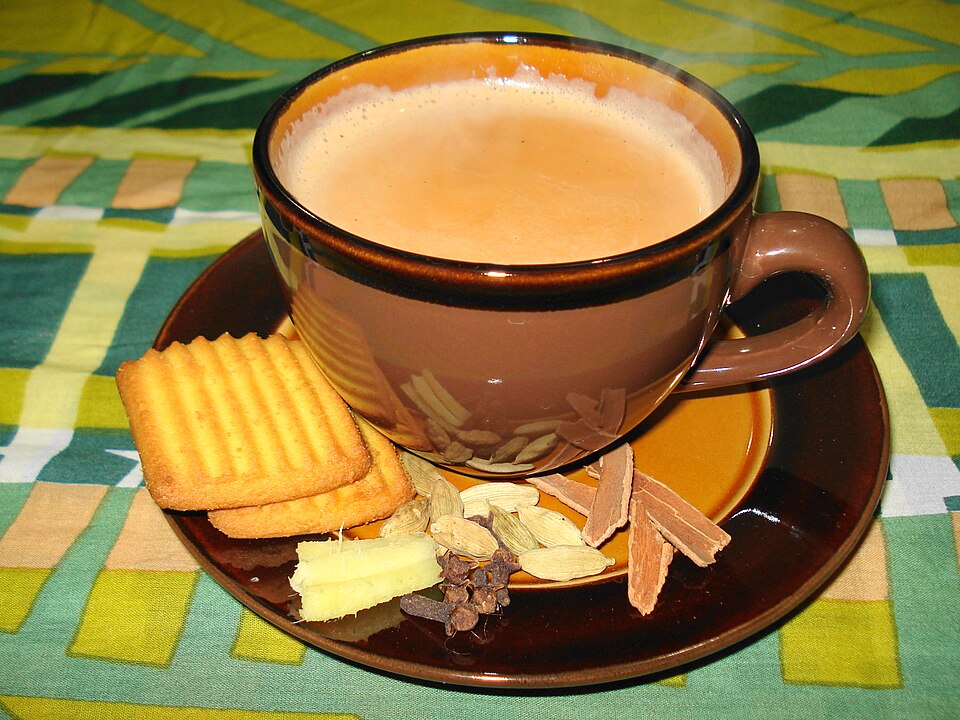
Masala chai with its spices laid out beside the cup — the drink that follows the samosa everywhere. Photo: Wikimedia Commons.
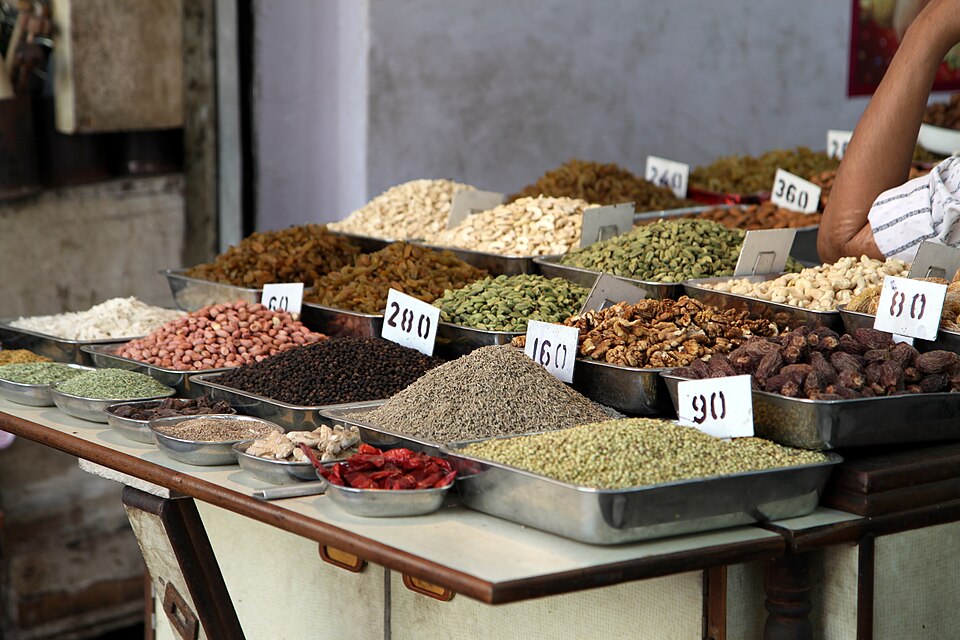
Khari Baoli, Old Delhi — the spice market where the festival's masalas are weighed out by the kilo. Photo: Wikimedia Commons.
The sweet is the greeting. At Diwali you do not arrive empty-handed — you arrive with a box of mithai. The sweets are not dessert. They are the festival's handshake, its thank-you note and its blessing, all in one box.
The wider table: one pot, a whole region — and what to drink
The biryani's family is the best map of the region's cooking, and it is worth following beyond India. The Bangladesh collection keeps Kacchi Biryani beside Ilish Curry (Shorshe Ilish) — hilsa fish in mustard sauce, the fish of Bengali identity — and Pitha, the winter rice cakes. The Pakistan collection keeps Sindhi Biryani beside Nihari, the slow overnight stew, and Karahi Gosht, meat cooked hard and fast in the wok-like karahi. The Mauritius collection keeps its biryani beside Dholl Puri, the island's stuffed flatbread. And the neighbours bring their own festival tables: Dal Bhat and Momos from the Nepal collection, Hoppers (Appa) and Kottu Roti from the Sri Lanka collection.
The same logic runs around the world: the raw-fish idea that Fiji calls kokoda becomes ceviche in the Peru collection and sushi in the Japan collection; the hot-sour soup becomes tom yum goong in the Thailand collection. One festival, one pot, one region — and the same story everywhere: the food that feeds a crowd is the food that carries a culture.
A note on what to drink: this day features no drink — Diwali's table is chai, lassi and the sweets themselves — but the India collection of World Spirits keeps the country's other side: Feni, Goa's fiery cashew spirit, distilled from cashew-apple juice in copper pots and protected by a GI tag; Arrack, South Asia's ancient palm spirit; and Indian Whisky, from the world's biggest whisky market. They belong to the celebration after the lamps, not to the puja — and they are there when the week turns to toasting.
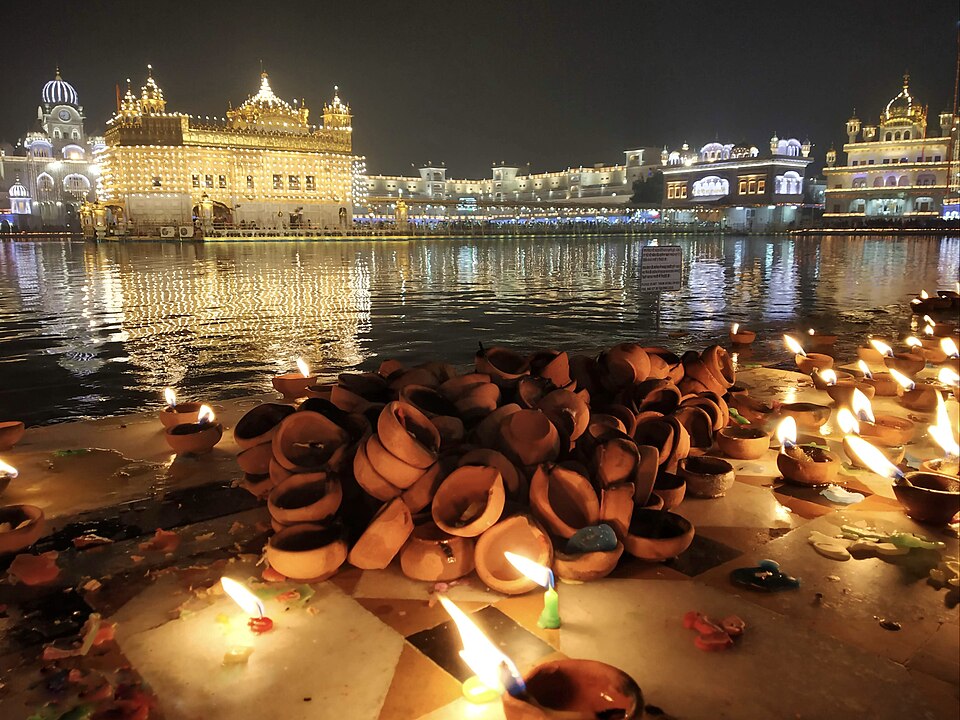
The Golden Temple, Amritsar, lit for Diwali — Sikhs mark the same night as Bandi Chhor Divas. Photo: Wikimedia Commons.
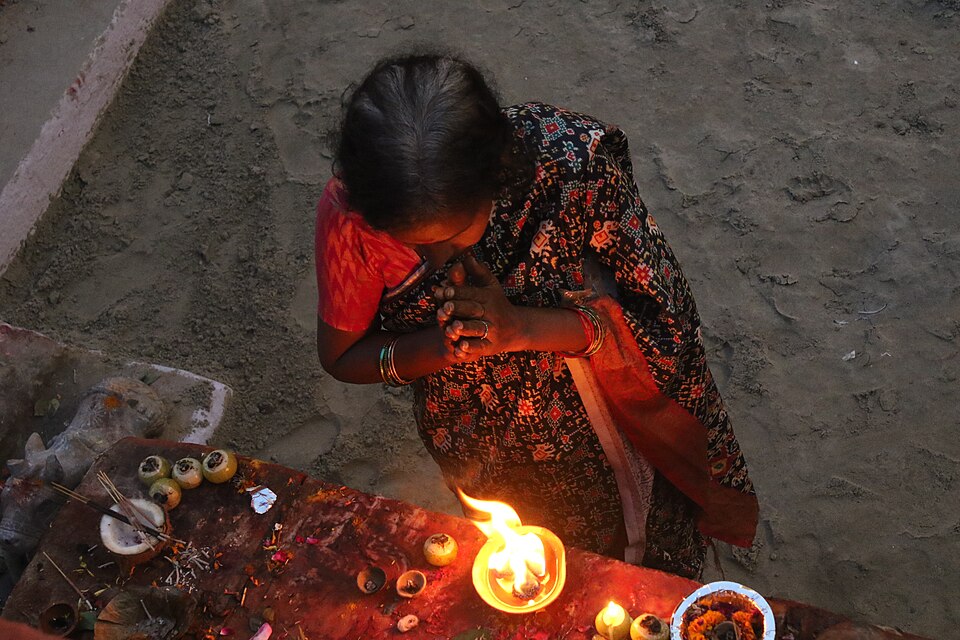
A devotee lights a diya on a Varanasi ghat as the city prepares for Dev Deepawali, the festival of lights of the gods a fortnight later. Photo: Wikimedia Commons.
From a festival table to your city's table
The Holiday Table travels all season — and when a feast makes you hungry for a restaurant table instead of a history lesson, the CallPages restaurant guides carry the same dish-by-dish honesty to the cities we track, every menu with its real prices: Paris, Rome, Madrid, San Francisco and New York. Ask for the biryani wherever you land — the sealed pot, the saffron, the layers — and judge the kitchen by whether it breaks the seal at the table.
The season ahead
That is day four — the Diwali season close, served from the Indian festival table. The lamps are out, the sweets are boxed, and the week ends on Wednesday with Bhai Dooj. Ahead of us: the British Sunday roast tomorrow, Thanksgiving on November 26, the December feasts — St. Nicholas, St. Lucia, Las Posadas, Nochebuena, Christmas tables from four continents — then New Year as a dozen cultures eat it, Three Kings on January 6, Orthodox Christmas, Lunar New Year and Carnival, all the way to February 20. Every day, one feast and the dishes that carry it, each one already waiting in the guides:
- World Cuisines — 781 dishes, 199 country collections, each dish with its origin, ingredients and history.
- World Spirits — 266 drinks, from the lagers of Luanda to the bottles opened at New Year.
- ¿Lees en español? Esta misma mesa está servida en español: Cierre de la temporada de Diwali: la mesa festiva de la India.
And keeping the night watch over the whole season — while the diyas burn from Ayodhya to Amritsar, our own host works the dark hours:
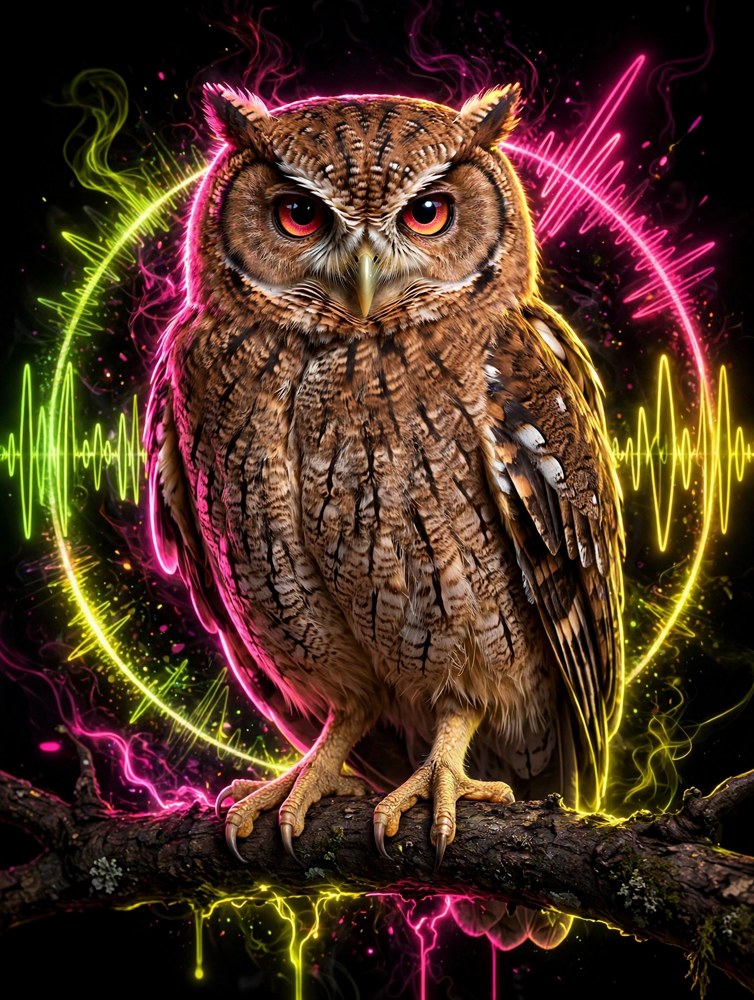
Your host for the season: the Múcaro, Puerto Rico's night owl, in CallPages acid colours. He keeps the night watch while the diyas burn.
Tomorrow, the table goes to Britain for the Sunday roast. Bring an appetite.
How it works
- Every featured dish comes from the CallPages World Cuisines guide — 781 dishes with their origins, ingredients and histories — linked dish by dish below.
- Holiday dates and customs are verified against published sources for the 2026–27 season; legends are labelled as legends.
- The Holiday Table runs daily from November 11, 2026 to February 20, 2027: one feast, one culture (or several), one story per day, through Thanksgiving, the December feasts, New Year, Three Kings, Lunar New Year and Carnival.
Related reading
Innovation by Vasily Starostenko, founder of CallPages.