Sunday roast: the British and Irish Sunday table — shepherd's pie, fish and chips and English ale
The Sunday roast is Britain and Ireland’s weekly ritual: roast meat, potatoes, Yorkshire pudding and gravy, eaten after church since the Industrial Revolution made the oven do the work. Today’s table adds shepherd’s pie — Monday’s answer to Sunday’s leftover roast — fish and chips, the 1860s pairing that fed industrial Britain, and English cask ale, the pub’s living beer.
The Sunday roast is the most imitated meal in the English-speaking world — and the most reduced to a single plate of meat and potatoes. Behind the plate is a weekly ritual with a real history: church, ovens, rationing, pubs and the Monday pie that eats Sunday’s leftovers. This is that ritual, dish by dish, from the roast itself to the chip shop by the sea.
Sunday roast: the British and Irish Sunday table — shepherd’s pie, fish and chips and English ale
It is Sunday. Somewhere in Britain and Ireland, the oven has been on since morning, the potatoes are in the tray, and the house smells of roasting meat and hot fat. The table is laid for more people than live in the house — because that is the point. The Sunday roast is not a recipe. It is a weekly appointment the whole household keeps with itself: a joint, gravy, and everyone at one table, the way it has been since the days when the meat went into the oven before church and came out, ready, when the service ended.
This is day five of The Holiday Table — our daily feast from November 11 to February 20, drawn from the World Cuisines guide (781 dishes) and the World Spirits guide (266 drinks). We opened the season with St. Martin’s goose feast, ate at Angola’s freedom table, kept Friday fish day from the Mediterranean to the Pacific, and yesterday we closed the Diwali season at the Indian festival table. Today the table stays close to home — the British and Irish Sunday table, where the roast is the ritual, the pie eats Monday’s leftovers, the chip shop feeds Friday, and the pub pours the ale.
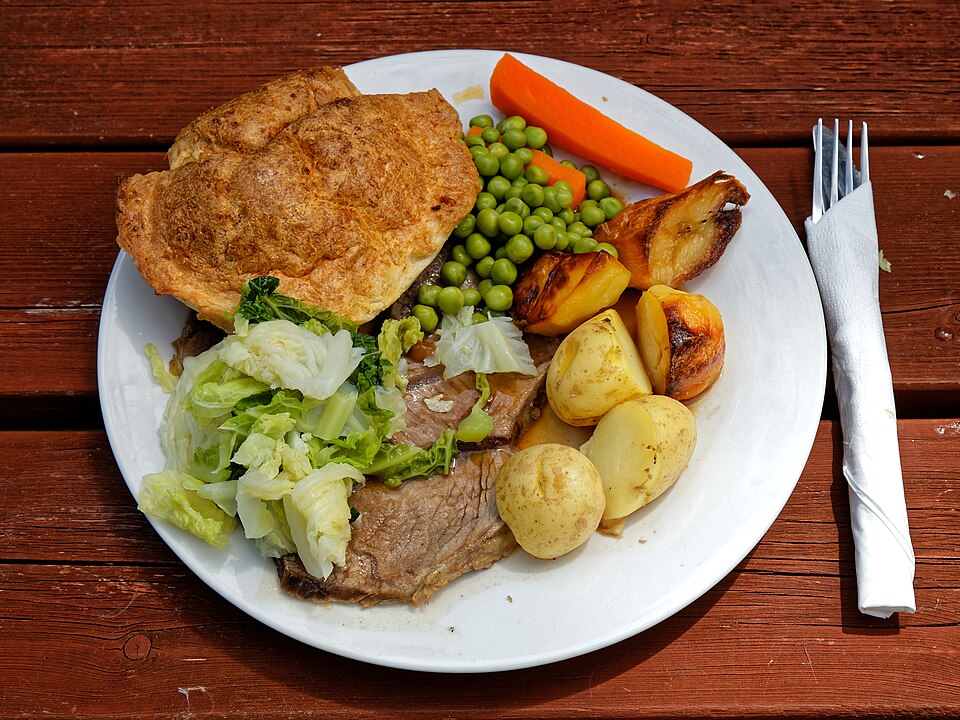
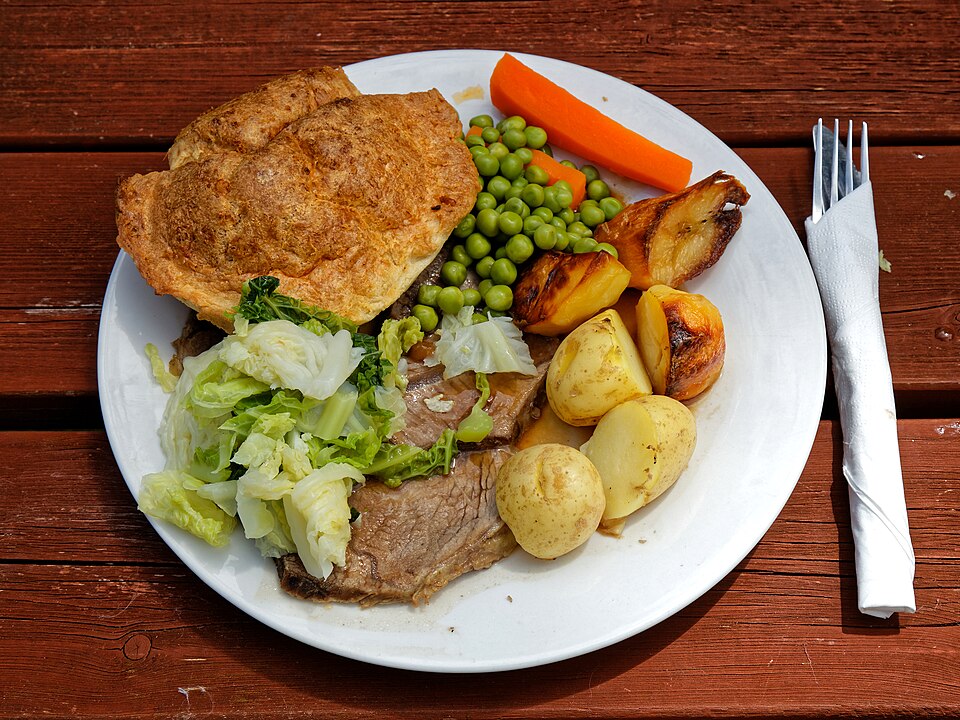
The Sunday roast as a pub serves it: roast beef, Yorkshire pudding, peas, carrots, cabbage and roast potatoes. Photo: Wikimedia Commons.
The Sunday roast: a meal that is a week in miniature
A Sunday roast — also called a roast dinner, Sunday lunch or Sunday dinner — is a British meal traditionally eaten on Sunday: roast meat, roast or mashed potatoes, and accompaniments such as Yorkshire pudding, gravy and stuffing, with condiments from horseradish sauce to mint sauce. The meat is usually beef, lamb, pork or chicken; seasonally it can be duck, goose, gammon or turkey. Roast beef with Yorkshire pudding, roast potatoes, vegetables and horseradish sauce is considered the national dish of England. But the list of ingredients is the least interesting part. The interesting part is the clock.
The roast began as the meal eaten after the church service on Sunday. Eating a large meal after church is common across Europe, but the British version grew its own shape — and the Industrial Revolution gave it its rhythm. In the late 1700s, working families would put a cut of meat into the oven as they got ready for church, add potatoes, turnips and parsnips before leaving, and come home to a meal that had cooked itself while they worshipped. Sunday was the one day of rest in a six-day working week, the one day meat could be afforded, and the oven did the work while the family was out. By the Victorian era the meal had grown elaborate — regional specialities, a joint for the table, the whole household gathered — and it became a symbol of domestic comfort and national identity. It has survived rationing, the rise of the takeaway and every food fad since: a 2024 poll found three in four Britons still call it the country’s favourite meal, and the pub has taken up the slack for every family that no longer cooks it at home.
The roast’s most famous side dish arrived as thrift. Yorkshire pudding is a batter of flour, eggs and milk, poured into sizzling beef dripping and baked until it puffs — and it began as a way to use the fat dripping from the joint. The earliest printed recipe appears in The Whole Duty of a Woman (1737) under the name “a dripping pudding”; Hannah Glasse then gave the dish its regional name in The Art of Cookery Made Plain and Easy (1747), instructing cooks to bake the batter beneath the meat so the juices ran into it. It was first served as a starter, with gravy, to fill people up before the expensive meat — today it sits beside the joint, its well made for gravy.
Roast beef itself became a patriotic badge long before that. Henry Fielding’s song The Roast Beef of Old England (1731) celebrated it, and in 1748 William Hogarth painted O the Roast Beef of Old England — also called The Gate of Calais — a swipe at French food and French absolutism, with a hunk of English beef carried in triumph past hungry French soldiers. There is a popular story that the tradition began in 1485, when Henry VII’s Yeomen of the Guard feasted on roast beef after Sunday service — but that is a legend, charming and unsupported by any dated record; the nickname “Beefeater” is real and old, and the line from a royal guardroom to your grandmother’s kitchen is not. The honest history is better: the roast grew out of church, spit-roasting, the village bakehouse and the working family’s oven, and it stuck because it solved a real problem — how to feed everyone, well, on the one day nobody worked.
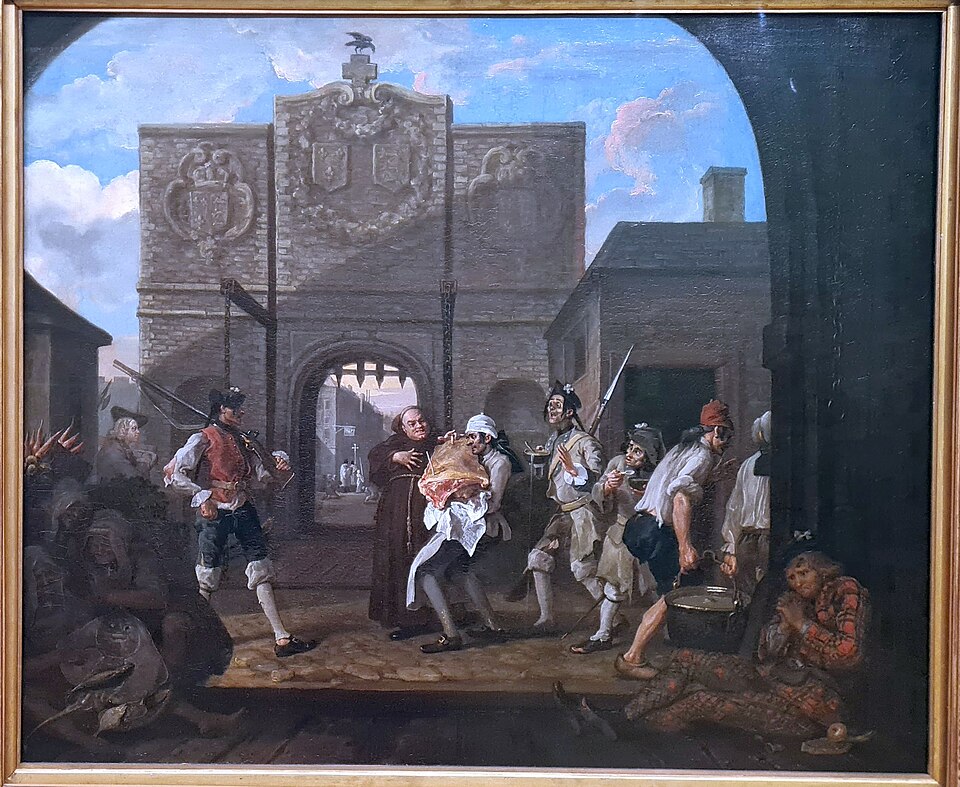
Hogarth’s O the Roast Beef of Old England (1748): the joint carried in triumph past hungry French soldiers — roast beef as patriotic badge. Photo: Wikimedia Commons.
The roast is a clock as much as a meal. The meat goes in before church; the potatoes and parsnips go in before the family leaves; the pudding goes in last, in the hottest fat. Come home, carve, pour the gravy — the whole week is measured in that one afternoon.
And it travelled. The roast went wherever Britain went — across the Commonwealth, to Canada, Australia, New Zealand and South Africa, where the joint stayed the same and the trimmings bent to the local climate and the local market. In the southern hemisphere the Sunday roast is a winter meal eaten in summer heat, and nobody minds; the ritual is the point, not the weather. The roast is one of the few British exports that was never really about empire at all. It was about the week: six days of work, one day of rest, and a table big enough for everyone who belongs to it. That is why it survived the move from the farmhouse kitchen to the city flat, from the coal oven to the electric one, from the family dining room to the pub — the shape of the meal never depended on the kitchen. It depended on the people sitting down.
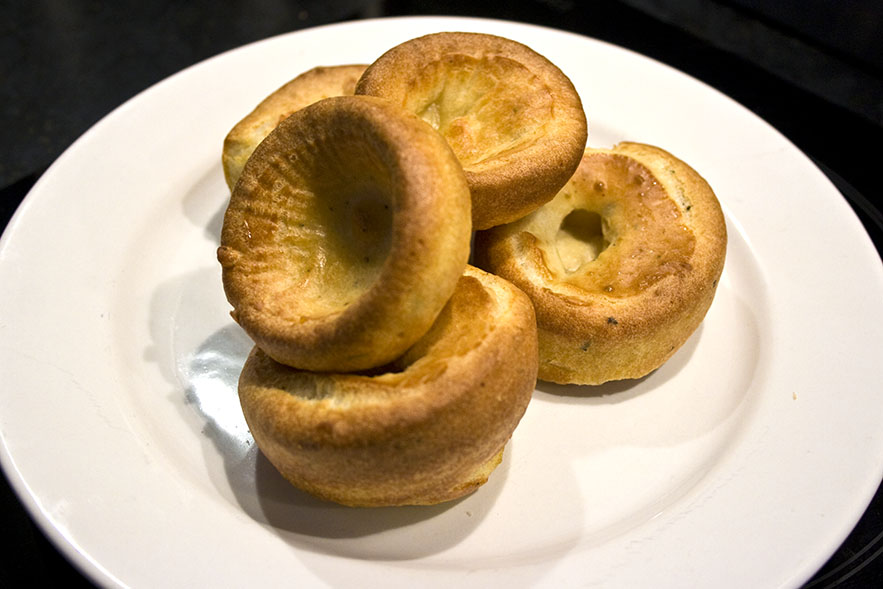
Yorkshire puddings, crisp and puffed — the batter first printed as a “dripping pudding” in 1737 and named by Hannah Glasse in 1747. Photo: Wikimedia Commons.
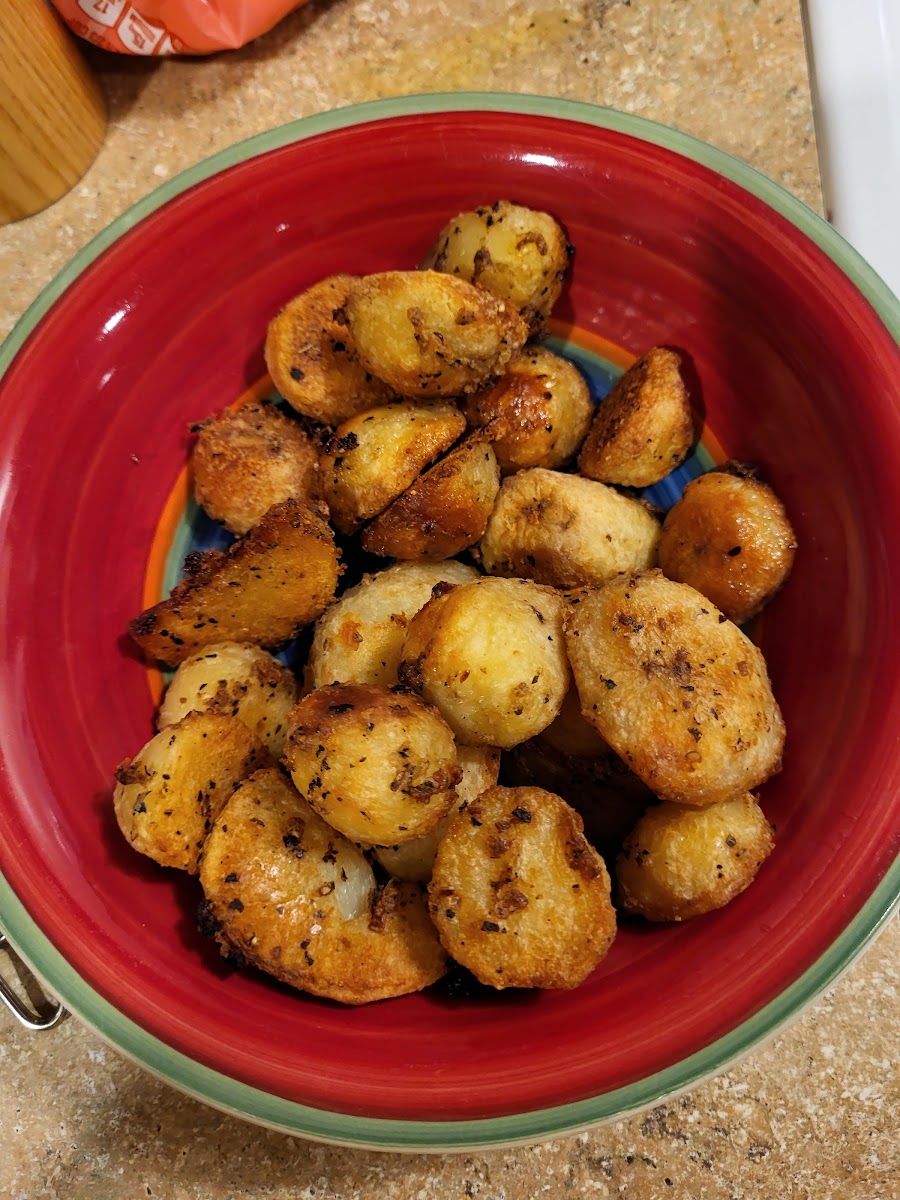
Roast potatoes — the part of the plate children steal from the tray, and the part the cook guards most. Photo: Wikimedia Commons.
The Sunday table, at a glance
| The plate | What it is | What joins it at the table | In the guides | | Shepherd’s Pie | Minced lamb in a rich, thyme-scented gravy under a cloud of mashed potato, forked into ridges and baked until bronzed | Buttered greens and more gravy | United Kingdom collection | | Fish and Chips | Battered white fish fried golden, with thick chips, malt vinegar, mushy peas and tartar sauce | Salt, vinegar, lemon — eaten with fingers by the sea | United Kingdom collection | | English Ale | The cask-conditioned “real ale” of the pub — top-fermented, lightly carbonated by living yeast, hand-pulled at cellar temperature | A dimpled mug, a pub garden, and the Sunday papers | England collection |
🇬🇧 Shepherd’s Pie — Monday’s answer to Sunday’s roast
Shepherd’s Pie is the cottage comfort: minced lamb in a rich, thyme-scented gravy under a cloud of mashed potato, forked into ridges and baked until bronzed. (Beef makes it a cottage pie.) The World Cuisines United Kingdom collection gives the working recipe: brown the lamb, soften onion, carrots and peas in the fat, add tomato paste, Worcestershire sauce and lamb stock, simmer into a thick gravy, season boldly, cover with buttery mash, ridge with a fork and bake until the peaks crisp. Serve with buttered greens and more gravy.
The pie is Sunday’s second act. It was invented to use up the roast: the leftover meat of the weekend, kept for later meals, and the potato — the poor family’s crust — gave it a cheap, satisfying way to stretch. The term “cottage pie” is first recorded in 1791, when the Reverend James Woodforde of Norfolk wrote in his diary for 29 August 1791 that he had “Cottage-Pye and rost Beef”. The name “shepherd’s pie” came later — first in an Edinburgh cookbook, The Practice of Cookery and Pastry, in 1849 — and the two names were used interchangeably for a long time. The distinction cooks insist on today is the meat: lamb or mutton for a shepherd’s pie, beef for a cottage pie, because a shepherd tends sheep and a cottager kept a cow. Before mincing machines, the meat was chopped by hand from the leftover joint, and the dish could not have existed at all before the potato became a staple in Britain at the end of the 1700s — earlier versions wore a pastry crust instead of mash.
That is why the pie belongs on the Sunday table’s story even though it is eaten on Monday. It is the roast, refused to end: Sunday’s joint, Tuesday’s gravy, the week’s thrift in a dish. In France the same idea is hachis Parmentier, named for Antoine-Augustin Parmentier, who popularised the potato in French cooking in the late 18th century. Every culture that roasts a joint invents a way to eat it twice — Britain’s way just happens to be the one with the forked mash on top.
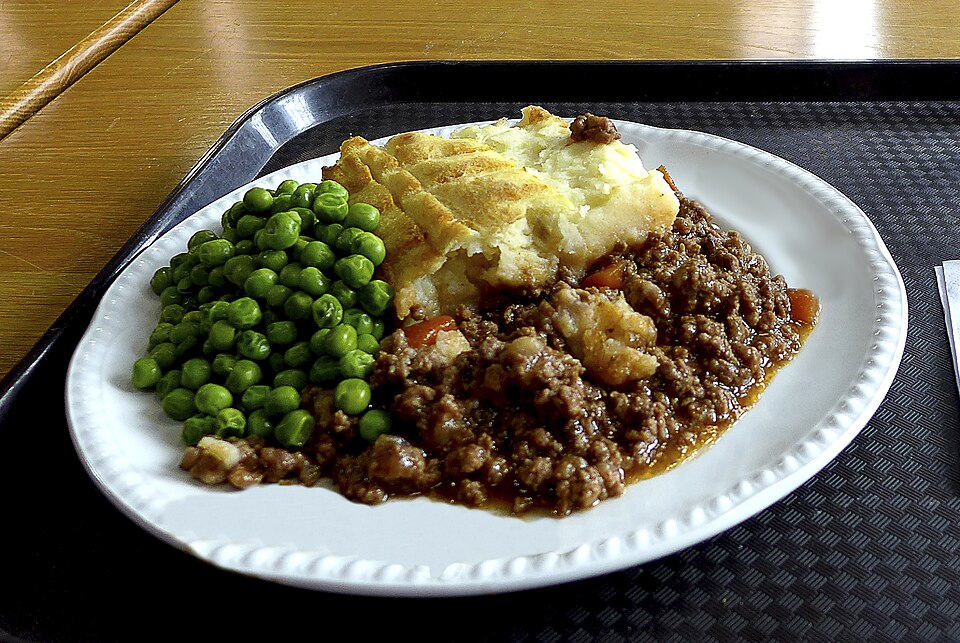
Shepherd’s pie with peas — minced lamb in thyme-scented gravy under a cloud of mash. From the World Cuisines United Kingdom collection.
🇬🇧 Fish and Chips — the Friday-night sacrament that joined the Sunday table
Fish and Chips is Britain’s Friday-night sacrament: battered white fish fried golden, with thick chips, malt vinegar, mushy peas and tartar sauce. Cod or haddock, self-raising flour, ice-cold beer or sparkling water for the batter, potatoes, beef dripping or oil, malt vinegar, lemon and salt. The method is a double fry: fat chips fried once low until soft, then again until loud and golden; the fish floured, battered and fried at 190°C until crisp and amber. Served on paper, salted and vinegared, eaten with fingers by the sea.
It began as two separate traditions that met on British streets in the 1860s and never separated again. Fried fish came with Sephardic Jewish refugees — Londoners were already eating fried fish in the 1830s, and Charles Dickens was writing about the city’s fried-fish shops. Chips came from the mill towns of Lancashire, or from Belgium and France — historians still argue. The pairing became a trade in the 1860s, and two shops compete for the title of first: Joseph Malin, a Jewish immigrant’s son, is generally credited with opening one of the first documented fish and chip shops in London around 1860, on what is now Cleveland Way in the East End; John Lees was selling fried fish and chips from a wooden hut in Mossley Market, Lancashire, from 1863, before moving into a permanent shop that claimed in its window to be the first fish and chip shop in the world. A blue plaque at Oldham’s Tommyfield Market marks the claim. The honest answer is that nobody knows who was first — several places popped up around 1860, and nobody knew at the time that something important was beginning.
What followed is not in doubt. By 1910 there were roughly 25,000 fish and chip shops across the UK; by 1927 there were about 35,000. The dish was so central to national morale that it was never rationed in either World War — Winston Churchill is said to have called fish and chips “the good companions”. It fed industrial Britain the way the Sunday roast fed the family: cheap, hot, filling, and eaten together, standing up, out of paper. Today more than 10,500 chip shops still trade across the UK, and the seaside version — eaten on a harbour wall, gulls circling — is the one every Briton pictures first.
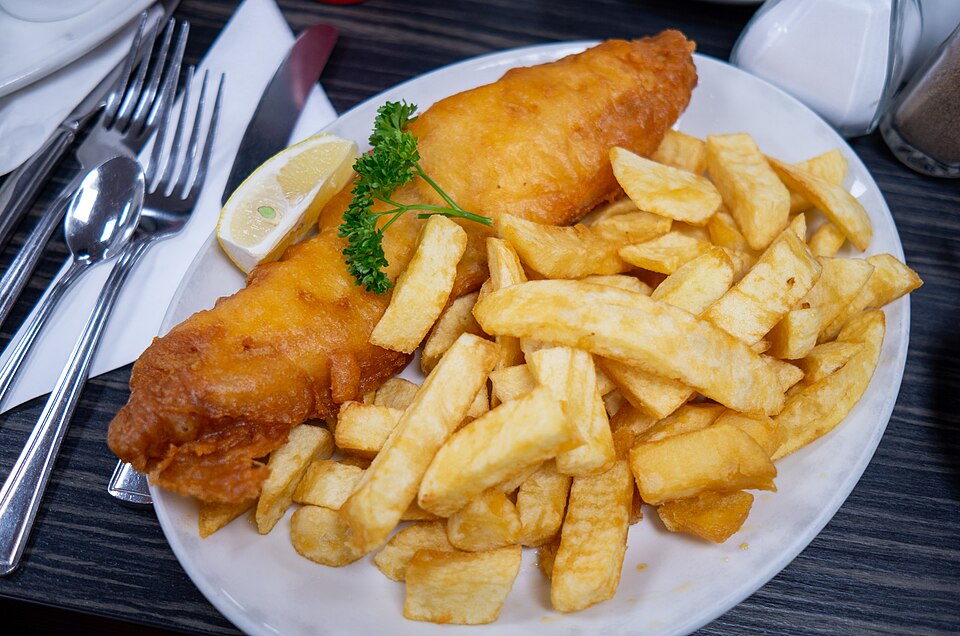
Fish and chips — battered white fish fried golden, with thick chips, malt vinegar and lemon. From the World Cuisines United Kingdom collection.
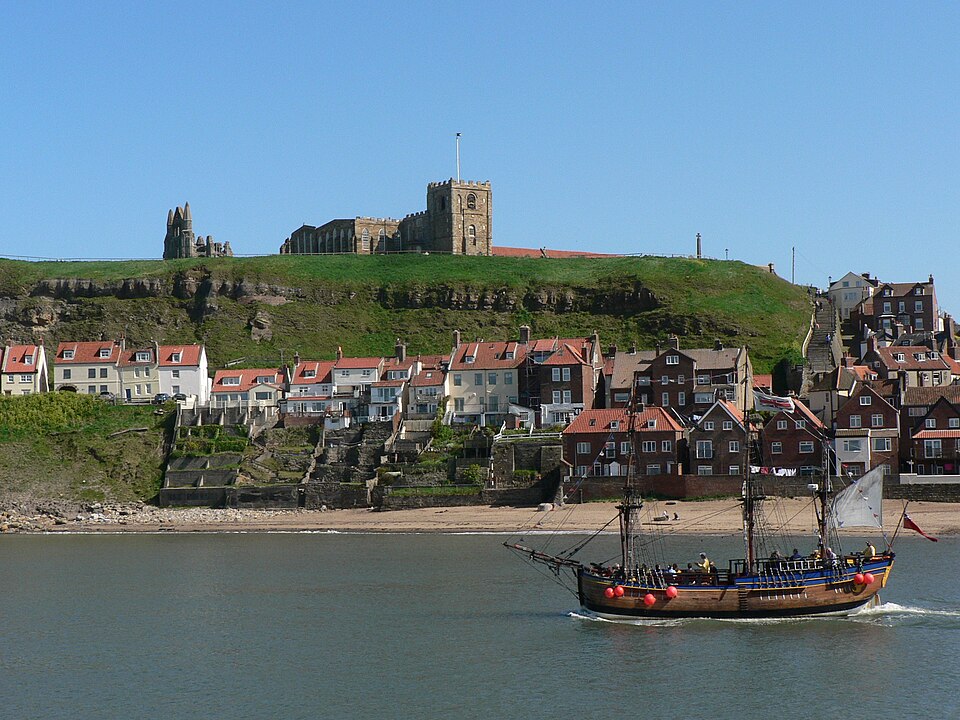
Whitby, Yorkshire — the harbour town where the fish-and-chips story and the seaside supper meet. Photo: Wikimedia Commons.
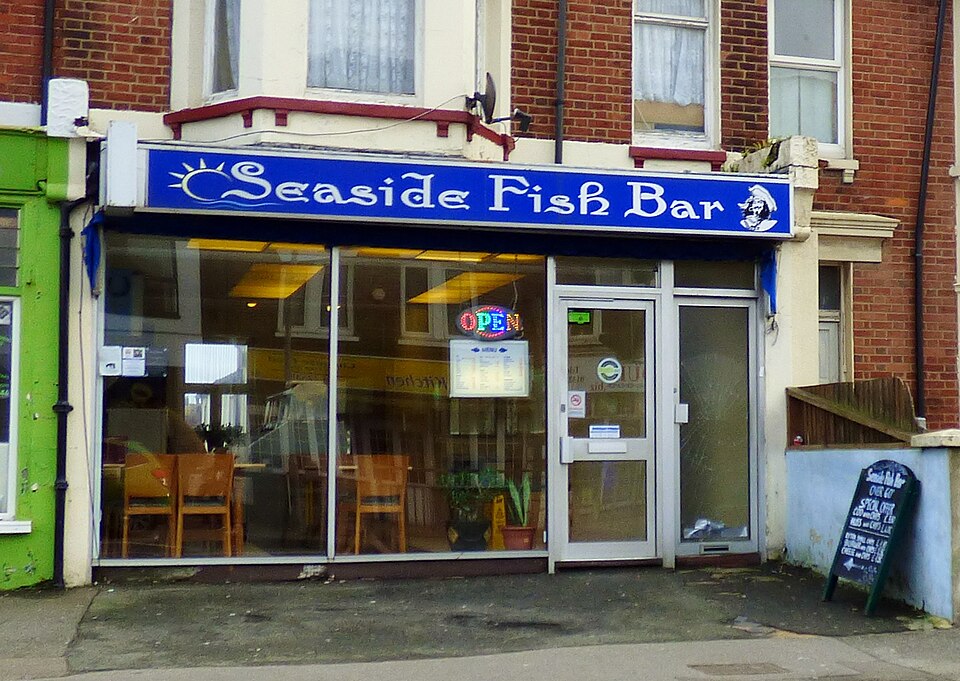
The seaside fish bar — the chip shop is still a shopfront first, paper and vinegar second. Photo: Wikimedia Commons.
Two shops, one argument, no winner. Malin in London, 1860; Lees in Mossley, 1863. The National Federation of Fish Friers backs Malin; Oldham’s blue plaque backs Lees. The only fact both sides agree on: by 1910, there were 25,000 chip shops, and the argument had already been settled by appetite.
🇮🇪 Ireland — the Sunday table across the water
Cross the Irish Sea and the Sunday table keeps the same shape with a different accent: the same joint, the same potatoes, the same insistence that Sunday is for sitting down together — but Ireland’s potatoes do more of the talking. The Ireland collection of World Cuisines keeps four dishes, and together they are a small history of the island.
Irish Stew is the hearth stew: lamb or mutton layered with potatoes, onions and carrots in a clear broth — the potatoes thicken it as it simmers into comfort. Two kinds of potato go in: floury ones to melt into the broth, waxy ones to hold their shape. It is the stew of tenant farmers who had one pot and the sheep on the hill, simmered very gently for an hour and a half or two, undisturbed, and served with parsley, soda bread and butter. Purists still argue over the carrots at Irish dinner tables — a later addition, they say, and not to be trusted.
Colcannon is Samhain’s buttery mash: potatoes whipped with kale or cabbage, scallions and oceans of butter, a coin or ring hidden inside at Halloween. The name comes from the Irish cál ceannann, “white-headed cabbage”, and the dish is Halloween food across Ireland — charms hidden for fortunes, and a song every Irish child learns. Serve it in a mound with a well of melting butter in the centre, beside ham or bacon.
Boxty is the north-west’s beloved bread-cake: a potato pancake of grated raw potato, mashed potato and flour, fried in butter. “Boxty on the griddle, boxty in the pan” — the rhyme promises a husband to whoever can make it. The name comes from arán bocht tíne, “poor-house bread”, and it stretches back to the pre-Famine potato economy, when the potato was not a side dish but the meal itself.
And Irish Soda Bread is the daily miracle: flour, salt, soda and buttermilk kneaded in minutes, marked with a cross and baked — no yeast, no waiting, a loaf from scarcity. Soda bread rose in the 1830s and 40s, when baking soda met Ireland’s soft wheat and sour milk; the cross is cut deep to let the fairies out, and to bake the centre. It is eaten the day it is made, with butter and jam or beside the stew — the bread that turned poverty into one of the world’s great loaves.
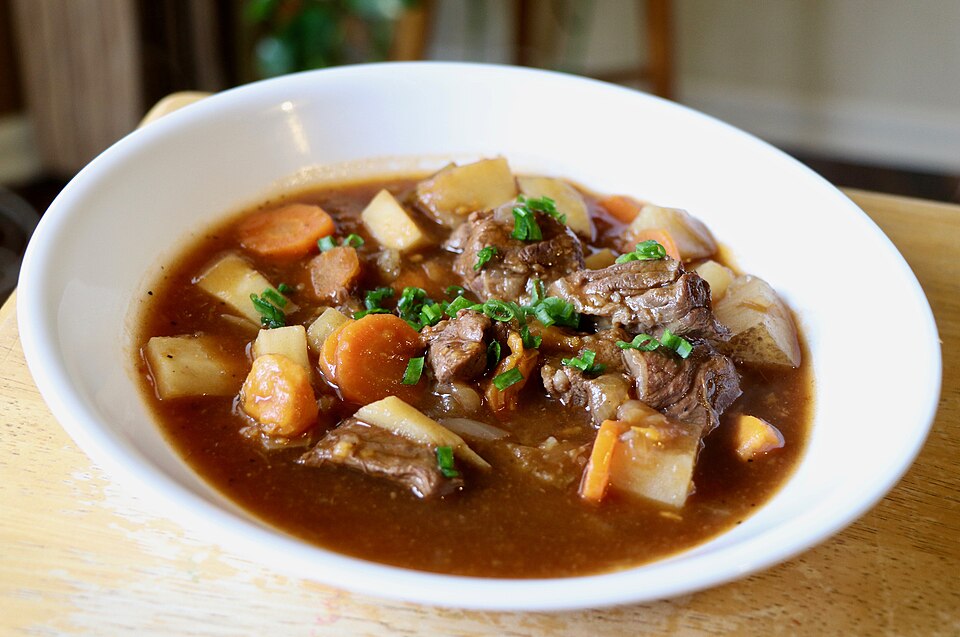
Irish stew — lamb layered with potatoes, onions and carrots, simmered until the potatoes thicken the broth. From the World Cuisines Ireland collection.
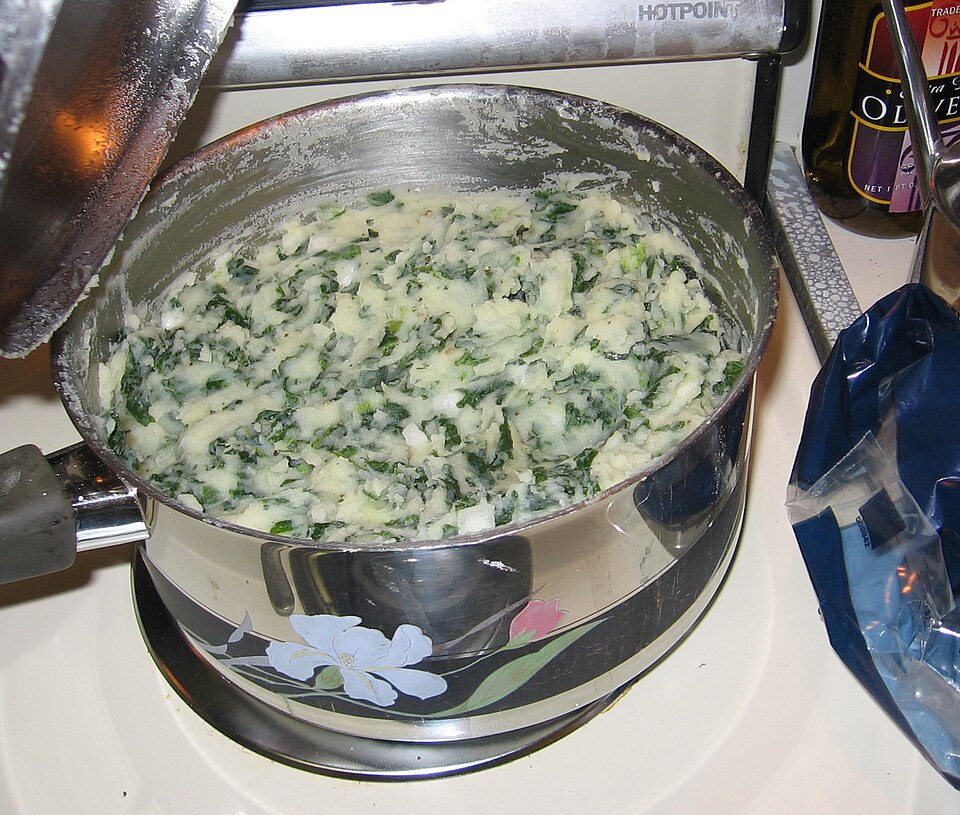
Colcannon in the pot — potatoes whipped with kale and scallions, drowned in butter. From the World Cuisines Ireland collection.
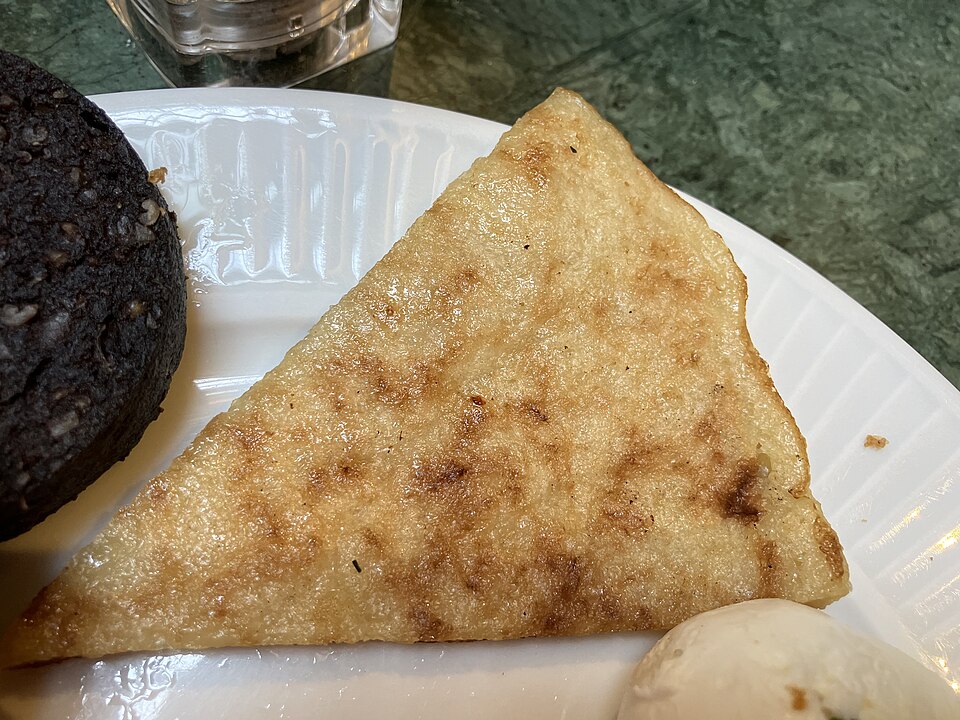
Boxty, the north-west’s potato pancake — grated raw potato, mashed potato and flour, fried in butter. From the World Cuisines Ireland collection.
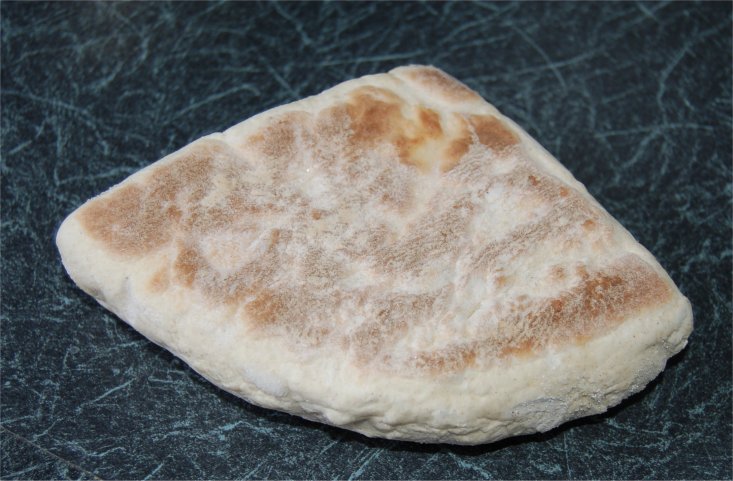
Soda bread farl — flour, salt, soda and buttermilk, marked with a cross and baked in minutes. From the World Cuisines Ireland collection.
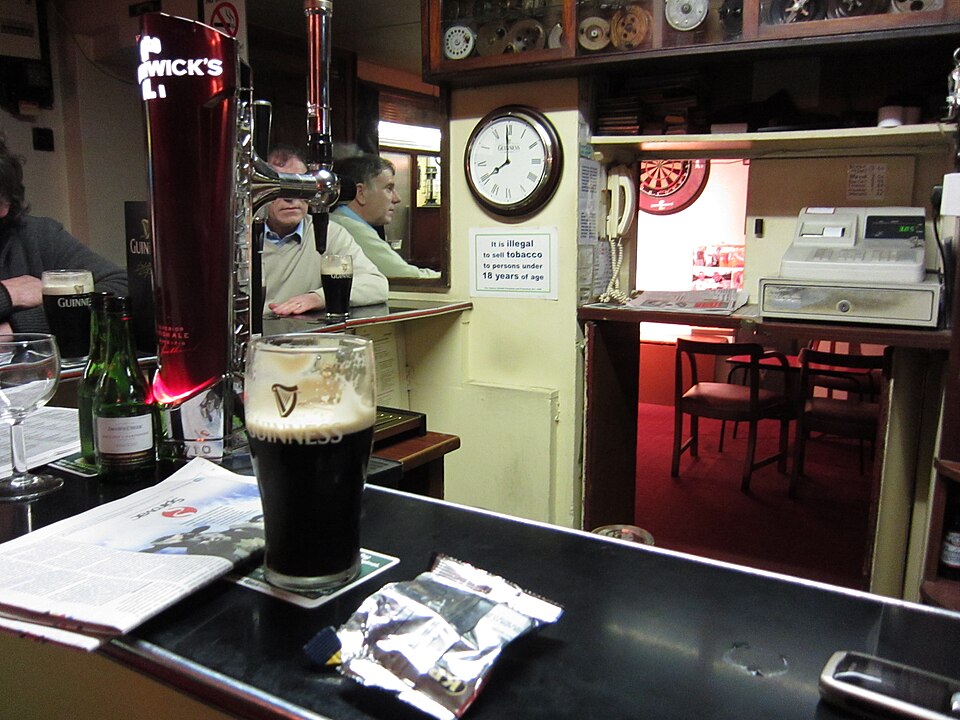
Inside an Irish pub — the bar is the living room, and the Sunday table often starts or ends here. Photo: Wikimedia Commons.
🍺 English Ale — the pub’s living beer
No Sunday table in England is complete without the pub, and no pub is complete without English Ale: the cask-conditioned “real ale” — top-fermented, lightly carbonated by living yeast in the cask, and hand-pulled at cellar temperature. England brewed ale for a thousand years; the cask tradition survived industrial lager thanks to a campaign that began in a pub in Ireland.
In March 1971, four young men from the north-west of England — Michael Hardman, Graham Lees, Jim Makin and Bill Mellor — formed the Campaign for the Revitalisation of Ale, soon renamed the Campaign for Real Ale, or CAMRA, to protect the beer they loved from the keg. Keg beer was filtered, pasteurised, gassed and chilled; cask ale was none of those things. It is brewed and top-fermented warm, racked into casks with finings while the yeast still lives, and left to condition in the pub cellar, served by handpump without added gas, at 11–13°C, in a dimpled mug or a straight glass, with a creamy head. The styles are the old ones: bitter, mild, brown ale and old ale, with porter and stout brewed in London too. CAMRA’s first Good Beer Guide came out in 1974; by 2014 the UK was drinking 634 million pints of cask ale a year — 60% of the ale in pubs and 17% of all beer in pubs. The pub, the guide says, is England’s living room, and cask ale is its heartbeat.
The England collection of World Spirits keeps two more pours beside the ale. London Dry Gin is the juniper-forward style that defines gin — Dutch genever met London’s stills in the 17th century, and after the Gin Craze the distillers of Plymouth and London refined the dry style in the 1800s. By law nothing but water is added after redistillation, and the result is the backbone of the Martini and the gin and tonic. And the Pimm’s Cup is England’s summer in a jug: James Pimm, a London oyster-bar owner, created his tonic cups in the 1840s, and the No. 1 Cup — gin-based liqueur lengthened with lemonade and a fruit salad of cucumber, strawberry, orange and mint — became the drink of Wimbledon and Henley. One part Pimm’s to three parts lemonade; serve too little fruit, and in June it is a social offence.
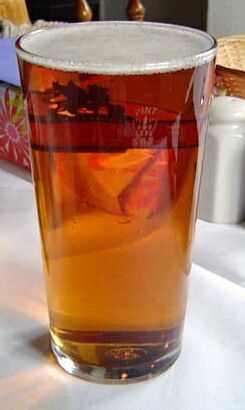
A pint of cask ale — top-fermented, lightly carbonated by living yeast, hand-pulled at cellar temperature. From the World Spirits England collection.
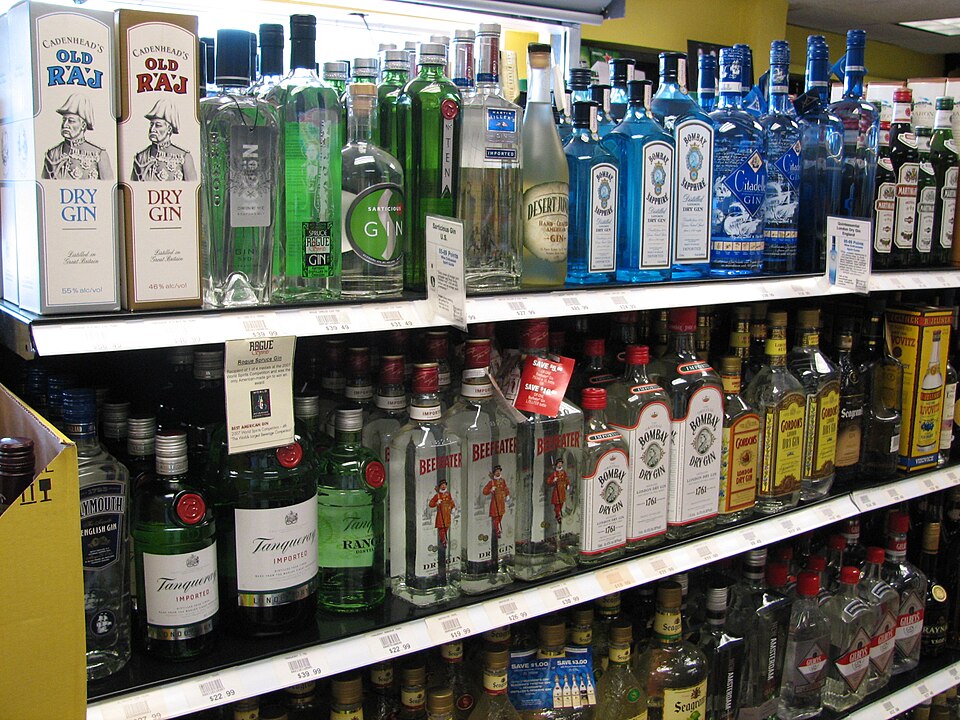
The gin shelf — London Dry Gin, the juniper-forward style that defines gin, from Plymouth to Tanqueray. From the World Spirits England collection.
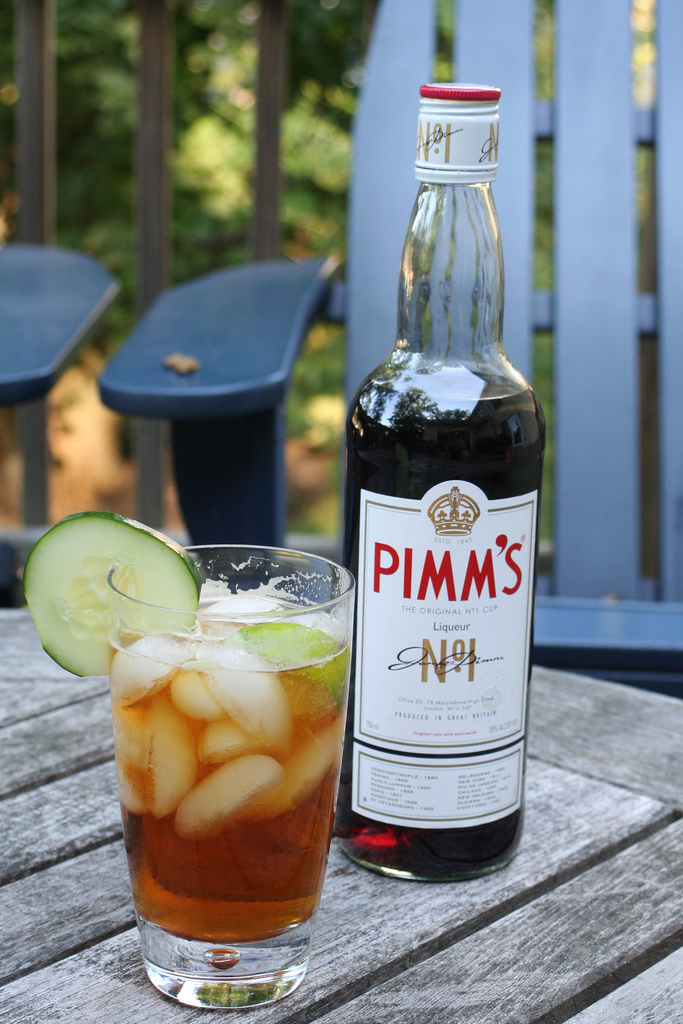
Pimm’s No. 1 and a Pimm’s Cup — James Pimm’s 1840s oyster-bar tonic, now the drink of Wimbledon and Henley. From the World Spirits England collection.
The rest of the table: the full English and the Wellington
The Sunday table has two more regulars, and they sit at opposite ends of the day. The Full English Breakfast is the full works: bacon, sausages, eggs, beans, mushrooms, tomatoes, black pudding and fried bread on one heroic plate, with strong tea and brown sauce. It began as the gentry’s country-house breakfast of the Victorian era and became the greasy-spoon “fry-up” that fuelled industrial Britain — the rules (beans as a dam, egg on toast) debated like law. On a Sunday it is often eaten as breakfast-for-dinner, the meal that starts the day the roast finishes.
Beef Wellington is the showpiece roast: a beef fillet spread with mushroom duxelles and wrapped in prosciutto and puff pastry, baked to a bronzed, pink-centred slice. Named, tradition says, for the Duke of Wellington after Waterloo — though the modern version owes as much to Escoffier-era French technique and television chefs as to any duke. It is the Sunday roast dressed for Christmas Day, which is why it returns on December 25 in this very programme: the roast, at its most theatrical.
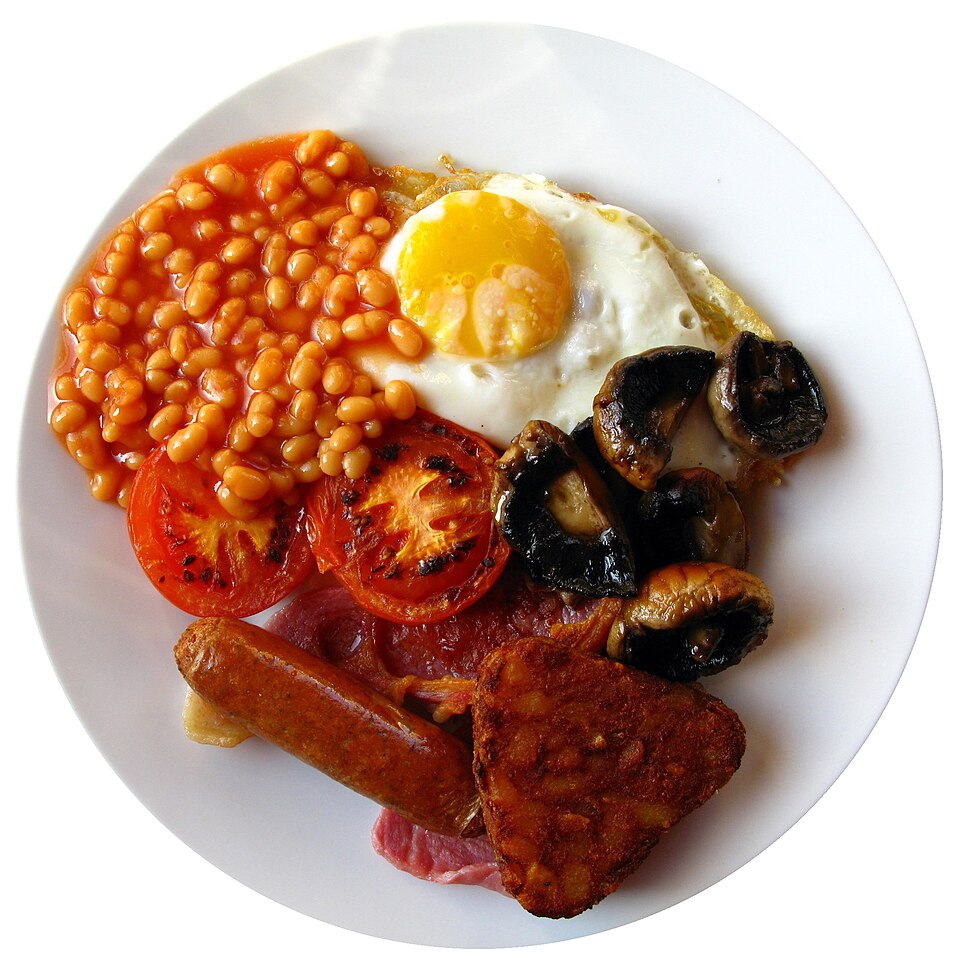
The full English — bacon, sausages, eggs, beans, mushrooms, tomatoes and fried bread, the gentry’s breakfast turned fry-up. From the World Cuisines United Kingdom collection.
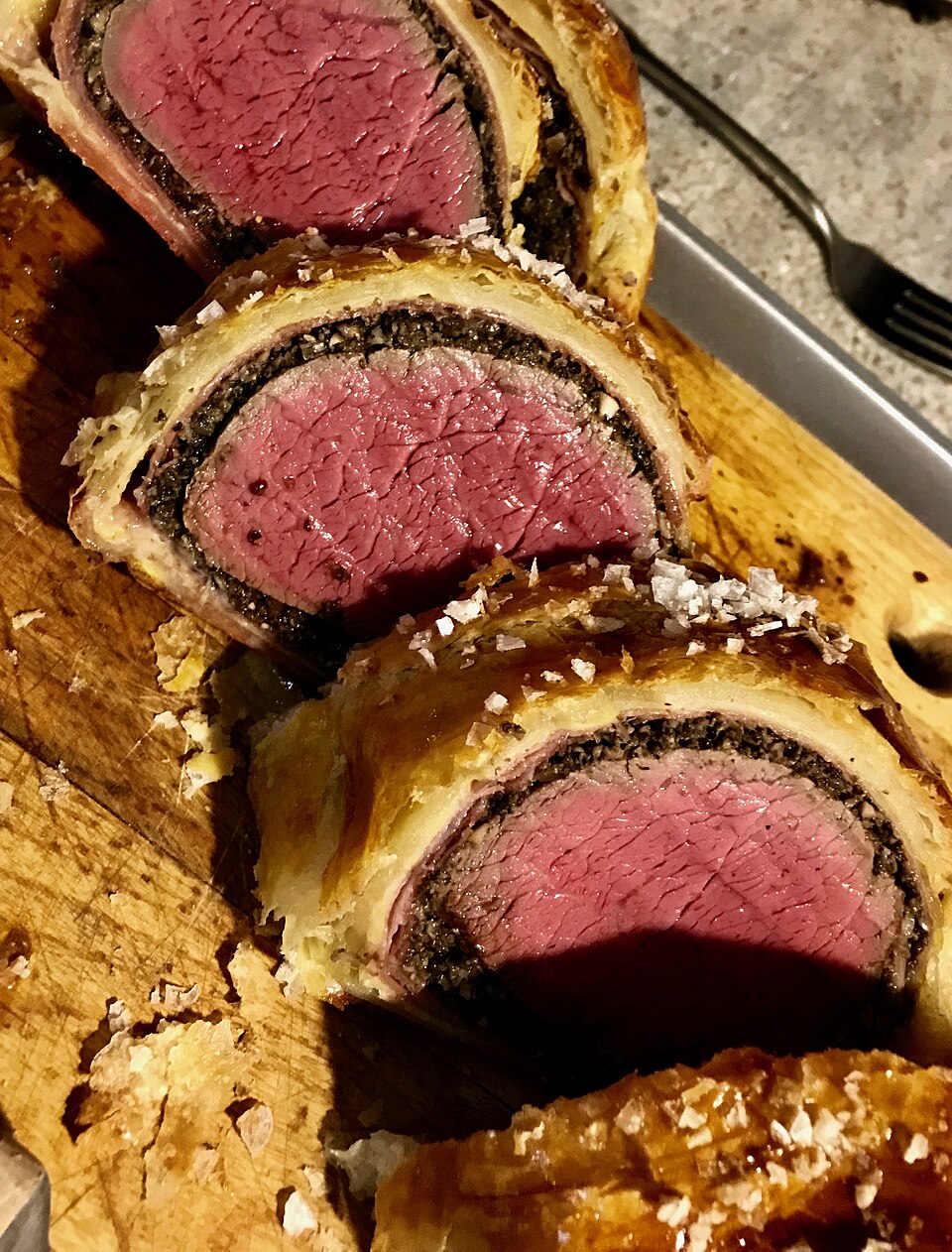
Beef Wellington, sliced — fillet, duxelles and pastry, the showpiece roast named, tradition says, for the Duke after Waterloo. From the World Cuisines United Kingdom collection.
How to eat it: finding the Sunday table
If you are in Britain or Ireland on a Sunday, the table finds you. Pubs serve the roast from midday — book ahead, because the good ones fill by one o’clock, and the carvery line is part of the ritual. Chip shops fry from Friday through the weekend; the seaside ones, eaten on the harbour wall with the gulls circling, are the ones worth the queue. Markets sell the joint on Saturday: Borough Market in London is where the butchers do the choosing for you, and the stalls will tell you which cut roasts best and how long to rest it.
If you are cooking it at home, the rules are the ones the history wrote: put the joint in early, the potatoes in before you leave for church, the pudding batter into the hottest fat at the last minute. Rest the meat — ten minutes at least, or the juices run onto the board instead of into the gravy. And keep the leftovers: Monday’s shepherd’s pie is not a consolation prize. It is the second half of the same meal, and the Victorians who invented it knew it.
The modern plate carries its own small history, too. The gravy granules in the cupboard are Bisto, first sold around 1908; the stuffing mix is Paxo, from about 1901; the mustard on the side is Colman’s, made in Norwich since 1814. None of them is traditional in the old sense — the old gravy was the drippings, thinned and seasoned — but all three have sat on the Sunday table for more than a century now, and the argument over whether the gravy should come from a packet or from the pan is itself part of the ritual. Every family has a ruling, and every family is right.
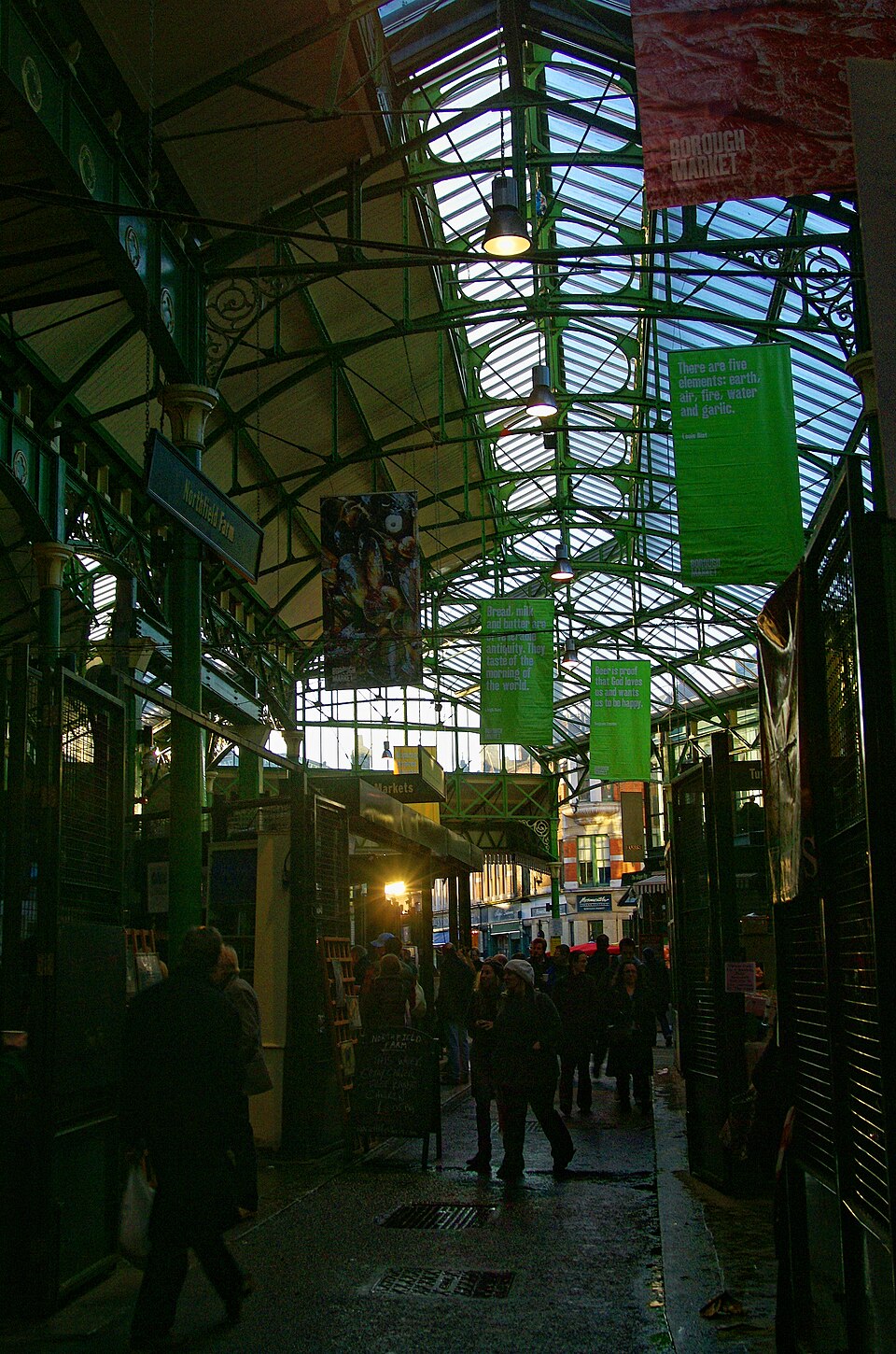
Borough Market, London — where the Sunday joint is bought on Saturday, and the market does the choosing. Photo: Wikimedia Commons.
The rule of the Sunday table is the rule of the week: nothing wasted, nobody rushed, everybody fed. The roast feeds Sunday, the pie feeds Monday, and the chip shop feeds Friday — one animal, one potato, one pub, seven days.
From a Sunday table to your city’s table
The Holiday Table travels all season — and when a feast makes you hungry for a restaurant table instead of a history lesson, the CallPages restaurant guides carry the same dish-by-dish honesty to the cities we track, every menu with its real prices: Paris, Rome, Madrid, San Francisco and New York. Ask for the roast wherever you land — the joint, the pudding, the gravy — and judge the kitchen by whether the potatoes are crisp and the gravy is made from the drippings, not a packet.
The season ahead
That is day five — the Sunday roast, served from the British and Irish table. The ovens are cooling, the pie is in the dish for Monday, and the week turns: tomorrow is Meatless Monday, and the table goes to Ethiopia’s fasting cuisine; then Thanksgiving week opens on November 23, Thanksgiving itself on November 26, the December feasts — St. Nicholas, St. Lucia, Las Posadas, Nochebuena, Christmas tables from four continents — then New Year as a dozen cultures eat it, Three Kings on January 6, Orthodox Christmas, Lunar New Year and Carnival, all the way to February 20. Every day, one feast and the dishes that carry it, each one already waiting in the guides:
- World Cuisines — 781 dishes, 199 country collections, each dish with its origin, ingredients and history.
- World Spirits — 266 drinks, from the lagers of Luanda to the bottles opened at New Year.
- ¿Lees en español? Esta misma mesa está servida en español: Domingo de asado: la mesa británica e irlandesa.
And keeping the night watch over the whole season — while the roast rests and the pie waits for Monday, our own host works the dark hours:

Your host for the season: the Múcaro, Puerto Rico’s night owl, in CallPages acid colours. He keeps the night watch while the roast rests.
Tomorrow, the table goes to Ethiopia for Meatless Monday. Bring an appetite.
How it works
- Every featured dish comes from the CallPages World Cuisines guide — 781 dishes with their origins, ingredients and histories — linked dish by dish below.
- Holiday dates and customs are verified against published sources for the 2026–27 season; legends are labelled as legends.
- The Holiday Table runs daily from November 11, 2026 to February 20, 2027: one feast, one culture (or several), one story per day, through Thanksgiving, the December feasts, New Year, Three Kings, Lunar New Year and Carnival.
Related reading
Innovation by Vasily Starostenko, founder of CallPages.
Create your call page
Turn your website visitors into phone conversations — set up in under two minutes.
Create your call page →