Quota-proof calls: automatic failover across AI providers, with your own keys first
2026-10-23 · CallPages Team · Release, Calls, Reliability, BYOK, Infrastructure
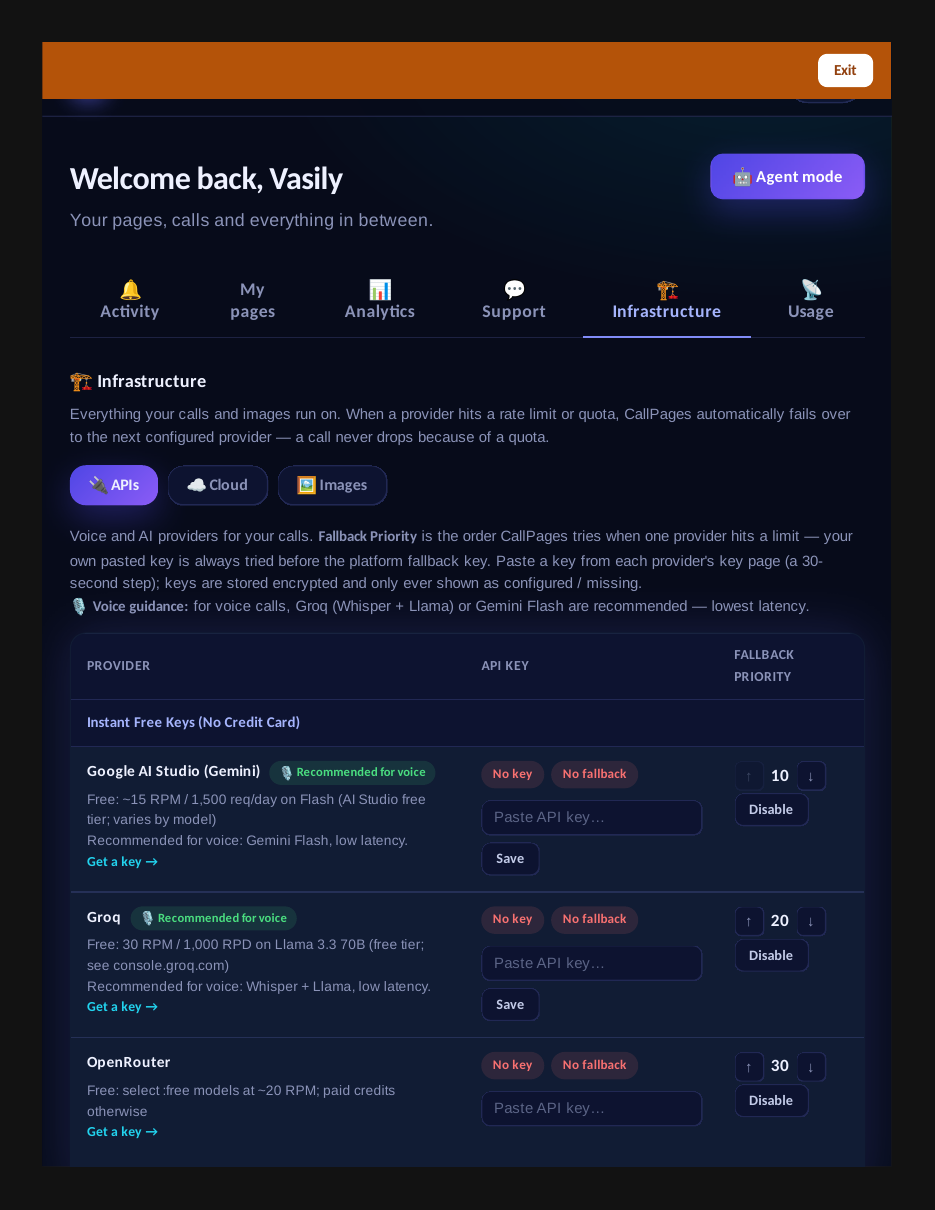
Calls are now quota-proof: when an AI provider hits its quota mid-call, the system fails over automatically — the owner’s own API keys (BYOK) first, then platform fallbacks — so no call ever dies for quota reasons alone. Owners manage every key in the new Infrastructure tab: a Provider | API Key | Fallback Priority matrix with honest rate limits and where-to-get-key links.
A voice call is a live conversation, and live conversations cannot pause for an API quota. When the provider behind the voice agent answered 429 — quota exhausted — the call had nowhere to go and died mid-sentence. One provider’s bad day became every caller’s problem, and the owner only learned about it from the silence. Quota is a billing event; it must never be a customer-facing event.
One provider’s bad day is no longer every caller’s problem
The rule behind this release is simple: quota is a billing event, not a customer-facing event. A caller mid-conversation should never hear silence because an API key ran out of its daily budget. So the call infrastructure now treats every provider as replaceable: Gemini, Groq, Mistral, OpenRouter, Cloudflare Workers AI, NVIDIA NIM, and the rest form a chain, and the moment one answers “quota exceeded,” the call continues on the next link — automatically, mid-sentence, with nothing for the owner to do.
Your keys first, the platform as safety net
Owners who paste their own API keys get two advantages: their calls burn their own quotas first (predictable billing, no shared-pool surprises), and the platform’s fallback keys stand behind them as the safety net. The Infrastructure tab makes the whole arrangement visible and editable: every provider is a row — name, key, fallback priority — grouped honestly into free-instant keys and trial/paid keys, each card carrying the provider’s real rate limits and a link to where the key is issued. Keys are probe-verified on save, so a typo can never silently poison the chain.
Cheap by design, not by accident
Failover without cost discipline would just move the bill. The standing frugal-model principle keeps the default on the lightest, cheapest, highest-limit model that does the job — heavier models only where the simple one provably underperforms — and voice guidance keeps live conversation on low-latency models. And when everything is truly exhausted, the call fails openly with a named reason the diagnostics record carries (see the companion story on full-AI call records): an honest ending is always better than a silent one.
Innovation by Vasily Starostenko.
How it works
- Automatic mid-call failover: when a provider responds with 429, quota, or rate-limit signals, the failure is classified (quota_429) and the same step is retried on the next provider/key in the chain — mid-call, automatically, with no owner action and no caller-facing gap.
- Two key layers: the owner’s own key is used first (BYOK, stored per account). When it is exhausted, the platform’s fallback key takes over, then the next provider in the chain. Your keys, your limits, your priority — the platform is the safety net, not the first resort.
- The Infrastructure tab: a Provider | API Key | Fallback Priority matrix, editable by the owner. Paste a key, drag the priority, and the key is verified with a harmless probe (list models) before it is saved — a dead key never enters the chain.
- Honest provider labels: providers are grouped into ‘Instant Free Keys (No Credit Card)’ and ‘Trial Credits / Pay-As-You-Go’. Each card shows the provider’s real rate limits and a link to where the key comes from. OpenAI and Anthropic are offered as paid BYOK only — they have no free API tier, so they are never listed as free.
- The frugal-model principle: the chain defaults to the lightest, cheapest, highest-limit model that does the job, escalating to heavier lower-limit models only where the simple one underperforms. Voice guidance steers live voice to low-latency models for the fastest turn-taking.
- Open failure, never silent: if every provider and key is exhausted, the call ends with a named reason instead of vanishing — an honest degraded error the diagnostics record, not a mystery.
- Proven pattern: the failover chain generalizes the image-provider chain that has run since 2026-10-18 (eleven providers with smart failover) — the same classify-and-continue discipline, now protecting live calls.
See it live: Mi Junta
Mi Junta — CallPage · Mi Junta — website
The Infrastructure tab’s BYOK provider matrix: Provider | API Key | Fallback Priority with honest rate limits.
Related reading
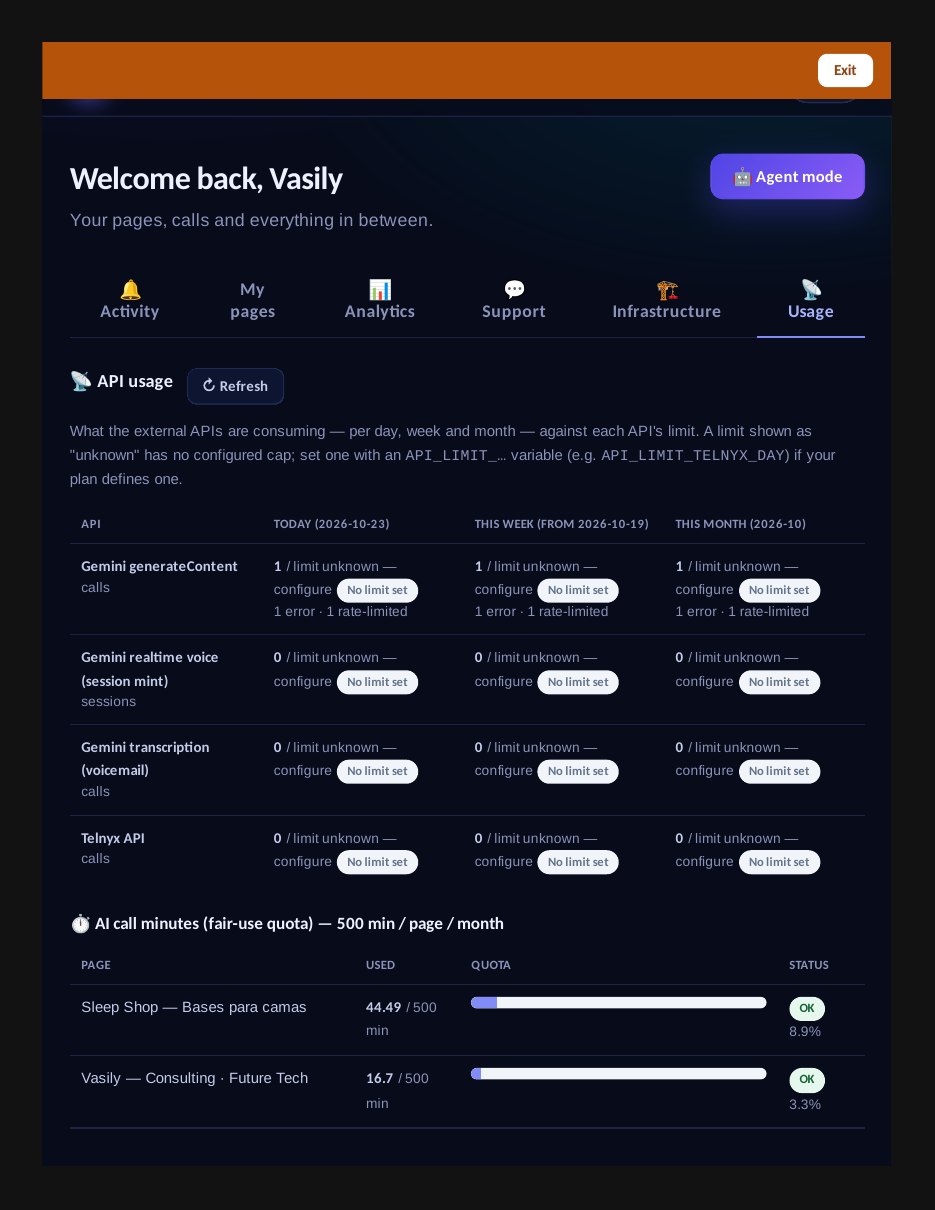
- The Usage tab: every API’s consumption, day by day, against its limits
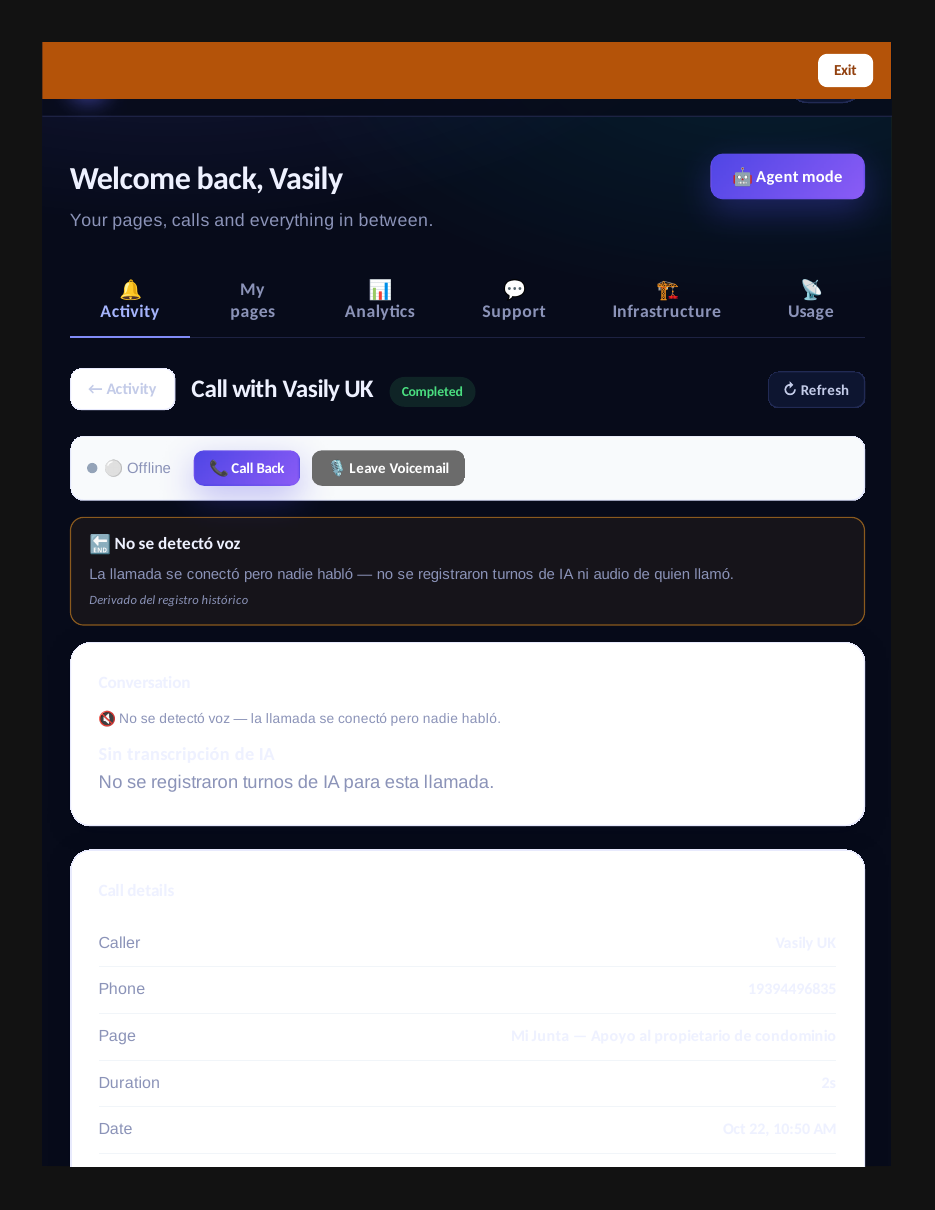
- Every call record now carries the full AI picture — and a clear reason it ended
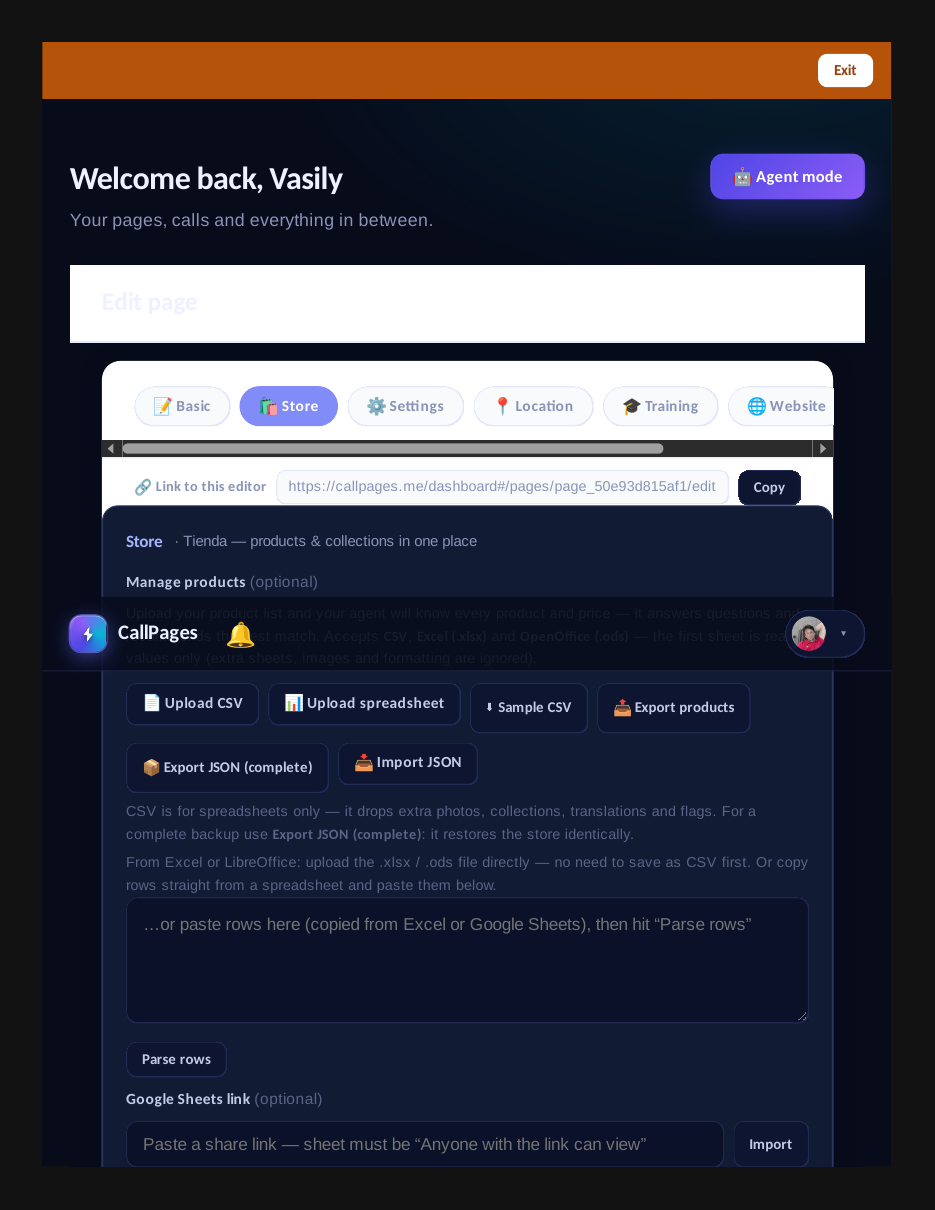
- Your catalog can’t be wiped by accident anymore
- This guide in the Learning Center
- Release notes 2026.10.23
Innovation by Vasily Starostenko, founder of CallPages.
Create your call page
Turn your website visitors into phone conversations — set up in under two minutes.
Create your call page →