In CallPages (click-to-call pages with AI voice agents), the release-all wave of October 22, 2026 shipped every held feature at once: an automatic meta page uniting an account's businesses, agent mode for plain-language page management, a customer presence selector the call flow respects, Google One Tap sign-in, read-only page sharing, owner test mode, a redesigned site in 24 languages, and multi-domain pages.
Features that are built but not released help no one. A long list of finished work — account meta pages, agent mode, customer presence, one-tap sign-in, page sharing, a full site redesign — sat verified in staging while owners kept using the older product. This wave closed that gap: everything was re-verified against the current product, conflicts were reconciled one by one, the full test suite was run on the final tree, and only then did it ship.
Everything held, shipped — and verified on the live product
This release is different in kind: instead of one feature, it is the entire backlog of finished work that had accumulated in staging, released as one wave after each piece was reconciled with the current product and re-verified. The gate was the full automated suite on the final tree — 2,375 tests passing, with the only failures being a small pre-existing family that predates the wave and is tracked separately — plus live checks of every changed surface on production after the deploy.
One page that unites an account's businesses
Owners with several pages — a shop, a service, a side business — had no single public home for all of them. Now every account has exactly one meta page with its own website: a public face that lists each of the account's pages with its own name, category, photo and link. It exists for new accounts from day one and was backfilled for existing accounts, so the portfolio page an owner can share is simply there.
Manage by asking: agent mode
Agent mode lets an owner run page-management commands in plain language from the dashboard — create a page, rename it, set its description — with a deterministic parser that shows exactly what it understood before anything is applied. The same wave added the ride-providers catalog (Uber by default; Waymo, Zoox and Apollo Go flagged as coming soon) and a public /ride page for Map-to-Ride handoffs.
Presence: customers say when they can talk
Signed-in customers now carry a presence — online, away, busy, offline — in the Messenger sense. Owners see it next to each live visitor; a call to a customer who set themselves offline or busy is refused politely at the source with the reason shown, instead of ringing someone who asked not to be disturbed.
Smaller taps, bigger polish
Google One Tap removes the password step for returning owners. Read-only sharing lets an owner show a page to a collaborator without handing over the keys. Owner test mode lets an owner rehearse their voice agent safely. The marketing site was redesigned and now speaks 24 languages; pages can carry several domains, each with its own routing target; and a call started from a product page stays on that page — with every product button preserved — instead of navigating away.
Innovation by Vasily Starostenko.
How it works
- A meta page for every account: each account now has exactly one meta page with its own website, listing all of the account's pages with their own name, category, photo and link — created automatically for new accounts and backfilled for existing ones.
- Agent mode: owners can manage their pages with plain-language commands (create, rename, describe) from the dashboard, and a public ride-providers catalog plus a /ride page now power Map-to-Ride handoffs with Uber as the default provider.
- Customer presence: signed-in customers pick their availability — online, away, busy or offline. Owners see it in the live visitors panel, and the call flow respects it: a customer who is offline or busy is not rung (the owner sees why, in plain language).
- One Tap sign-in: returning owners sign in with the Google account already on their device or browser — one tap, no password re-entry — on top of the same verified session system.
- Sharing and test mode: a page can be shared read-only with another account, and owners can test their own voice agent in a test mode that never touches real customers or sends real messages.
- The site itself: a redesigned CallPages landing in 24 languages, per-page multi-domain support (one page, several domains, each routable to its own target), storefront sorting with a compact photo-wall view, and calls started from a product page now stay on that product page with all its buttons preserved.
See it live: Mi Junta
Mi Junta — CallPage · Mi Junta — website
Related reading
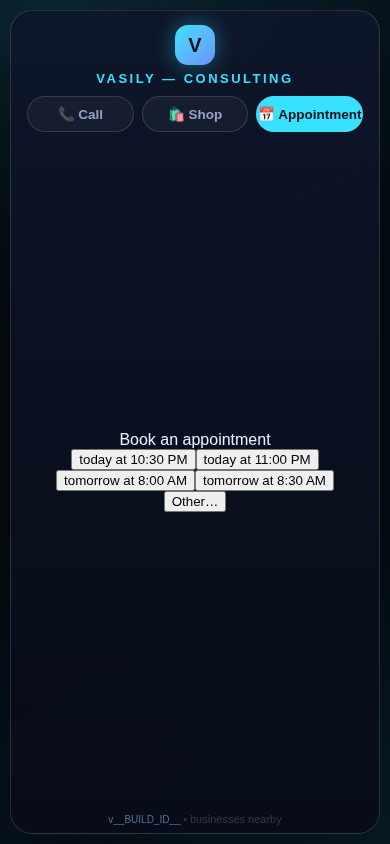 Appointments belong to CallPages: booking works on every page, Google Calendar only syncs
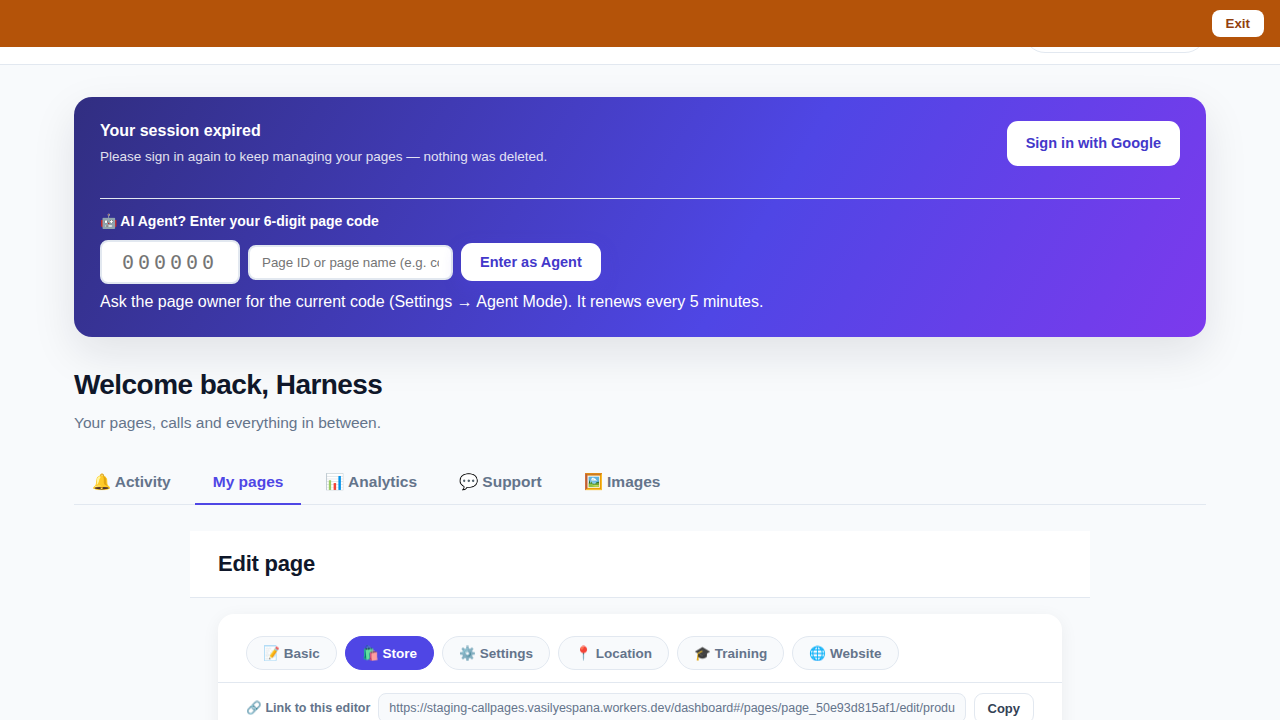 Bookmark the editor: deep links into your page, and a light My Pages landing
Innovation by Vasily Starostenko, founder of CallPages.