Dysfunctionality: the software industry's default setting — and the command center we rebuilt instead
Dysfunctionality is software that performs the appearance of working instead of working: buttons that do nothing, streams that load forever, errors that blame the user for the system’s failures. We found all three in our flagship, and we publish the evidence — because leadership in live-call command is not a feature list. It is the refusal to ship pretense, proven on the real surface, before and after side by side.
Every software team ships dysfunctionality eventually: the control that toggles nothing, the feed that spins forever, the error message that lies politely. It survives because demos run on tiny fixtures, because a 200 response is mistaken for a working product, and because nobody opens the real screen on the real account at real volume. This week the person who found it in CallPages was our founder — in Mission Control, the flagship surface of the whole platform — and our doctrine says that moment is not an embarrassment to bury. It is the most valuable QA event a company can have, and the correct response is to reproduce it, restore the real thing, and publish both.
This morning, our founder opened the CRM, went to Mission Control, and pressed Maximize.
Mission Control is the flagship surface of CallPages: the live command center where a business owner watches an AI voice agent talk to a real customer — silently, by listening in, or by stepping in as a participant. It is the feature we demo, the feature we lead with, the feature whose design he personally directed down to the color of his own turns in the transcript.
Maximize gave him a slightly bigger box.
His message to the team was exact: “the mission control is completely broken. The maximize state looks nothing like what we had before. Do you remember when we had it maximized — the very beautiful mission control command center? This is not what I was asking for. You need to check what was the good mission control, which I liked.”
So we checked. This article is what we found — all of it, including the parts that are our fault — and what we rebuilt. We publish it because the finding has a name, the name indicts an entire industry, and the only credible claim to leadership in this space is a public refusal to practice it.
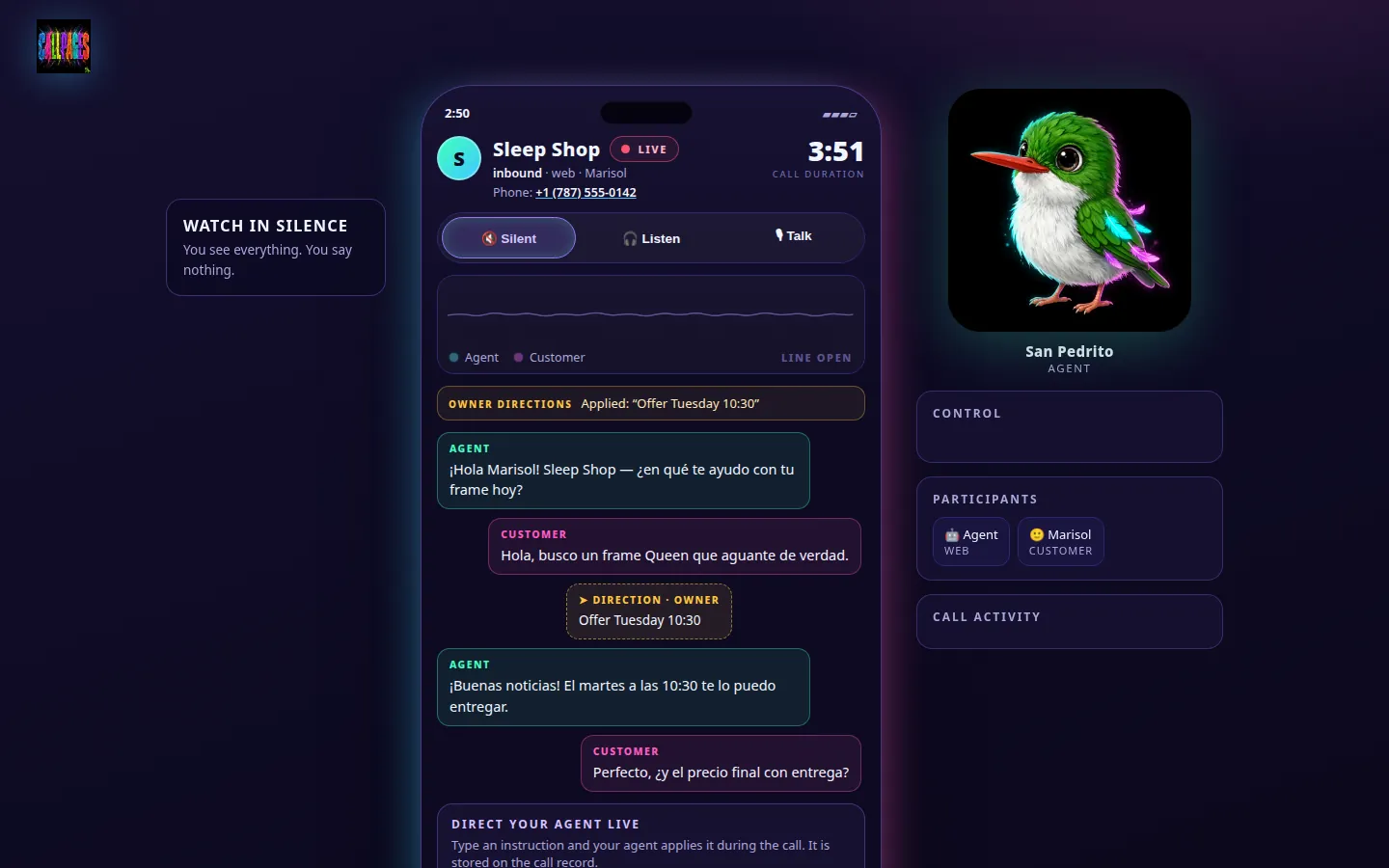
The command center as it was designed: one phone, center and huge; the three modes on the handset; the page’s animal — San Pedrito — alive at its right edge. This render is the restored build, shown in full below, next to what it replaces.
The disease has a name: dysfunctionality
Dysfunctionality is software that performs the appearance of working instead of working.
It is not the honest bug — the crash, the red banner, the error that says what broke. Honest bugs are visible, and visible things get fixed. Dysfunctionality is the polite kind: the control that responds to your click with a subtle animation and changes nothing; the feed that says Loading… with total confidence, forever; the error message that blames your connection for a failure the system caused and could name. Dysfunctional software passes demos, passes screenshots, passes status codes — and fails the only test that matters, which is a person trying to use it for real.
Every team ships it eventually. The question that separates the industry is what happens next: whether the pretense gets a coat of paint, or gets hunted down, reproduced, and published. This week we found three specimens of it in our own flagship product, within days of each other. Here they are, named.
Exhibit A: the button that did nothing
The Maximize control in Mission Control was built and shipped — a real button, wired to a real handler. The handler did exactly one thing: it toggled the visibility of the elements inside the panel. What it never had — what nobody ever wrote — was a single rule of styling for the maximized state itself.
Read that again, because it is the purest form of the disease: the expansion shipped with zero expanded-state CSS. Pressing Maximize re-showed the same small panel in the same light column. With no live calls, it revealed a small dashed-border box reading “🎛️ Mission Control is on.” With a live call, the call stage appeared at 720 pixels inside the column — the command center, postage-stamped.
Every gate we run passed it. The button existed. The handler fired. The state toggled. Nothing anywhere asserted the only thing the owner meant by the word maximize: that the stage becomes the room.
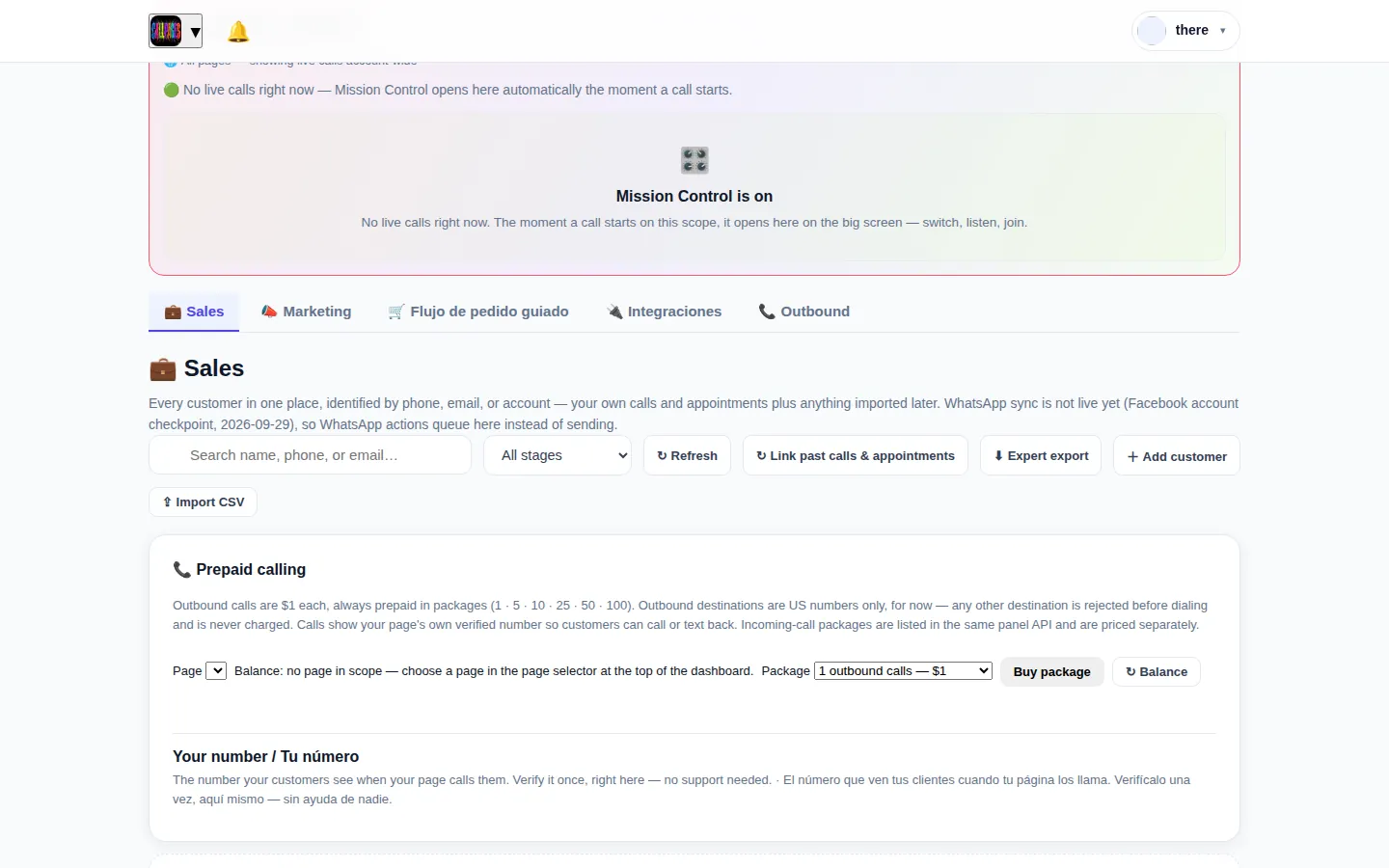
BEFORE — the maximized state, zero calls: a dashed box in a column. This is the screenshot our founder’s verdict describes, reproduced from the exact shipped build (20261113T12432).
Exhibit B: the stream that loaded forever
The Stream tab in the same dashboard had been sitting on “Loading stream…” — through thirty seconds, through a reload, through twenty-five more. Not slow. Never.
The root cause is an arithmetic lesson the whole industry keeps failing. The server path behind that tab re-ran an unbounded fan-out of database queries on every read — and the tab re-polls every five seconds:
- The inbox portion loaded every conversation thread on the account, then ran one query per thread for its messages.
- A completeness check ran one query per non-closed support ticket — roughly 800 queries on the founder’s real account — and then repeated the per-thread fan-out on top.
- A third portion built a database
IN()list with ~4,458 bind parameters — one per page on the account — beyond the database’s statement limits. That failure was silently caught, so the check did not crash; it just returned wrong numbers, forever, quietly. - And the client, for its part, painted nothing at all until both the events request and the metrics request had resolved — so one slow leg blanked the whole tab behind a loading message.
Why did no test catch this? Because test fixtures are tiny. On a fixture account with four threads and three tickets, the fan-out is twelve queries and the tab loads instantly. Dysfunctionality is scale-blind: it is invisible at demo volume and total at real volume. The founder’s account — thousands of pages, hundreds of open tickets — is precisely the account our gates never simulated.
Exhibit C: the error that lied
The third specimen arrived the same morning, from the founder’s phone. Our Android merchant app opened to a full-screen message: “Couldn’t load your pages. Check your connection and try again.”
His connection was fine. We verified the platform healthy at the very minute of his screenshot — health endpoint green, and the pages endpoint answering a correct, clean unauthorized response to a request without a session. That was the actual story: the app’s session had expired, the server said so precisely, and the app translated that precise answer into a vague accusation against the user’s network — plus a Try again button that replays the identical doomed request. A dead end, wearing a helpful expression.
This is the third face of dysfunctionality: the error that lies politely. A system that knows exactly what failed owes its user that fact, in words: your session expired — sign in again. An error that names its step can be acted on. An error that blames the connection can only be endured.
Three exhibits, one disease: a button performing expansion, a stream performing loading, an error performing help. None of them crashed. All of them shipped. That is what dysfunctionality means — and it is why we treat it as the enemy, in public, starting with our own product.
Why smart teams ship pretense
It is tempting to read those three exhibits as carelessness. They are not. They are what competent teams produce under four ordinary pressures:
Demos run on fixtures. Small data makes fan-outs free and loading instant. The defect class only exists at real volume, so it is only findable at real volume.
A 200 is mistaken for evidence. The button returned success, the endpoint returned success, the app received a well-formed response. Status codes certify that a server answered. They say nothing about whether a person got what the screen promised.
Green suites feel like proof. Our gates ran thousands of tests over this code. Every one of them tested the product we described, not the product the owner meant — because the meaning (“maximize = the stage becomes the room”) lived in a design demo, not in an assertion.
Politeness is cheaper than truth. A generic “check your connection” never has to be wrong in a support ticket. A precise error creates obligations. Systems drift toward the message that costs the least to say.
The countermeasure is not more effort. It is a different definition of done — one that makes pretense structurally hard to ship. The rest of this article is that definition, applied.
The promise, as published at launch. Dysfunctionality is the distance between the card and the click — the distance this restore closes.
The restore: return to the design, prove it on the surface
The founder’s instruction contained its own specification: “check what was the good mission control, which I liked.” The good one existed — as a complete design base he had directed and approved: a futuristic concept demo built around a single realistic handset, which he had greeted, at the time, with “Love it. I love the character, I love our brand, I love the futuristic style.” The shipped product had drifted from that base into a competent grey dashboard. The defect was the drift. So the restore did not invent a new design. It brought the product back to its own approved one.
The stage is recomposed around one handset — center, huge, vertical — on the deep indigo-violet ACID nebula, the official v5 POWER wordmark top-left. On the phone, top to bottom: the status row and dynamic island; the call header (avatar, business, LIVE chip, timer); the segmented three-mode control; a waveform colored by speaker — the agent in mint #40FFBE, the customer in magenta #FF5CC4, the owner in gold #FFC640 — with a tag naming who is speaking; the persistent OWNER DIRECTIONS strip; the transcript bubbles (agent left, customer right, owner turns in gold); the directions composer; and the presence line, whose progress hairline fills in the mode’s color as the owner’s presence deepens. A caption chip at the left restates the current mode in plain words, so the state of the call is never a riddle. The page’s animal stands large at the phone’s right edge, unboxed, reacting to the mode — calm in silence, attentive in listening, celebrating a direction applied.
The old stage, for the record, had the animal boxed at 196 pixels beside a rainbow bar waveform, the transcript in a side card, three emoji buttons (🔇 🎧 🎙) in a control card, and speaker colors that contradicted the design — the agent in acid green, the customer in cyan, and the owner’s own turns in violet, a color the design assigns to silence. Everything worked. Nothing was right.
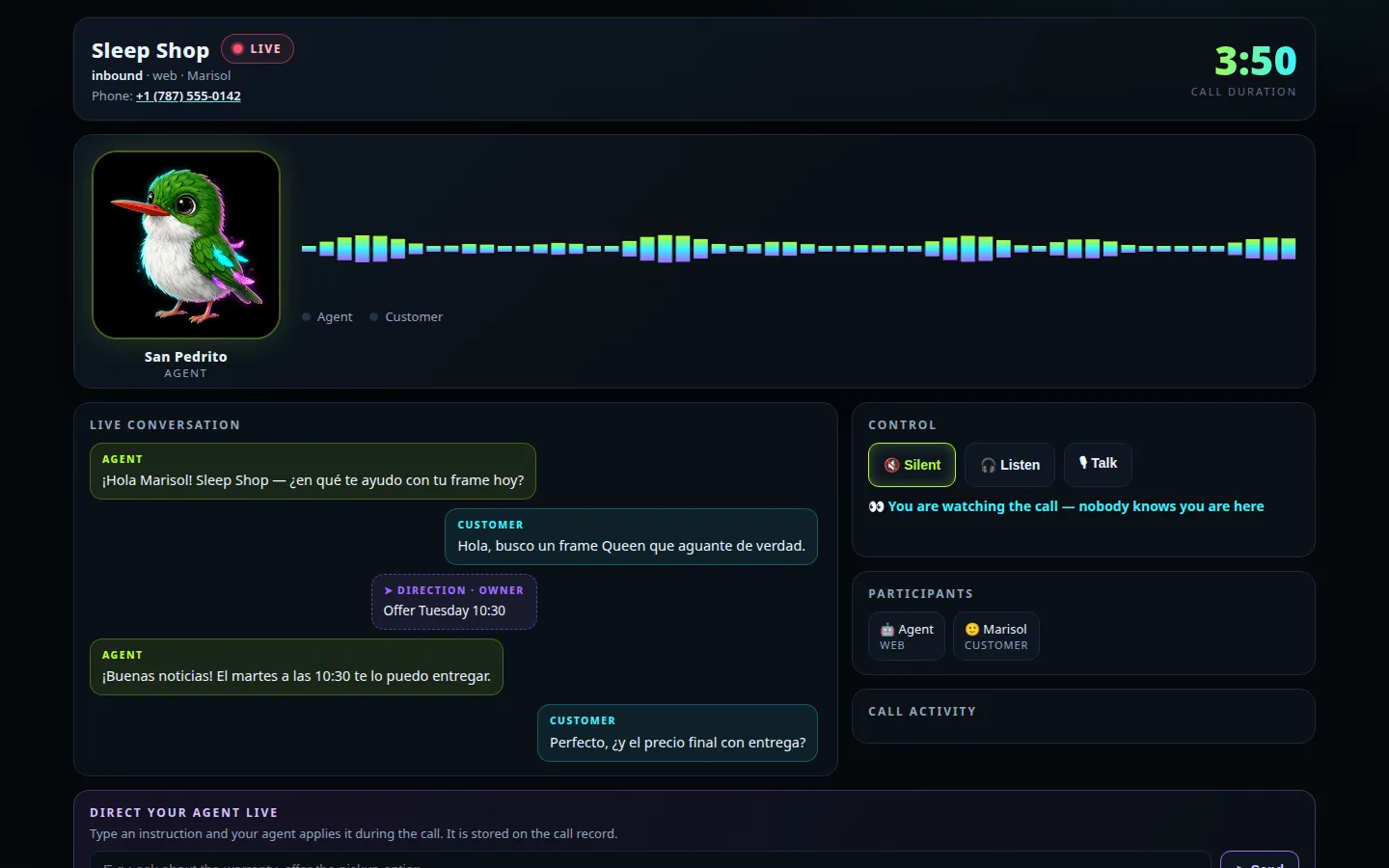
BEFORE — the same stubbed call on the shipped stage: panels, cards, and the wrong palette throughout.
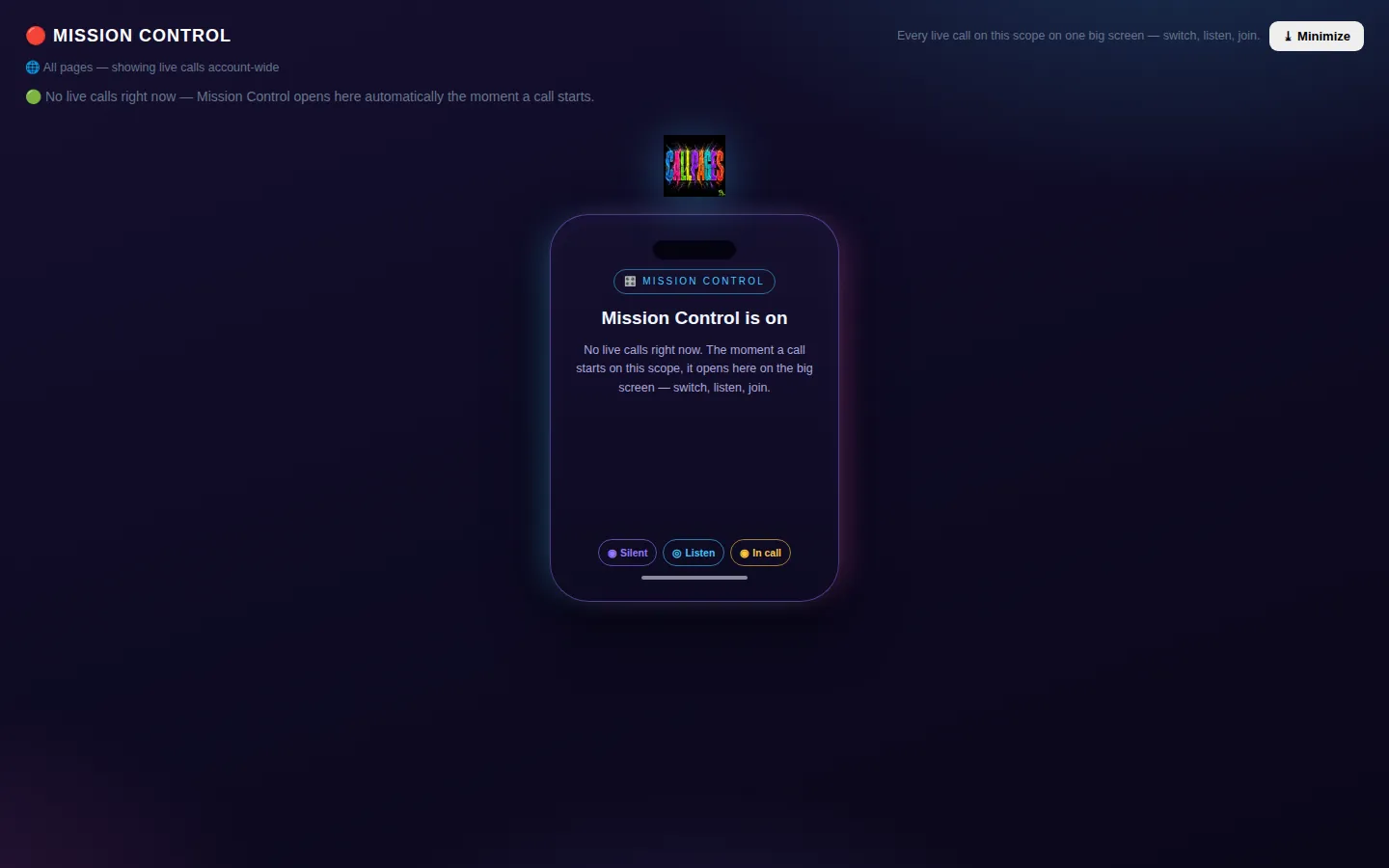
AFTER — Maximize, zero calls: the full-viewport stage with the handset at rest, its three modes legible before any call exists.
Underneath the visuals, the Stream’s fan-out is now bounded: message loads are batched through a chunked loader (at most 90 keys per statement, order preserved, identical results), the 4,458-bind list is replaced by a subquery selecting the same set, and the client paints the events list the moment the events leg lands — the metrics leg runs concurrently and can no longer blank the tab by failing. Maximize is now a true stage: a full-viewport fixed surface on the nebula, the frame filling it, and the zero-call state showing the phone at rest instead of a dashed apology.
Two verification details deserve print, because they are the doctrine operating on itself. First, the fix was written test-first: a new suite of five tests was written against the shipped tree and failed on all five, for the named reasons — the stream’s statement count at seeded volume (60, against a bound of 4), the missing render-order fix, the missing phone regions, the missing lockup and palette, the missing expanded-stage CSS. After the restore: five of five pass, including assertions that the feed’s semantics did not change while its cost collapsed. The full suite ran A/B against a pristine copy of the shipped tree — 6,847 tests on the fixed tree, zero new failures. Second: the first “after” screenshot of the maximized stage caught a bug in the fix — a legacy inline style outranked the new stage background, and only the screenshot showed it. The CSS was scoped properly and the shot re-taken. Even the repair gets verified on the real surface. Especially the repair.
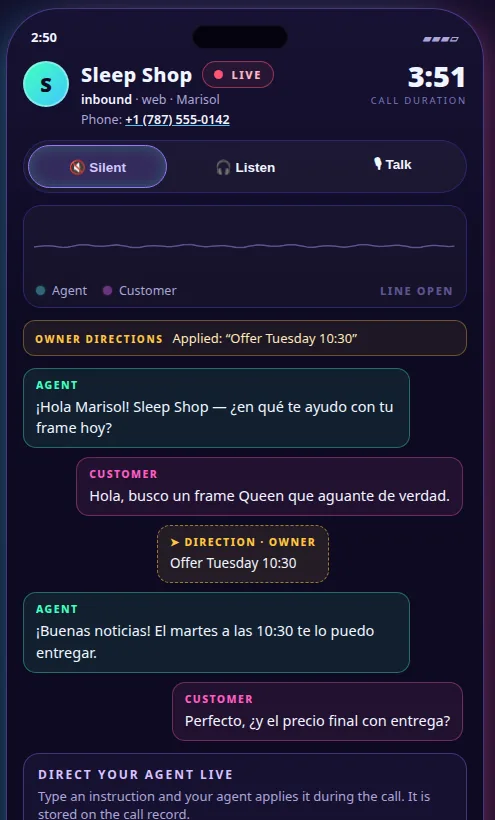
The handset close: header, timer, the three modes, and the OWNER DIRECTIONS strip — the latest applied direction, kept as evidence.
The doctrine: three modes of presence
Why does a call need a command center at all? Because an AI agent talking to your customer is the most consequential unattended act in a modern small business — and the owner’s relationship to it cannot be a log file reviewed tomorrow. It has to be presence, graded exactly to intent. That grading is the three modes, and each is a philosophy before it is a button.
Silent — watch, and say nothing. The owner sees everything: the live transcript as it forms, the waveform, the timer, the business’s own agent handling a real customer in real time. Presence without intrusion. The customer never knows; the agent never performs for an audience. This mode is for trust — the owner’s right to verify, continuously, that the voice speaking in his name deserves it. In the design, silence has a color (violet) and a caption that says what it means: You see everything. You say nothing.
Listen — hear the room. Transcripts flatten the truth: they lose the hesitation before a “yes,” the warmth, the irritation rising under politeness. The second mode adds the owner’s ears to the call — the room tone of his own business, live. Supervision stops being textual and becomes human again. (We state its build status plainly in Method & limitations below: the mode’s place in the design and the stage is built; end-to-end listen-in audio proof is a named verification still ahead of us, and we will not describe it as proven until it is.)
Participate — direct, and join. The owner is not an observer of his own business. In the third mode he conducts: he types a direction — offer Tuesday at 10:30 — and the agent applies it inside the live call, the direction landing in the transcript as a gold turn, permanently on the record. The stage keeps the latest applied direction in its strip, not as decoration but as evidence: supervision that leaves an audit trail. And when direction is not enough, the owner joins the call as a participant — the agent’s principal stepping onto his own stage. The presence hairline tells the story at a glance: a third full in silence, two thirds in listening, full in gold when he is in the call.
This is the orchestra-conductor model our founder set for the product: the agent plays, the owner conducts — present at the exact depth the moment requires, never locked out of his own performance, never forced to interrupt it either. Around the handset, the CRM keeps Mission Control always on and large: every live call on the account, switchable in one tap; and when a call ends, it reopens in the same view as a replay — the settled transcript and record where the live stage stood, so history and presence share one surface instead of two.
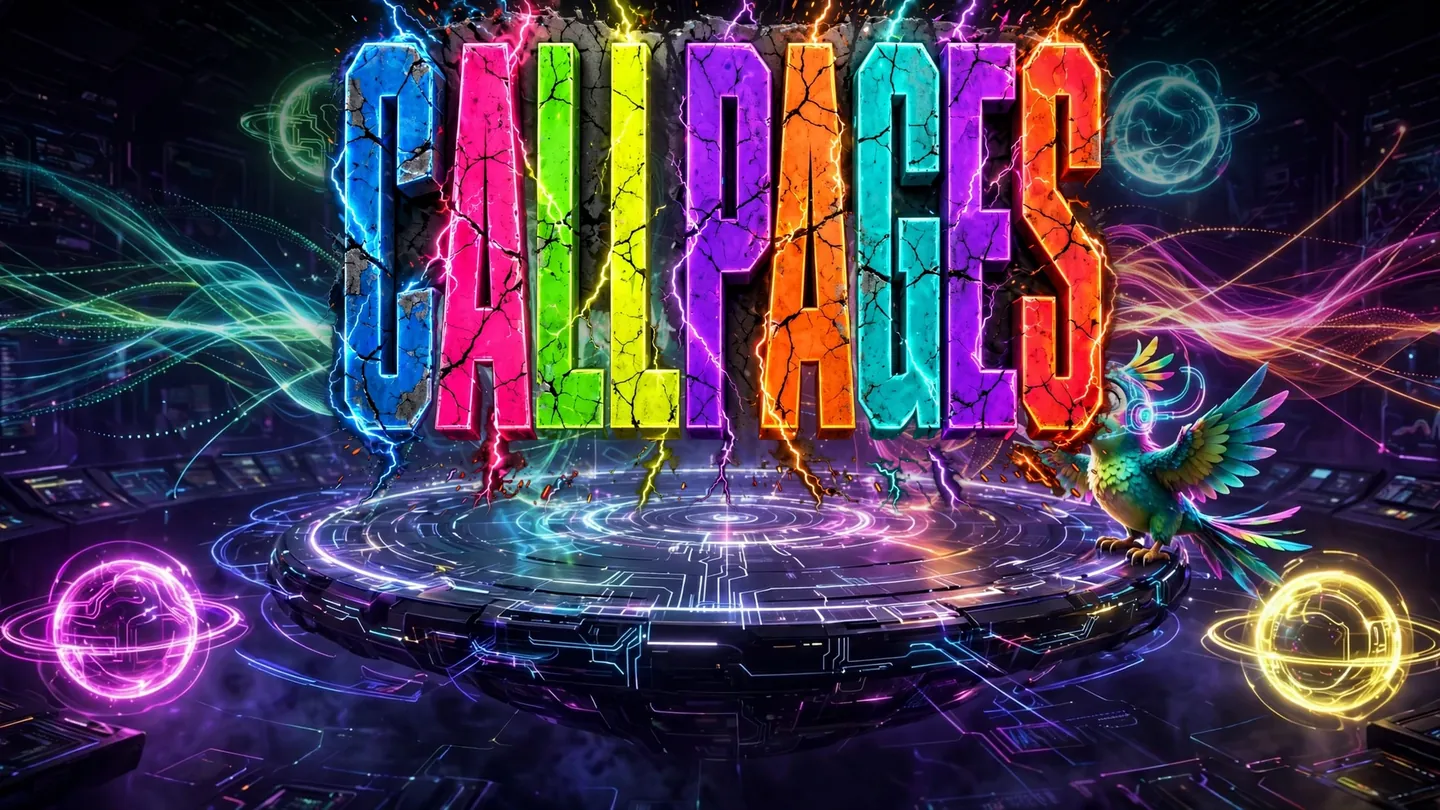
The vision as drawn at concept time: the handset at the center of an ACID world, the cast in attendance. The restore treats this art as specification, not inspiration.
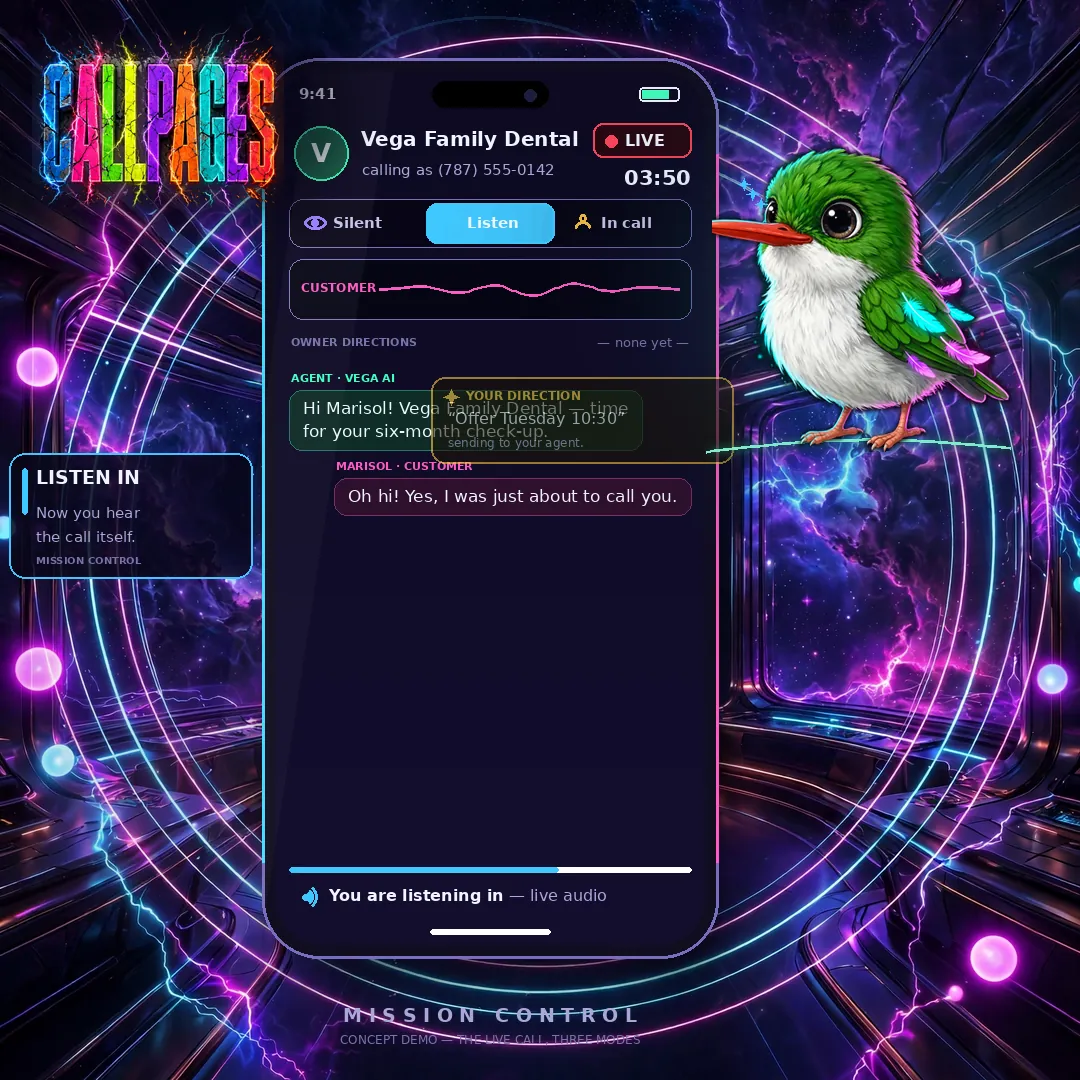
From the original demo the owner approved: the call as a phone, the animal reacting at its edge. Every Mission Control decision since traces back to this frame’s logic.
The phone is the true form of a call
There is a reason the command center is a phone and not a dashboard, and it is not aesthetics.
For the customer, the call is a phone: a voice in their hand, in their kitchen, on their job site. A monitoring grid of panels describes the call the way a spreadsheet describes a conversation — completely, and falsely. The grid tells you a call is a row with attributes. The handset tells you the truth: this is a person, talking, now, in an object you understand at a glance because you have held one ten thousand times.
Command should mirror the thing commanded. When the owner looks at Mission Control he should feel what the founder’s directive demanded on the day the doctrine was set: like holding the phone and talking yourself — except the voice agent is talking. Every element on the handset earns its place by that standard: the transcript is the conversation, the waveform is the voice, the modes are your grip on the call — watch it, hear it, take it. Nothing is on the phone that a phone would not carry; everything the owner needs is one glance deep.

The Múcaro — one of the official animal hosts who live on these surfaces as real characters, reacting to the call beside the phone. In the Sleep Shop stage above, the seat belongs to San Pedrito.

Vertical concept study: the call fills the frame the way it fills the customer’s attention.
The demo in motion: the handset cycling its modes. Motion was part of the specification from the first day — the animal reacts, the hairline fills, the mode announces itself in words.
Leadership is a refusal discipline
Any vendor can announce a command center. The feature list is not the leadership claim; a grid of panels with emoji buttons also has a feature list, and we know — we shipped it.
Leadership in live-call command is the discipline that makes dysfunction structurally unlikely and publicly answered when it appears:
- The design the owner approved is treated as a specification with legal force inside the building; drift from it is a defect class, not a taste difference.
- Every surface is verified the way the founder verifies it — opened, on the real account, at real volume — because that is where dysfunction lives.
- Failures found by the customer’s own hand are classified as process failures: the instance gets fixed, and the gate that should have caught it gets built the same day.
- Errors are required to tell the truth, in words, naming their step — because a system that lies politely to its user has chosen its own comfort over the user’s agency.
- And the evidence gets published: the before, the after, the counts. This article is itself an instance of the policy. The three exhibits above are our own product, our own week, our own fault — printed at full size, next to the restored design, because a leadership claim that cannot survive its own screenshots is marketing, and marketing is just dysfunctionality with better lighting.
What does the moat look like, then? Not a feature. A loop: detect on the real surface → reproduce at real volume → restore against the approved design → prove with fail-first tests → publish the pair. Run that loop faster and more honestly than anyone else in the category, and the category’s center of gravity moves to you. That is the business we are building, in the open, one restored surface at a time.
Maximum ACID, on the record: the brand standard every surface is restored against.
Method & limitations
How the evidence in this article was produced, and what it does not claim:
- Renders. The BEFORE screenshots were rendered locally from the exact shipped tree (production build 20261113T12432) and the AFTER screenshots from the fixed tree, both driven by the same stubbed live feed and the same fixture (a Sleep Shop inbound web call), so the pair differs only in the product, not the data. They are not photographs of the founder’s live account.
- Status of the restore. The restored command center and the Stream fix are built and verified in the staging tree — new fail-first suite 5/5 after being 5/5 red on the shipped tree; 161 neighboring tests green; full-suite A/B against a pristine copy with zero new failures — and they ship in the next release train. They are not yet in production as this article publishes. The founder’s own live proof (CRM → Mission Control → Maximize, plus the Stream tab, on his real account after the release) is a named, scheduled step; this article will be updated when it lands.
- Full-suite caveat. In the A/B run, the pristine tree failed 71 of 6,842 tests and the fixed tree 48 of 6,847; the 23-test difference is a known load-sensitive flaky family that failed only in the pristine run under heavy host load. We claim zero new failures, not zero failures.
- Listen mode. The three-mode stage, including Listen, is built into the restored design; end-to-end listen-in audio has not yet been proven on a live call, and it is framed in this article as build direction, not as demonstrated capability.
- Feed limits. The live call feed carries no presented number and no recording URL. The restored header therefore shows the counterparty’s number (as the prior build did) rather than inventing a “calling as” number; ended calls show the settled transcript and record in the same view (text replay). Audio replay with synced subtitles, seeking and speed lives in the call-detail surface and was not rebuilt here.
- Scope. The CRM Outbound tab’s blank render is a separate open defect with a separate lane; the Stream root cause documented here does not explain it, and this article claims nothing about it. The Android session error (Exhibit C) is diagnosed — platform healthy at the minute of the report, the endpoint’s answer correct, the app’s translation of it wrong — and its fix follows the same pipeline: fail-first, restore, prove, publish.
- Sources. Design doctrine: the founder’s Mission Control directives of 2026-11-08/09 and the approved concept demo. Defect and fix record: the Mission Control restore registry of 2026-11-13 (design delta, patch of 4 files / 62,352 bytes applying cleanly to the shipped tree, full test record). No metrics appear in this article that are not in that record.
The standard, going forward
Dysfunctionality is the default setting of software — the industry ships pretense because pretense is what survives its processes. Our answer is a process that pretense cannot survive: real-surface reproduction, fail-first proof, truthful errors, restoration against an approved design, and publication of the evidence, especially when the evidence is embarrassing.
Mission Control is where that answer matters most, because Mission Control is where a business owner stands next to his own agent while it speaks for him. He deserves a command center that is one — a phone at the center of the room, three honest modes of presence, and a record that shows his directions in gold.
Watch silently. Listen in. Join as a participant. And when something on the screen is not what it claims to be — say so, fix it, and publish the pair.
Innovation by Vasily Starostenko.
How it works
- Reproduce on the real surface first: no fix is attempted until the failure is re-created from the exact shipped build, at real data volume, and captured — screenshot, statement count, named step.
- Write the fail-first test that names the defect: the test must fail on the shipped tree for the stated reason before any fix code exists, so ‘fixed’ is a measurement, not an opinion.
- A 200 is not evidence: a route counts as working only when a real render paints its real content — in the requested language, in the real account, at the real scale.
- Every error names its step: a user-facing error states what failed and why, in words. An expired session is never reported as a connection problem; a missing style is never reported as success.
- Restore, do not reinvent: when a design was approved by the owner, the fix returns the product to that design — the demo is the specification, and drift from it is the defect.
- Publish the before and the after: the same feed, the same fixture, both renders side by side, with the test counts. Leadership claims are grounded only in evidence a reader can inspect.
- The owner’s verdict outranks the suite: when the person who uses the product finds a defect by hand, that is a process failure — the same day, the permanent test case that would have caught it joins the gates.
See it live: Sleep Shop
Sleep Shop — CallPage · Sleep Shop — website
The command center, restored: one phone, center and huge, the page’s animal alive beside it. Rendered from the fixed tree with a stubbed live feed — the design the owner approved in November 2026, back where it belongs.
BEFORE. The shipped stage: competent panels, wrong product. The animal boxed at 196 pixels, a rainbow bar instead of a speaker-colored waveform, the owner’s direction in violet — a color the design never assigned him.
AFTER. Maximize with zero calls: a full-viewport stage and the phone at rest, its three modes already legible. Mission Control is on — and now the screen says so like it means it.
BEFORE. This is what Maximize maximized: the same small dashed box, in the same column, at the same size. The expansion shipped with zero expanded-state CSS — the button toggled visibility and nothing else.
The handset, close: header, three modes, and the OWNER DIRECTIONS strip carrying the latest applied direction as permanent evidence on the call.
Related reading
- Mission Control for Your Calls: Outbound Calling Is Live in CallPages CRM
- Every page gets its own robot: identity-bound agents that own the outcome
- This guide in the Learning Center
- Release notes 2026.11.13
Open Mission Control in your CRM →
Innovation by Vasily Starostenko, founder of CallPages.
Create your call page
Turn your website visitors into phone conversations — set up in under two minutes.
Create your call page →