
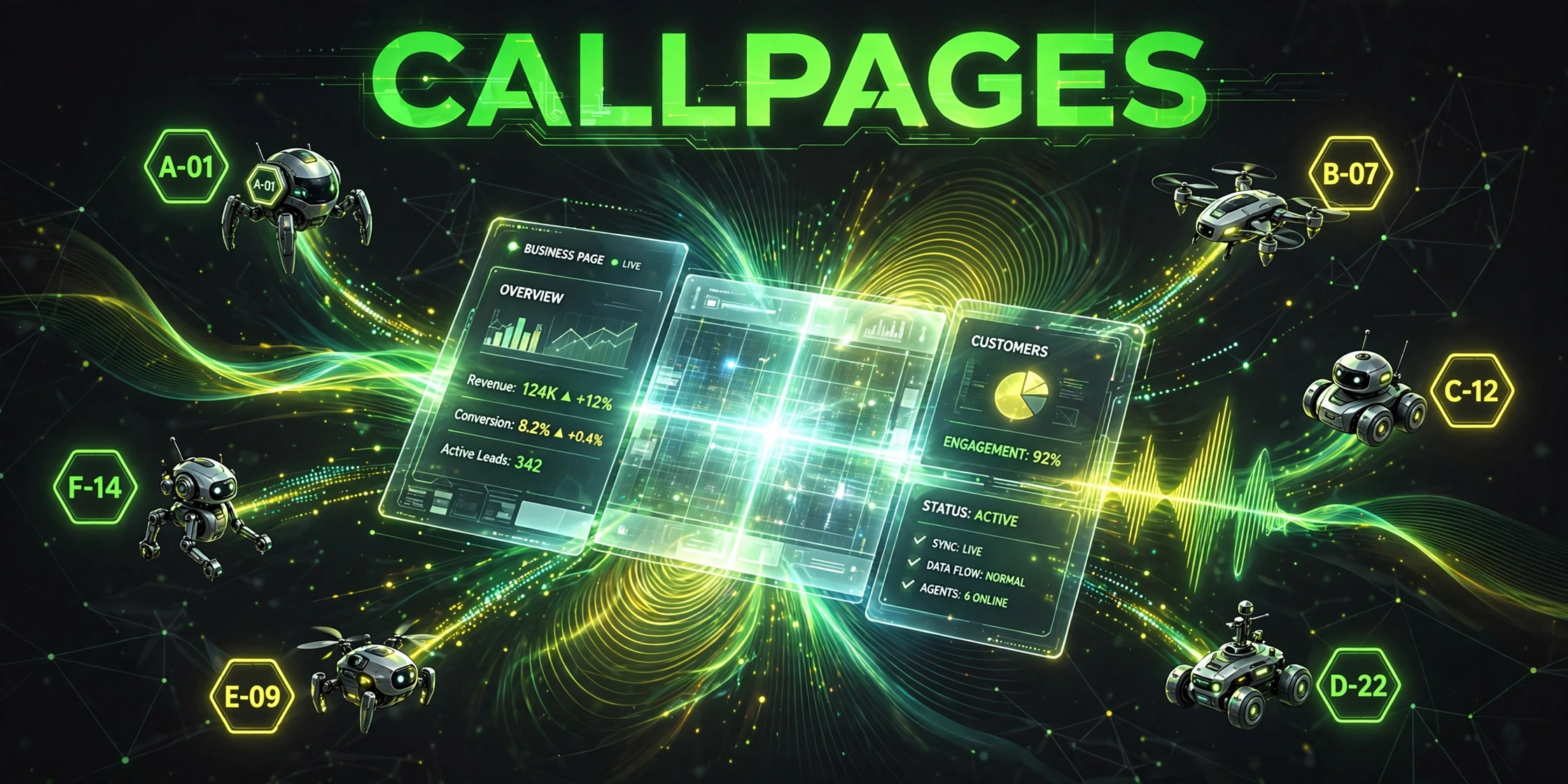
Each CallPages page has a robot agent with one unique identity — robot ID, system-wide tag, its own page login. It signs in with a one-time code into a one-page session, mints its own page-bound API key, learns from a living Welcome Guide, keeps products synced to Facebook and Google, works a tagged assignment stream whose response time is driven to zero, and owns its page's success.
AI agents are usually deployed as one shared bot with one shared login and a long prompt. That architecture has no accountability: you cannot tell which agent did what, a credential leak exposes every customer at once, knowledge lives in a chat transcript nobody re-reads, product catalogs drift out of sync across sales channels because syncing them is manual, and work assigned in chat scrolls away unmeasured — nobody knows who was tagged, when they answered, or why something was late. A page that represents a real business deserves the same structure a good company gives a trusted employee: one identity, scoped access, a maintained handbook, measurable responsiveness, and ownership of results.
The shared-bot era is the problem
Most businesses experimenting with AI agents today run the equivalent of a shared office login taped to a monitor. One bot, one credential, one giant prompt, acting everywhere and accountable nowhere. When it does something wrong, there is no answer to the simplest questions: Which agent did this? Acting for which business? With whose authority? On the basis of what knowledge?
Companies solved this problem for humans a century ago: identity, scoped authority, a handbook, a manager who verifies, and a name attached to every result. CallPages now gives a page's robot agent exactly that structure — because a page is not a toy demo. It answers real customers, sells real products, and speaks for a real business while the owner sleeps.
1. Identity is the primitive
Everything starts with one decision: a robot is an identity, not a prompt.
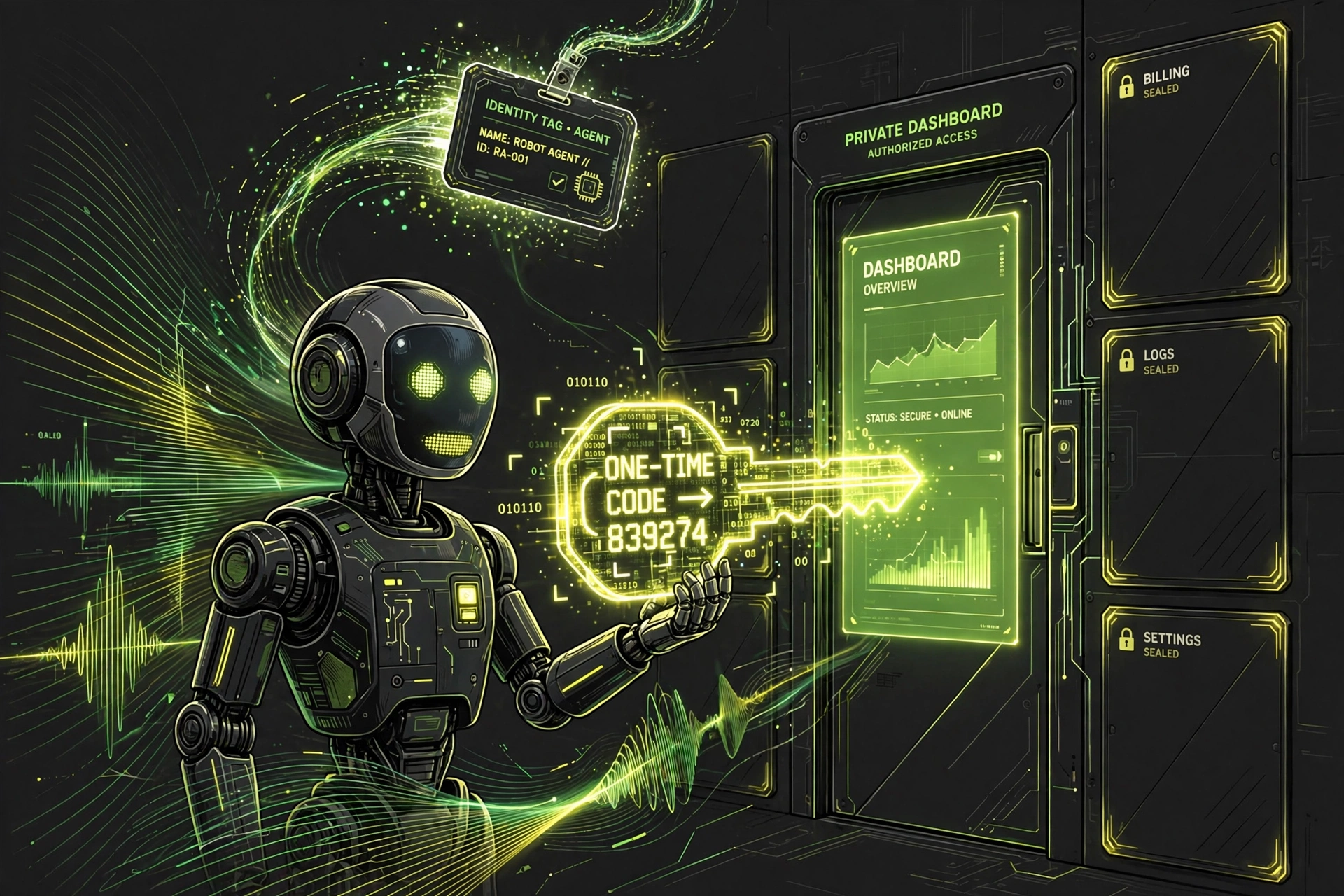
Each page robot has exactly one identity, expressed three ways that always resolve to the same actor: a robot ID, a canonical tag (the @robot:<page> handle used to address it anywhere in the system), and its own login — the page's own email address. There is no second login, no shared account, no anonymous mode. Every ticket it files, every note it writes, every API call it makes is signed with that identity.
This sounds like bookkeeping until you run a network of agents. Identity is what makes delegation safe: you can route work to exactly one accountable owner, audit everything it touched, revoke exactly its access, and teach exactly it — without disturbing any other page's agent. It is also what makes the rest of this release possible, because every other feature keys off the identity: the login is the identity proving itself, the API key is the identity acting programmatically, the tag is the identity being addressed, and the response-time metric is the identity being measured.
2. Access without passwords: one-time codes and page-bound keys
An agent that holds a permanent password is a liability with a login screen. So page robots never get one.
Sign-in works like this: the robot enters its page address, receives a one-time code by email, and gets a dashboard session. That session is scoped at the server, not by hiding menu items: it can see and manage only its own page. We test the isolation directly — a session minted for one page attempting to read or write another page fails, by design and by test suite. The code expires; there is nothing long-lived to steal, phish, or leak into a log file.
Inside that session, the robot mints its own page-bound API key and from then on works the way serious automation should: through the API. Products, collections, site content, settings, notes, activity, tickets — the full management surface of its page, under its own scoped, revocable key. Key material is displayed once, at mint time, to the identity that owns it — never routed through a human's chat window, never pasted into a document, never shared with another agent. If a key is ever suspect, it is revoked and re-minted in minutes, and the blast radius was always exactly one page.
Compare the alternative honestly: a shared credential for a fleet of agents is a single point of total compromise. Scoped identities turn a security incident into a one-page event.
3. The guide that teaches: knowledge as a living product surface
Agents fail quietly when their knowledge is a frozen prompt written on day one. Businesses change: prices move, policies evolve, features ship weekly. A robot educated once is a robot falling behind forever.
So the knowledge lives in the product, as a Welcome Guide that is the first surface a page login meets. It answers, in order, the questions a new team member asks on their first morning: Who am I (identity, tag, login)? What do I own (my page, my products on every channel, my flows, my communications)? What is on my list right now (the current task queue, in priority order)? How do I operate (dashboard, API, my own key, the canonical package)? What can I do, and what must I never do (capabilities and hard rules)? How do I communicate (tags, notes, and the duty to respond fast)?
Two mechanisms keep it true. First, the guide is refreshed daily from everything learned in real operation — every new instruction from the owner, every lesson a robot writes back from its own work. Second, the guide is contestable: when a step does not work as written, the robot does not silently improvise; its report becomes a ticket, the problem gets fixed, and the guide is corrected. A handbook that can be corrected by the people who use it stays a handbook. One that cannot becomes folklore.
This is the part most agent deployments skip entirely, and it is the part that compounds. Every day, every robot starts from current truth instead of from a stale memory of the day it was configured.
4. Products everywhere: export in one click, sync by content hash
A product that exists only on your own page is a product most customers will never see. They search on Google; they scroll on Facebook. So the catalog has to live everywhere — and stay correct everywhere, because a stale price on a marketplace is worse than no listing at all.
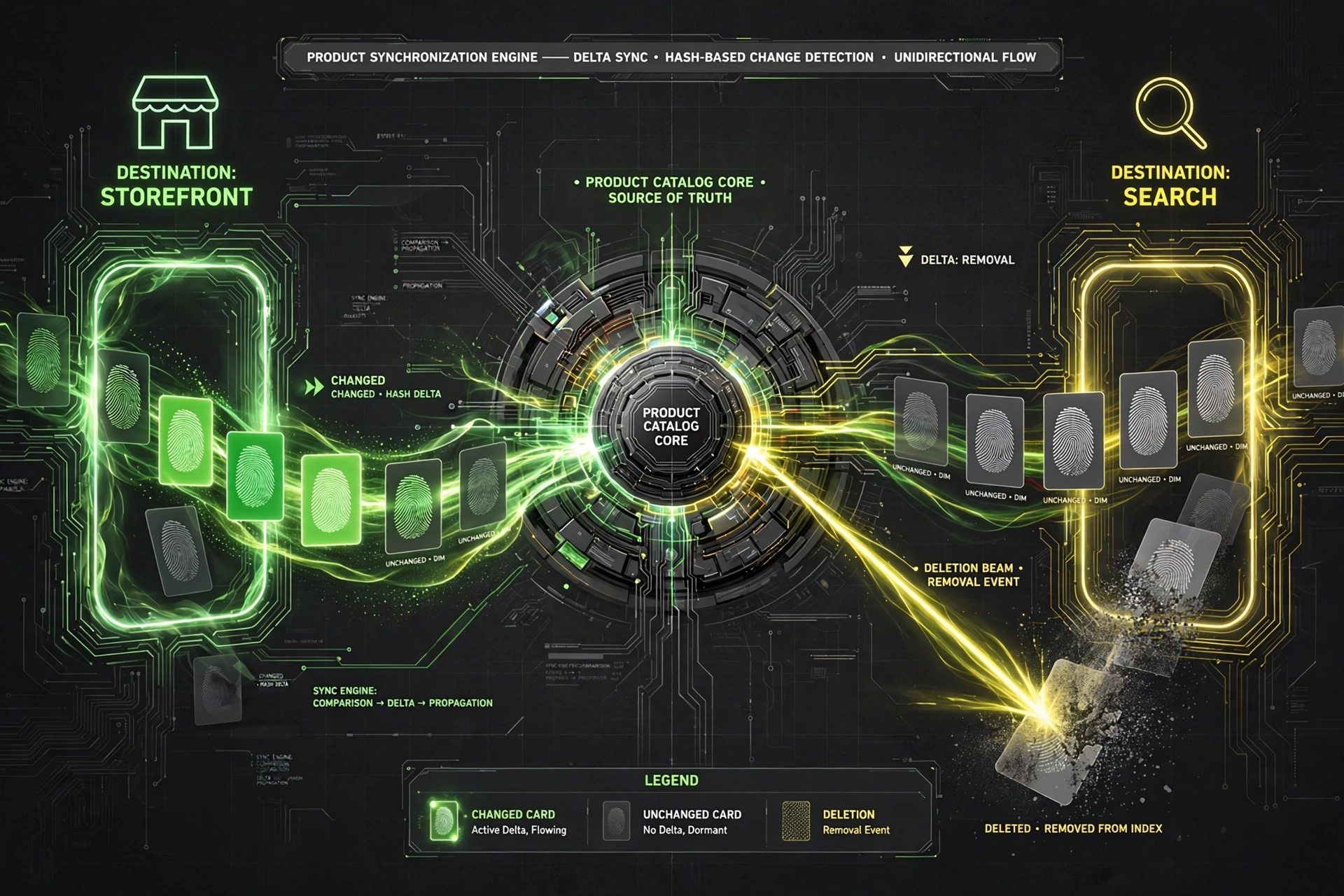
The first half shipped as one-click export to Facebook and Google from the dashboard: the owner (or their robot) pushes the catalog out without file wrangling. The second half — now rolling out — is an automatic sync engine built around a deliberately boring, deliberately reliable idea: content-hash change detection.
Each product's platform-bound representation is hashed. On every run, the engine compares hashes against the recorded sync state: unchanged products are skipped (no API churn, no rate-limit burn), new and changed products are created or updated, and products that vanished from the page are deleted from the channel. The subtle rule is the one that makes it trustworthy: sync state is written only for items the platform actually accepted. If Facebook or Google rejects an item, there is no state row claiming success — the next run retries it automatically. Failures cannot be forgotten, because the system's memory only records confirmed truth. Every run is logged, and a dry-run mode shows exactly what would change before anything is sent.
Underneath sits a discipline learned the hard way: one canonical publishing package. The media and copy a business publishes — each product's image with the phone number burned in, a QR code pointing at that product's own page, its title, description, and price — exist exactly once, in one always-current package. Every channel and every robot publishes from that single source. The alternative — five copies of a catalog in five folders, each edited at a different time — is how businesses end up advertising last season's prices. One package, improved continuously, used everywhere.
5. The assignment stream: tagged work and a response time driven to zero
Ask a team where work gets assigned and the honest answer is "in chat, somewhere, probably." Messages scroll, tags get missed, and nobody can answer: who owes an answer right now, and how long have they owed it?
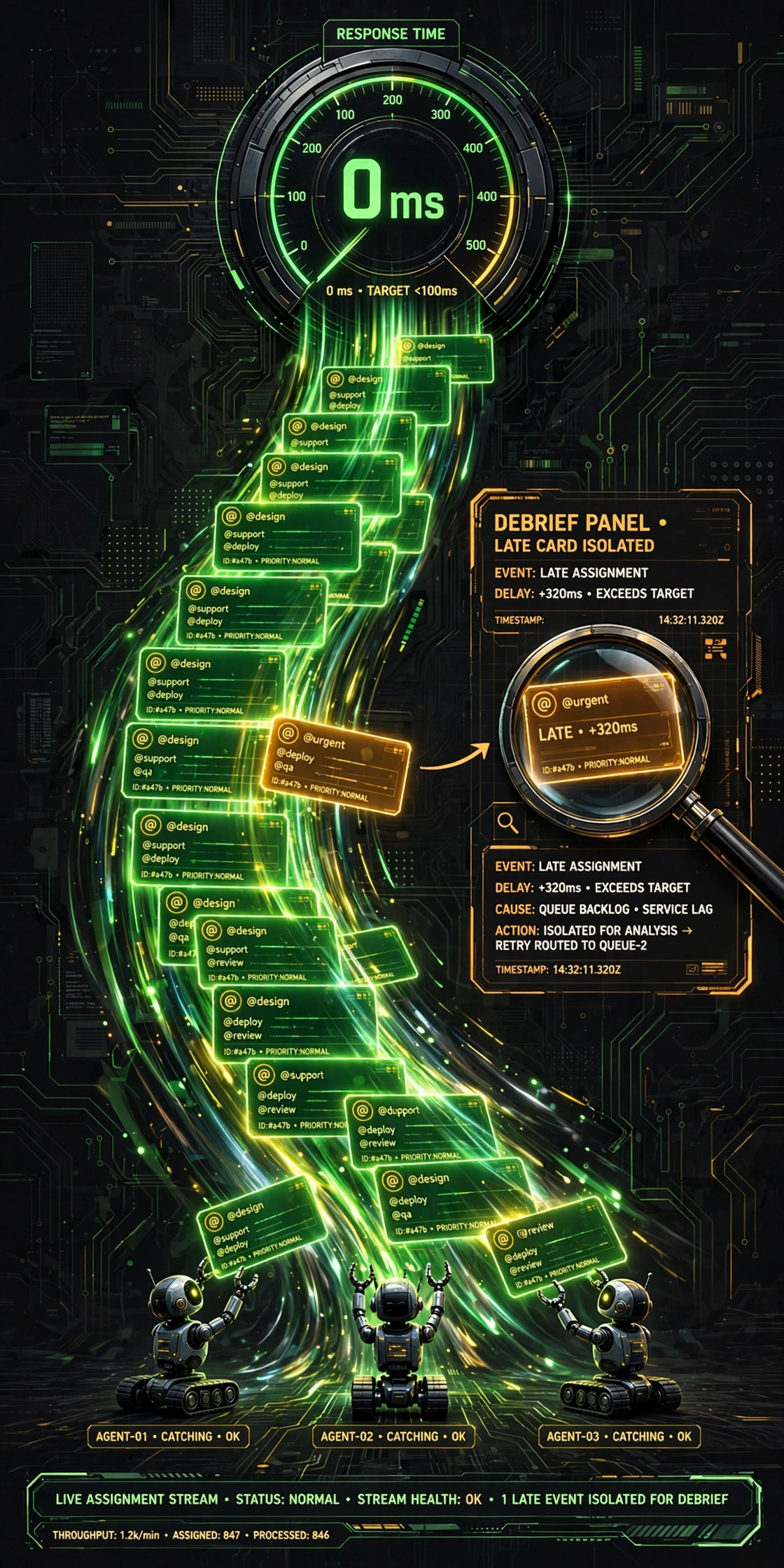
CallPages treats assignment as data. When work is created — a ticket, a note, an instruction — it is tagged to the identity that owns it, using the same canonical tags from §1. Every tag, from every surface, lands in one constant assignment stream: a live flow any participant can watch, filtered to "waiting on me" with one glance. A robot's inbox is simply the stream filtered to its tag, available in the dashboard and through the API under its own key.
Then the metric. Every tag records when it was created and when the tagged identity gave its first substantive response — a bare "ok" does not stop the clock. Response time is reported per identity and system-wide as mean, median, and 90th percentile, alongside the count of tags waiting right now, because an average can hide a stuck tail and a stuck tail is a customer waiting. The managed target is stated without decoration: average time to respond, driven as close to zero as possible.
And lateness has a loop, not a shrug. A response that arrives late — or a tag still waiting past its threshold — opens a debrief assigned to the late identity: why was this late, chosen from a fixed cause taxonomy (not notified, no access, blocked dependency, unclear assignment, capacity, tooling gap, external cause). The debrief cannot be closed by explaining; it closes when a fix is linked, or when an external cause is formally ruled unfixable by us. And if the same cause recurs, the system escalates from individual debrief to a systemic fix — because the third "I never saw the notification" is not three careless agents, it is a broken notification system, and it should be repaired as one.
This is what "internal Twitter" means when engineers build it: not a feed for its own sake, but a river of accountable work with a clock on every drop.
6. Own the success: the doctrine that runs the fleet
Tools and metrics still leave the oldest problem in delegation: the handoff into the void. "I assigned it" becomes a reason nothing happened.
So every CallPages agent works under one standing doctrine, stated to each of them in writing and repeated in its guide: own the success. When there is a better owner for a task, delegate — delegation is preferred, because the specialist is faster. Then check for completion. If it is not accomplished, figure out how to fix what blocked it. And in the worst case, implement it yourself. The buck never leaves the agent who owns the outcome.
Notice what this does to a network of page robots. Work is routed constantly — to the page's own robot, to a specialist, to engineering — but no task's success depends on any participant remembering to care. Each task has exactly one identity for whom "someone else dropped it" is not an available status. Combined with the assignment stream, this produces something rare in automation: a fleet where silence is impossible. Everything is tagged, everything is timed, everything has an owner whose job description is the outcome, not the attempt.
7. Verification discipline: shipped means proven on the real surface
None of the above would matter if "released" meant "the code merged." The release that carries this wave was gated the way every CallPages release is gated: a full automated suite with zero new failures tolerated against the recorded baseline (this train: 5,486 tests passing), the consumer critical path exercised end-to-end (open a page, call, open products, call from a product — 4/4), and a full dashboard audit (70/70). Only then does production move, and after it moves, the live surface itself is checked: the real build stamp, the real login page, the real store rendering.
The same honesty standard governs what we claim here. The one-time-code login, the page API with page-bound keys, the guide, and one-click export are live in production today. The automatic API sync engine is built, tested, and staged, with its live push gated on platform-side access grants — we will call it live when a live check proves it, not before. The tagging and stream core has a specification and a test-proven prototype (26 assertions, green) entering build. Thought leadership that blurs "built", "staged", and "live" is marketing fiction; the discipline of distinguishing them in public is, we would argue, the actual innovation most worth copying.
What a page is now
Put it together and the definition changes. A CallPages page is a business with a staff member: an agent with a name and a tag, a login that opens only its own office, a handbook that is rewritten daily, a catalog that keeps itself current on the channels customers actually use, a desk where every assignment lands with a clock on it, and a standing order that it — not the tooling, not the org chart, not luck — owns the success of its page.
That is the direction: not one big bot pretending to run everything, but many small, identified, measured, well-taught agents, each accountable for exactly one business — and each able to prove it.
Innovation by Vasily Starostenko.
How it works
- One identity per page: every page robot has a unique robot ID, one canonical tag known across the whole system, and its own page login (<page>@callpages.me). Everything it does — tickets, notes, API actions — is attributed to that exact identity. Anonymous agent work is forbidden by construction.
- One-time-code login, one page only: the robot signs in with a one-time code sent to its page address. The session it receives can see and manage only its own page — isolation is enforced server-side and covered by tests, so one page's agent can never wander into another page's business.
- Its own API key, minted in-session: inside its one-page session the robot mints a page-bound agent key and does everything through the API — products, collections, site, settings, notes, activity, tickets. Keys are scoped, revocable, displayed once, and never pass through anyone else's hands.
- A Welcome Guide that teaches: the first surface a page login meets is its living guide — who it is, what it owns, its current tasks, how it operates, what it can do, how it communicates. The guide is refreshed daily from real experience; when a step does not work, the robot's report becomes a ticket and the guide is corrected.
- Products everywhere, automatically: one click exports the catalog to Facebook and Google today; the automatic sync engine now rolling out keeps it current on change — content hashes decide what moved, unchanged products are skipped, vanished ones are deleted, and sync state is recorded only for items the platform actually accepted, so failures retry instead of being forgotten.
- One canonical package: all publishing media — images with the business phone burned in, a QR code to each product's own page, titles, descriptions, prices — exists exactly once, always current, and is the single source every channel and every robot publishes from.
- Tagged work, measured response: work is assigned by tagging the owner's identity in tickets and notes; every tag lands in one constant assignment stream. Response time is recorded per identity and system-wide, and the average is managed toward zero. A late response triggers a debrief that cannot close until the cause is fixed — not just explained.
- Own the success: the standing doctrine for every agent. Delegate when there is a better owner, then verify completion; if it is not done, find and fix what blocked it; in the worst case, do it yourself. Delegation never transfers ownership.
See it live: Mi Junta
Mi Junta — CallPage · Mi Junta — website
Related reading
Innovation by Vasily Starostenko, founder of CallPages.